
AI-powered medical search engine that delivers synthesized, cited answers from peer-reviewed research for clinicians.

SixSentences
€19/moStarting price
0Popularity
About SixSentences
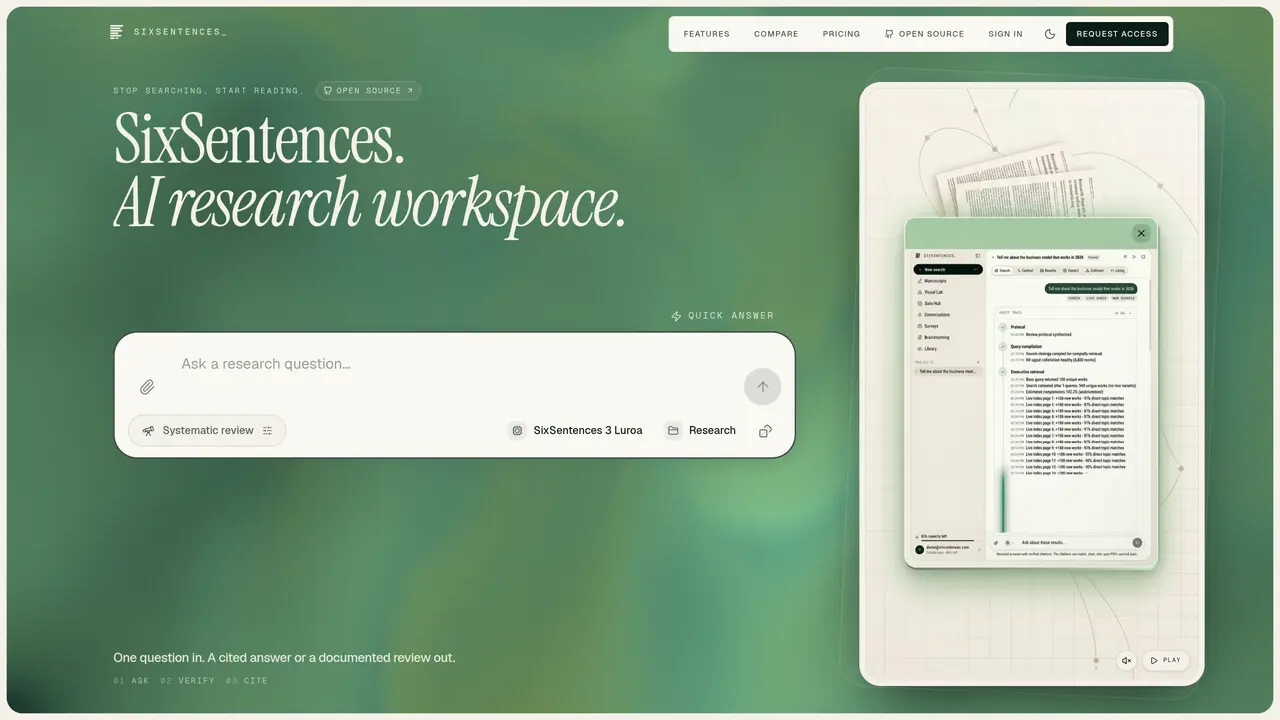
SixSentences provides an open-source workspace for conducting literature reviews, systematic searches, and research synthesis. It supports collecting papers, webpages, interviews, and datasets into a single project while maintaining traceable records of sources, decisions, and changes. The tool offers workflows for evidence synthesis, manuscript writing, qualitative analysis, and survey design, with every claim linked back to its original source. Users can start with a research question, screen literature, verify quotes, and generate publication-ready outputs within the same environment. The platform emphasizes transparency by allowing inspection of how evidence moves through the workspace and enabling self-hosting for full control over data and operations. It integrates with tools like Zotero and Citavi and supports AI-led interviews and automated analysis, with costs tied to actual usage rather than fixed subscriptions.
Key features
- Literature search and screening
- PDF chat and annotation
- Manuscript Studio for writing with citations
- Visual Lab for creating publication-ready figures
- Data Hub for structured research data analysis
- AI-led interview studies
- Zotero and Citavi integrations
- Self-hosting capability
Use cases
- Conducting systematic literature reviews
- Writing research manuscripts with traceable citations
- Analyzing qualitative interview data
Pros
- Open-source under Apache 2.0 license
- Self-hostable with full infrastructure control
- Traceable research workflows with source-to-claim linking
- Supports multiple research methods (systematic reviews, interviews, surveys)
- Integrations with Zotero and Citavi
Cons
- Community edition is in early alpha with potential API/UI changes
- No annual pricing available yet
- Limited to 100 MB storage in free tier
- AI-led features incur usage-based costs
Frequently asked questions about SixSentences
What is SixSentences actually for?
SixSentences connects the work between a research question and a finished output, including literature search, screening, source reading, data collection, interviews, figure creation, and manuscript writing. Its key difference is maintaining a traceable record of sources, decisions, and changes alongside the research process.
Is SixSentences open source?
Yes. The complete SixSentences community application stack is available on GitHub under the Apache 2.0 license, including the web workspace, API, research engine, worker, browser capture, and macOS companion source. Users can inspect, contribute, or operate it on their own infrastructure.
Where do the papers and sources come from?
SixSentences can search OpenAlex scholarly metadata and the live web, follow citation relationships, and use records, PDFs, and webpages added by the user. It does not cover every field, so discipline-specific databases or additional sources may still be required for rigorous reviews.
Can I trust the citations and AI-written text?
Not without verification. SixSentences connects claims to source records and supporting passages, but models can miss studies, misread evidence, or draft unsupported text. Every material claim, number, quotation, and citation should be checked against the original source.
Will it run a systematic review for me?
It can preserve search routes, eligibility criteria, screening reasons, duplicate handling, and flow counts for PRISMA-oriented reporting, but it cannot make a search exhaustive or a review automatically compliant with PRISMA or disciplinary standards. Method design and final study selection remain researcher decisions.
Can it fetch paywalled papers for me?
No. It does not bypass paywalls or publisher access controls. Full text is attached only when openly available, supplied by the user, or otherwise lawfully accessible. If a source can be identified but no verifiable PDF is available, users can keep the citation and add a lawful copy themselves.