
AI-powered medical search engine that delivers synthesized, cited answers from peer-reviewed research for clinicians.

STORM
0Popularity
About STORM
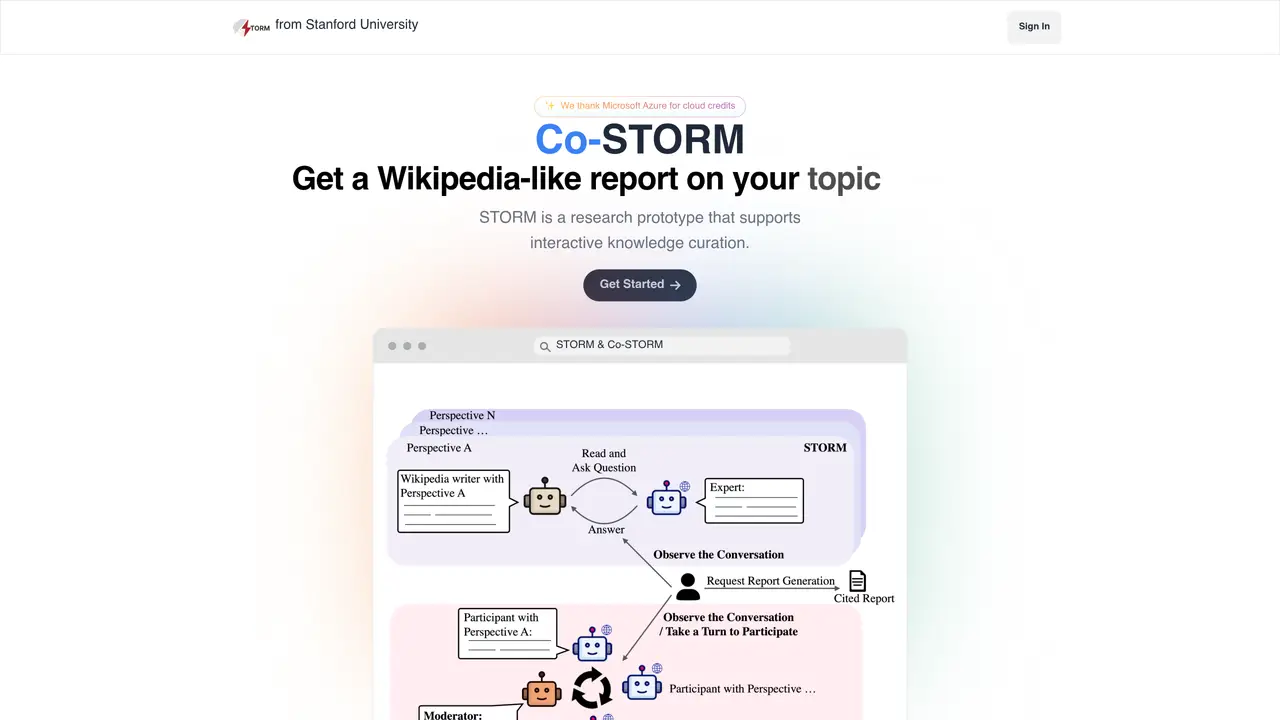
STORM is a research prototype developed by Stanford Open Virtual Assistant Lab that automates the knowledge curation process. It generates structured reports on specific topics by collecting and synthesizing information from multiple sources, reducing the need for manual research. The tool is designed for researchers, students, and individuals who require quick access to accurate and relevant content without the time-consuming task of sifting through various references. STORM aims to produce concise, well-organized reports that can support learning, inform decision-making, or serve as a starting point for deeper exploration. Users can specify a topic, and the system handles the rest, delivering a curated summary that mimics the format of a Wikipedia article. This approach streamlines the research process while maintaining a focus on clarity and relevance.
Stanford University
Stanford, United States · Founded 1885
- Founders
- Leland Stanford, Jane Stanford
- Founded
- 1885
- Headquarters
- Stanford, United States
Key features
- Automates gathering and summarizing information from multiple sources
- Generates Wikipedia-like structured reports on user-specified topics
- Reduces manual research time by synthesizing content automatically
- Designed for researchers, students, and general users
- Produces concise, well-organized summaries
- Supports quick access to accurate and relevant information
- Handles topic specification and delivers curated reports
- Aims to streamline the knowledge curation process
Use cases
- Quickly gather and synthesize research on a specific topic
- Create structured summaries for learning or decision-making
- Automate knowledge curation for academic or personal projects
Pros
- Automates knowledge curation by synthesizing information from multiple sources
- Generates structured reports that mimic the format of Wikipedia articles
- Reduces manual research time by handling topic-specific data collection
- Designed for clarity and relevance in curated summaries
- Supports researchers, students, and individuals in quick content access
Cons
- Limited to topics supported by available source data
- Output quality depends on the comprehensiveness of input sources
- May not cover highly specialized or niche subjects thoroughly
Frequently asked questions about STORM
What does STORM do?
STORM automates the process of collecting and synthesizing information from multiple sources to generate structured reports on specific topics.
Who is STORM designed for?
The tool is designed for researchers, students, and individuals who need quick access to accurate and relevant content without manual research.
How does STORM generate reports?
Users specify a topic, and STORM handles the rest by collecting and synthesizing information to produce a curated summary.
Can STORM replace manual research entirely?
While it reduces manual research time, STORM is intended to streamline the process rather than replace deeper exploration.
What format do STORM's reports follow?
The reports are structured to mimic the format of Wikipedia articles, providing concise and organized summaries.