Generate lifelike human videos with AI, making professional video creation fast and accessible for any user.

Podcuts
0Popularity
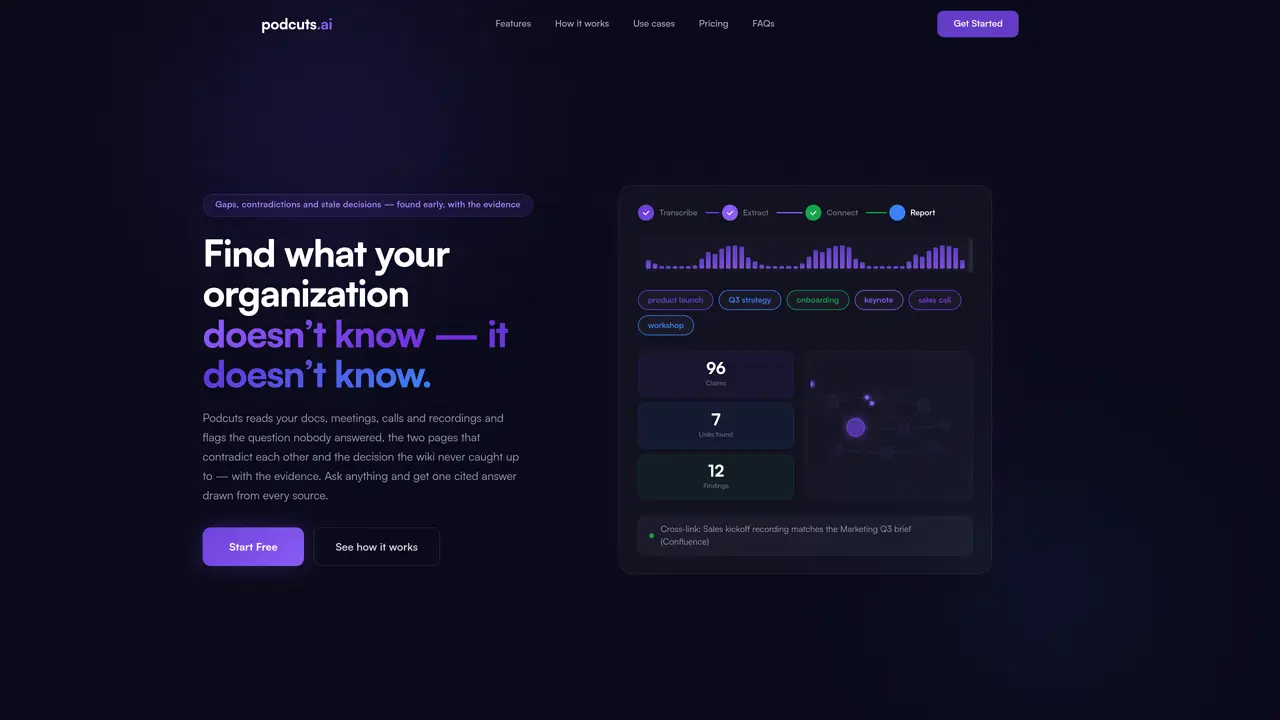
About Podcuts
Podcuts.ai is an AI-powered platform that surfaces hidden knowledge within an organization’s documents, meetings, calls, and recordings. It ingests content from sources such as Confluence, Notion, Zoom, Google Meet, and Teams, as well as uploaded recordings or YouTube links, and transcribes them into searchable, structured data. The tool extracts key decisions, numbers, commitments, and action items while mapping them to a unified ontology of people, teams, and topics, ensuring consistency across siloed information sources. Podcuts flags gaps, contradictions, and stale decisions with direct evidence, enabling users to ask plain-language questions and receive cited answers linked to the original documents or timestamps. Answers are accompanied by receipts, allowing users to verify claims in one click. The platform also generates comprehensive reports and shareable clips, which can be exported as PDFs for distribution, helping teams maintain alignment and avoid redundant work. By connecting disparate knowledge sources, Podcuts ensures decisions are consistently documented and accessible across the organization, reducing the risk of miscommunication or overlooked information.
Key features
- Automatic transcription of long-form audio and video
- Detection of high-engagement moments for clip selection
- Animated captions and translations for clips
- Social media formatting for TikTok, Reels, and YouTube Shorts
- Export and scheduling options for automated posting
- Scalable content distribution for creators and teams
- Reduction of manual video editing time
- Consistent cross-platform posting capabilities
Use cases
- Repurposing webinars or live streams into short promotional clips
- Turning educational or tutorial videos into bite-sized social content
- Converting conference talks or panel discussions into engaging social media posts
Pros
- Automatically extracts decisions, numbers, commitments and action items from documents, meetings and recordings
- Provides cited answers with direct links to the exact source, ensuring traceability
- Identifies gaps, contradictions and stale decisions across organizational knowledge
- Generates shareable reports and clips with evidence for easy distribution
- Supports multiple content sources including Confluence, Notion, Zoom, Google Meet, Teams and direct uploads
Cons
- Requires integration with existing organizational tools and workflows
- May surface sensitive or conflicting information that requires manual review
- Dependent on the quality and completeness of input documents and recordings
Frequently asked questions about Podcuts
What types of content can Podcuts process?
Podcuts can process documents from Confluence and Notion, as well as recordings and transcripts from Zoom, Google Meet, Microsoft Teams, or direct uploads. It also supports importing SRT, VTT or JSON transcripts.
How does Podcuts ensure the accuracy of its extracted information?
Every answer and finding includes direct citations to the original source, allowing users to verify the information by clicking through to the exact page or timestamp in the recording.
Who is Podcuts designed for within an organization?
Podcuts is built for any organization that produces knowledge, including enterprises, leadership teams, sales, training and L&D departments, and teams that rely on meetings and documentation.
Can Podcuts identify inconsistencies or gaps in organizational knowledge?
Yes, Podcuts flags contradictions, unanswered questions and stale decisions across documents and recordings, presenting them with evidence and suggested next steps.
What happens to the data processed by Podcuts?
Content is processed over TLS and stored privately under the user’s account. Podcuts does not use the data to train models, and users can delete content at any time.
How can teams use the reports generated by Podcuts?
Reports can be saved as PDFs and shared with stakeholders, providing a consolidated view of decisions, findings and evidence for projects or entire libraries.