
Create stunning visuals, develop ideas with AI-powered tools, and instantly share content without coding or formatting.

GPT-2 Text Generator
$0.07Starting price
0Popularity
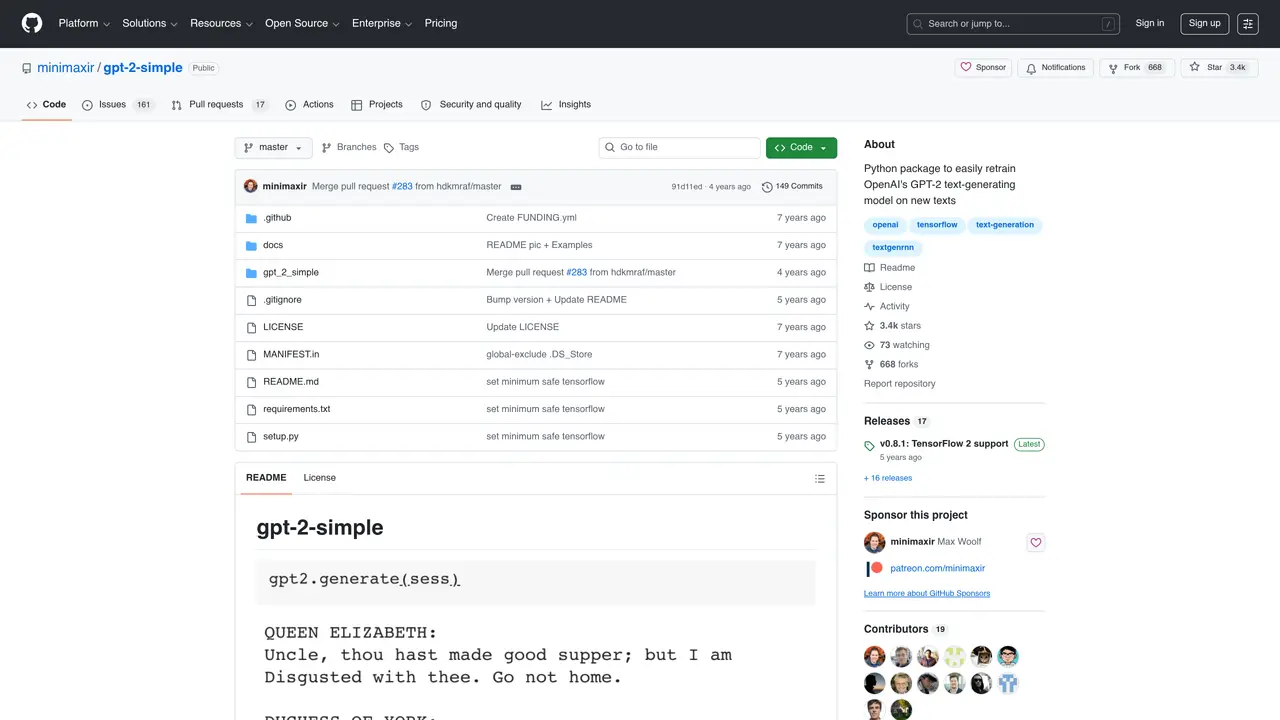
About GPT-2 Text Generator
GPT-2 Text Generator is an open-source text generation tool powered by machine learning. It uses the latest version of Google’s advanced natural language processing technology (GPT-2) to generate high-quality, realistic text from any input. With GPT-2 Text Generator, you can create compelling, original content quickly and easily. Simply provide your desired text prompt, and the tool will generate a variety of text samples based on it. These samples can be used as creative writing prompts, blog post ideas, or even as the starting point of a longer article. GPT-2 Text Generator is a great way to get started with natural language processing and create high-quality content in no time. The tool has several use cases, including generating original content for blogs and articles, creating compelling writing prompts, and easily generating realistic text from any input.
GitHub, Inc.
San Francisco, California, US · Founded 2008
- Founders
- Tom Preston-Werner, Chris Wanstrath, PJ Hyett, Scott Chacon
- Founded
- 2008
- Headquarters
- San Francisco, California, US
- Legal status
- Subsidiary of Microsoft (NASDAQ: MSFT)
Key features
- Generate original content for blogs and articles
- Quickly create compelling writing prompts
- Easily generate realistic text from any input
Use cases
- Generating original content for blogs and articles
- Creating compelling writing prompts
- Easily generating realistic text from any input
Pros
- Simplifies fine-tuning and text generation with OpenAI’s GPT-2 model through a Python package
- Supports both small (124M) and medium (355M) GPT-2 model versions for flexibility in use cases
- Allows easy text generation with customizable prefixes and output file management for curation
- Provides a Colaboratory notebook for free GPU-based training without requiring local setup
- Compatible with TensorFlow 2.X and integrates with existing GPT-2 model management scripts
Cons
- Requires TensorFlow 2.X for operation, adding dependency complexity for some users
- Model checkpoints are large (500MB for 124M, 1.5GB for 355M), consuming significant storage space
- Development has been largely superseded by more efficient alternatives like aitextgen
- Fine-tuning performance is significantly slower on CPUs compared to GPUs
Frequently asked questions about GPT-2 Text Generator
What is GPT-2 Text Generator and what does it do?
GPT-2 Text Generator is a Python package that simplifies the process of fine-tuning and generating text using OpenAI's GPT-2 model. It allows users to retrain the model on custom datasets and generate text based on provided prompts or prefixes.
Who is GPT-2 Text Generator designed for?
The tool is designed for developers, researchers, and content creators who need to generate or fine-tune text using GPT-2. It is particularly useful for those familiar with Python and machine learning workflows.
How do I get started with GPT-2 Text Generator?
To get started, install the package via PyPI using pip3 install gpt-2-simple. You will also need TensorFlow 2.X installed. The package provides example scripts for downloading models, fine-tuning, and generating text.
Can I use GPT-2 Text Generator without a GPU?
Yes, you can use the tool without a GPU, but text generation will be significantly slower compared to using a GPU. Fine-tuning is strongly recommended to be done on a GPU for optimal performance.
What are the model size options available in GPT-2 Text Generator?
The package supports the 'small' 124M and 'medium' 355M hyperparameter versions of the GPT-2 model. The pretrained 124M model is approximately 500 MB, while the 355M model is about 1.5 GB.
Are there alternatives to GPT-2 Text Generator?
Yes, the development of gpt-2-simple has been largely superseded by aitextgen, which offers similar capabilities with more efficient training time and resource usage. However, checkpoints trained with gpt-2-simple can still be loaded into aitextgen.