Create stunning visuals, develop ideas with AI-powered tools, and instantly share content without coding or formatting.

nanoGPT
$0.07Starting price
0Popularity
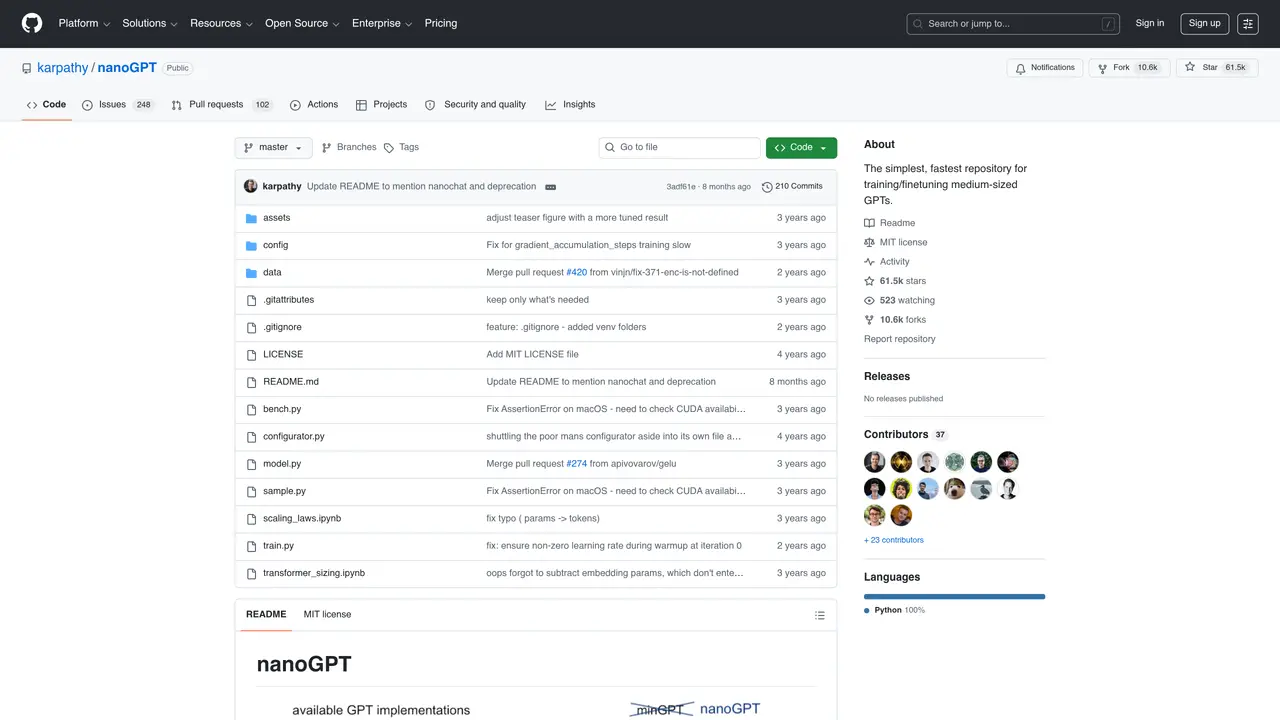
About nanoGPT
nanoGPT is a powerful natural language processing (NLP) tool designed to help users generate text with state-of-the-art quality. Ideal for developers, researchers, and content creators, nanoGPT enables users to quickly create text-based content from scratch. This service is powered by a pretrained GPT-2 model, which is capable of producing text that is both fluent and accurate. nanoGPT’s simple and intuitive interface makes it easy to use, even for those without technical expertise. With just a few clicks, users can quickly generate text that is tailored to their specific needs. The service is highly flexible and can be used to create content for a variety of applications, such as chatbot conversations, product descriptions, and blog posts. What sets nanoGPT apart from other NLP tools is its ability to generate text that reads as if it is written by a human.
GitHub, Inc.
San Francisco, California, US · Founded 2008
- Founders
- Tom Preston-Werner, Chris Wanstrath, PJ Hyett, Scott Chacon
- Founded
- 2008
- Headquarters
- San Francisco, California, US
- Legal status
- Subsidiary of Microsoft (NASDAQ: MSFT)
Key features
- Generate text-based content quickly and accurately
- Create content for chatbot conversations, product descriptions, and blog posts
- Simple and intuitive interface
- Powered by a pretrained GPT-2 model
- Highly flexible and adaptable to various applications
- Ability to generate human-like text
Use cases
- Generating text content for chatbots and conversational interfaces
- Creating product descriptions and marketing materials
- Writing blog posts and articles with high-quality, engaging content
Pros
- Open-source and freely available for modification and redistribution
- Minimalist and readable codebase (~600 lines total) for easy customization
- Supports training and fine-tuning of medium-sized GPT models from scratch
- Compatible with pretrained GPT-2 checkpoints from OpenAI
- Designed for efficiency with plain PyTorch implementation
Cons
- Deprecated in favor of newer alternatives like nanochat
- Requires technical expertise in deep learning and PyTorch for effective use
- Limited built-in user interface, primarily command-line driven
- Training large models demands significant computational resources
Frequently asked questions about nanoGPT
What is nanoGPT and what does it do?
nanoGPT is a minimal, open-source repository designed for training and fine-tuning medium-sized GPT models. It provides a simple and fast framework for building, training, and sampling from GPT-style language models.
Who is nanoGPT suitable for?
nanoGPT is suitable for developers, researchers, and practitioners interested in training or fine-tuning GPT models. Its simplicity and readability make it accessible even to those with basic programming knowledge.
How do I get started with nanoGPT?
To get started, clone the repository and install dependencies like PyTorch and NumPy. Follow the quick-start guide to train a character-level GPT on the Shakespeare dataset by running the provided prepare, train, and sample scripts.
Can nanoGPT be used to fine-tune pretrained models?
Yes, nanoGPT supports loading and fine-tuning pretrained GPT checkpoints, such as the GPT-2 models from OpenAI, allowing users to adapt existing models to their specific tasks.
What are the hardware requirements for using nanoGPT?
Hardware requirements depend on the model size and dataset. For example, training a small GPT on the Shakespeare dataset can run on a single GPU, while larger models may require more powerful hardware like an A100 GPU.
Is nanoGPT still actively maintained?
nanoGPT is considered deprecated in favor of nanochat, a newer and improved repository. However, the code remains available for reference and educational purposes.