
Generate speech with customizable voices in any language, and create captivating stories using natural-sounding voices.

Vibe Voice Realtime
$0.03Starting price
0Popularity
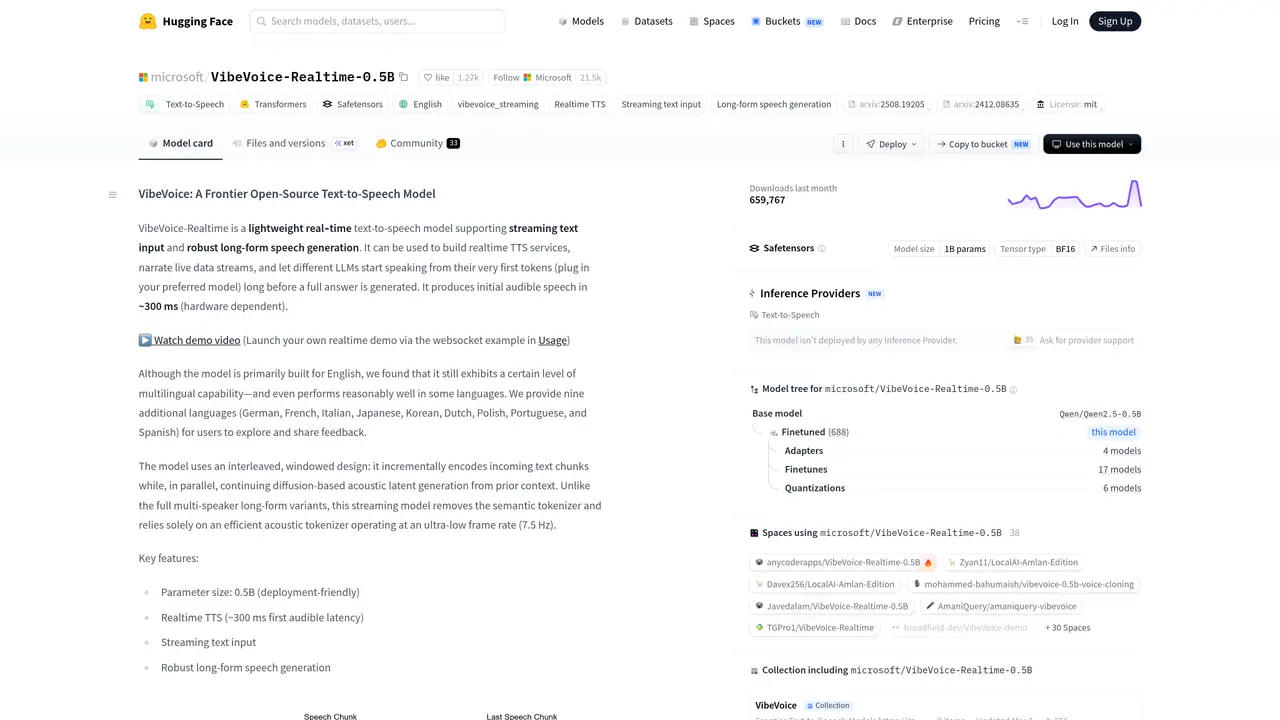
About Vibe Voice Realtime
Vibe Voice Realtime is an open-source AI model developed by Microsoft that converts text into natural, emotionally expressive speech with minimal delay. Designed for real-time applications, it excels in scenarios requiring smooth and lifelike interactions, such as conversations, podcasts, virtual interviews, and live broadcasts. The model prioritizes low-latency responses and supports long continuous speech output, making it particularly useful for developers, creators, and accessibility specialists who need responsive and high-quality speech synthesis. Its lightweight architecture ensures efficient deployment while maintaining performance, though users may need to optimize settings for specific use cases. Vibe Voice Realtime is built to handle dynamic and interactive environments where natural intonation and emotional expression are critical. The tool is open-source, allowing for customization and integration into broader AI systems or applications requiring real-time voice capabilities.
Key features
- Real-time text-to-speech conversion
- Natural and emotional speech output
- Low-latency response for instant interactions
- Supports long continuous speech
- Lightweight model size for efficient deployment
- Open-source and free to use
- Developed by Microsoft
- High-quality speech synthesis
- Minimal delays for smooth conversations
Use cases
- Enable real-time chatbot voice replies
- Provide instant audio commentary for live streams
- Generate natural voices for NPCs in games
Pros
- Lightweight 0.5B parameter model optimized for real-time deployment
- Low first-audible latency (~300 ms) for responsive speech generation
- Supports streaming text input and long-form continuous speech output
- Open-source under MIT license for research and development use
- Demonstrates competitive zero-shot TTS performance on standard benchmarks
Cons
- Primarily designed for English with limited multilingual support
- Single-speaker output only, lacking multi-speaker conversational capabilities
- Requires additional setup for integration with external systems
- May produce unpredictable results in unsupported languages
Frequently asked questions about Vibe Voice Realtime
What is VibeVoice-Realtime-0.5B?
VibeVoice-Realtime-0.5B is a lightweight, open-source text-to-speech model developed by Microsoft designed for real-time speech generation with minimal delay. It supports streaming text input and produces long-form speech output efficiently.
Who should use VibeVoice-Realtime-0.5B?
The tool is suitable for developers, creators, and accessibility specialists building real-time applications such as conversations, podcasts, or virtual interviews where low-latency and natural speech output are essential.
What languages does VibeVoice-Realtime-0.5B support?
The model primarily supports English but includes experimental support for nine additional languages, including German, French, Italian, Japanese, Korean, Dutch, Polish, Portuguese, and Spanish. Performance may vary across these languages.
How can I get started with VibeVoice-Realtime-0.5B?
Users can get started using the Transformers library by loading the model with a pipeline or directly via the VibeVoiceStreamingForConditionalGenerationInference class. Instructions and examples are available on the Hugging Face model page and GitHub repository.
What are the key features of VibeVoice-Realtime-0.5B?
Key features include real-time text-to-speech with approximately 300ms first audible latency, streaming text input, robust long-form speech generation, and a lightweight 0.5B parameter size optimized for deployment efficiency.
Does VibeVoice-Realtime-0.5B support multi-speaker speech generation?
No, this real-time variant supports only a single speaker. For multi-speaker conversational speech generation, other VibeVoice models should be used instead.