
Generate speech with customizable voices in any language, and create captivating stories using natural-sounding voices.

GPT-SoVITS
$0.07Starting price
0Popularity
About GPT-SoVITS
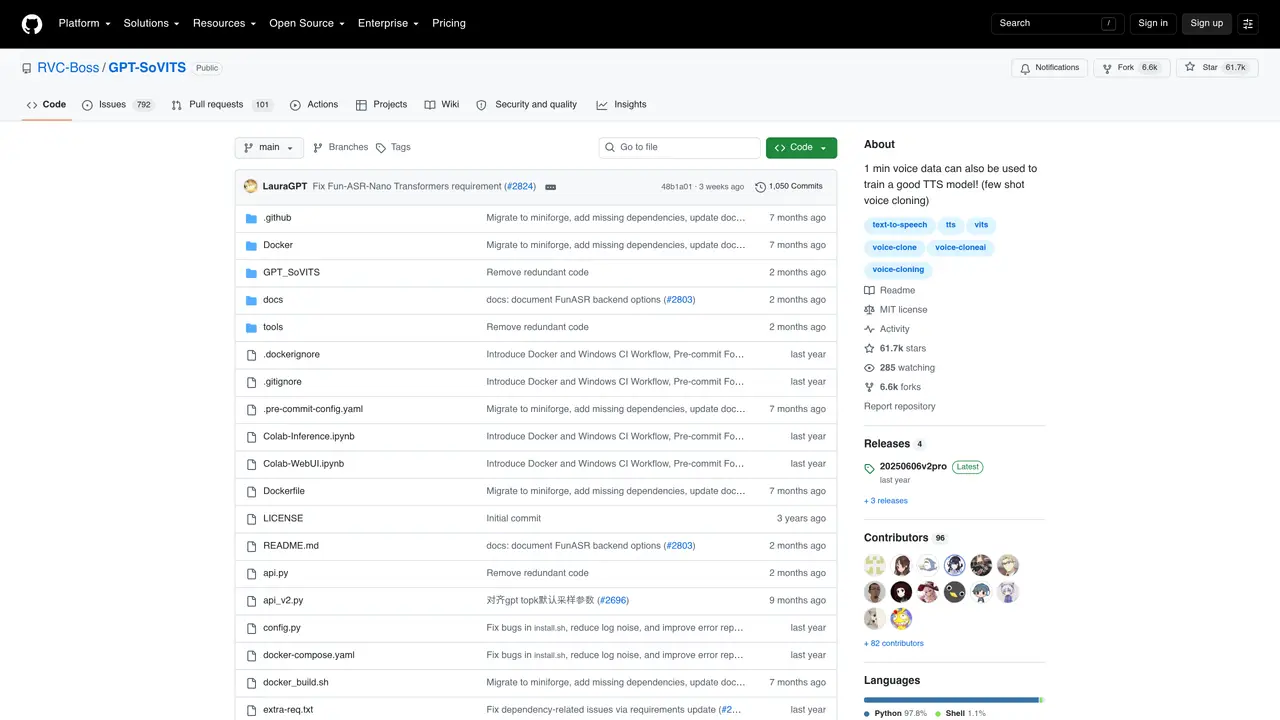
GPT-SoVITS is an open-source WebUI designed for few-shot voice cloning and cross-lingual text-to-speech synthesis. It enables zero-shot speech generation from as little as a five-second reference sample or higher-fidelity cloning with about one minute of fine-tuning. The tool supports both GPU and CPU inference, making it accessible on a wide range of hardware. It includes built-in dataset preparation features such as vocal separation, automatic segmentation, and multilingual ASR-assisted transcription, which streamline the creation of labeled training data. Deployment options include a Windows integrated package, Conda environments for Linux, macOS, or Windows, and Docker Compose for reproducible setups. The WebUI provides controls for reference upload, ASR transcription, segmentation previews, and TTS inference, with real-time progress tracking. Versioned model families allow users to balance stability, fidelity, and speed according to their needs. The tool is particularly suited for teams with limited voice data, multilingual requirements, or on-premises constraints, enabling rapid prototyping of brand voices, character dialog, and localized content without relying on external providers.
GitHub, Inc.
San Francisco, California, US · Founded 2008
- Founders
- Tom Preston-Werner, Chris Wanstrath, PJ Hyett, Scott Chacon
- Founded
- 2008
- Headquarters
- San Francisco, California, US
- Legal status
- Subsidiary of Microsoft (NASDAQ: MSFT)
Key features
- Zero-shot speech synthesis from five-second reference samples
- Few-shot voice cloning with one-minute fine-tuning for higher fidelity
- Cross-lingual TTS supporting English, Japanese, Korean, Cantonese, and Chinese
- Built-in vocal separation and automatic segmentation for dataset cleanup
- Multilingual ASR-assisted transcription and proofreading
- GPU and CPU-optimized inference with sub-real-time performance
- Windows integrated package, Conda, and Docker Compose deployments
- Versioned model families for balancing stability, fidelity, and speed
- WebUI for reference upload, transcription, segmentation, and synthesis control
- Local-first workflow with no external data transmission required
Use cases
- Prototyping brand voices or character dialog with minimal voice data
- Localizing content across multiple languages without retraining datasets
- Standing up internal voice services for applications like audiobooks or virtual assistants
Pros
- Enables few-shot voice cloning with as little as one minute of training data
- Supports zero-shot text-to-speech synthesis from a five-second reference sample
- Provides cross-lingual synthesis across multiple languages including English, Japanese, Korean, Cantonese, and Chinese
- Offers flexible deployment options including Windows integrated packages, Conda environments, and Docker Compose
- Includes built-in tools for vocal separation, automatic segmentation, and multilingual ASR-assisted transcription
Cons
- Model quality trained on Apple silicon is significantly lower compared to GPU-trained models
- Requires manual setup for certain environments, particularly for macOS users
- Inference speed varies significantly depending on hardware, with slower performance on CPUs
Frequently asked questions about GPT-SoVITS
What is GPT-SoVITS used for?
GPT-SoVITS is used for few-shot voice cloning and cross-lingual text-to-speech synthesis, enabling users to generate realistic speech from minimal voice data or create localized content in multiple languages.
Who is GPT-SoVITS suitable for?
The tool is particularly suited for teams with limited voice data, multilingual requirements, or on-premises constraints, including developers, researchers, and content creators.
Does GPT-SoVITS support real-time inference?
Yes, the WebUI provides real-time progress tracking during inference, and the tool supports GPU and CPU inference, though speed varies by hardware.
What languages does GPT-SoVITS support for synthesis?
GPT-SoVITS currently supports English, Japanese, Korean, Cantonese, and Chinese for cross-lingual text-to-speech synthesis.
How do I get started with GPT-SoVITS?
Users can start by downloading the integrated package for Windows, using Conda environments for Linux/macOS, or deploying via Docker Compose, followed by running the WebUI with provided scripts.
Can GPT-SoVITS run on CPU-only systems?
Yes, GPT-SoVITS supports CPU inference, though performance and output quality may be lower compared to GPU-based setups.