
Revolutionize transcription with unmatched accuracy, speed, and language support.

Microsoft VibeVoice
$0.07Starting price
0Popularity
About Microsoft VibeVoice
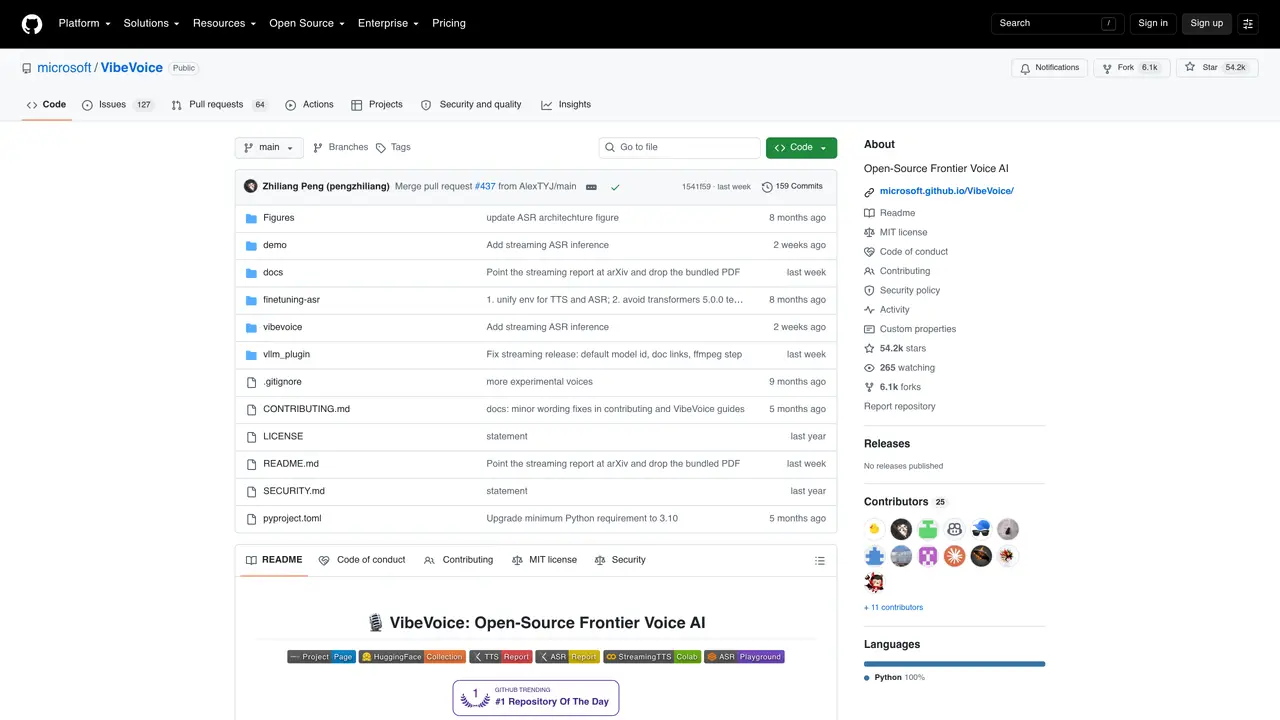
VibeVoice is Microsoft’s open-source voice AI stack that combines long-form automatic speech recognition (ASR) and real-time text-to-speech (TTS) in a single framework. It transcribes up to sixty minutes of audio in one pass, delivering structured transcripts that include speaker diarization, utterance boundaries, and timestamps. The system supports multilingual scenarios and allows for customized hotwords to improve recognition accuracy for domain-specific terminology. For synthesis, VibeVoice offers a real-time TTS model with sub-second latency, making it suitable for interactive agents and production-like demos. The architecture integrates with Hugging Face Transformers and vLLM for scalable inference, while BitNet compression enables CPU-friendly deployment with real-time throughput on multicore systems. This makes VibeVoice a practical choice for teams building transcription pipelines, searchable audio archives, meeting note systems, broadcast captioning, or real-time voice interfaces. It is designed for ML engineers, researchers, and platform teams seeking reproducible baselines and standardized workflows without requiring dedicated GPUs. The stack includes ASR and TTS models optimized for fidelity, latency, and efficiency, and is accessible via simple Python APIs, CLI workflows, or Azure AI Foundry Labs for evaluation without infrastructure maintenance.
GitHub, Inc.
San Francisco, California, US · Founded 2008
- Founders
- Tom Preston-Werner, Chris Wanstrath, PJ Hyett, Scott Chacon
- Founded
- 2008
- Headquarters
- San Francisco, California, US
- Legal status
- Subsidiary of Microsoft (NASDAQ: MSFT)
Key features
- Hour-long transcription with speaker diarization and timestamps
- Multilingual ASR with support for global content indexing
- Customizable hotwords for improved domain accuracy
- Real-time TTS with sub-second latency for interactive agents
- CPU-friendly inference via BitNet compression (1.58 GB weights)
- Integration with Hugging Face Transformers and vLLM for scalable inference
- Structured transcript outputs (Who/When/What format)
- On-device ASR support for multicore CPUs without GPUs
- Simple Python APIs and CLI workflows for quick deployment
- Open-source under MIT license with responsible use guidance
Use cases
- Transcribing and indexing long meetings or lectures for searchable archives
- Building real-time voice interfaces for assistants, call-bots, or telephony systems
- Deploying on-device ASR for edge devices or CPU-first environments
Pros
- Open-source framework enabling full customization and transparency for voice AI development.
- Supports long-form audio transcription (up to 60 minutes) in a single pass with structured outputs.
- Includes real-time text-to-speech (TTS) with sub-second latency for interactive applications.
- Offers multilingual support across over 50 languages for ASR and multiple languages for TTS.
- Integrates with Hugging Face Transformers and vLLM for scalable inference and optimized performance.
Cons
- TTS component has been removed from the repository due to misuse concerns, limiting current TTS capabilities.
- Requires technical expertise for deployment, particularly for fine-tuning and model optimization.
- Real-time performance may vary based on hardware and model configuration.
Frequently asked questions about Microsoft VibeVoice
What is VibeVoice and what does it do?
VibeVoice is an open-source voice AI framework developed by Microsoft that combines automatic speech recognition (ASR) and real-time text-to-speech (TTS) capabilities. It transcribes long-form audio with speaker diarization, timestamps, and customizable hotwords, while its TTS model generates streaming or long-form speech with low latency.
Who is VibeVoice designed for?
VibeVoice is designed for ML engineers, researchers, and platform teams building voice AI applications such as transcription pipelines, meeting note systems, or real-time voice interfaces. It is particularly suited for those seeking reproducible baselines and standardized workflows without requiring dedicated GPUs.
Does VibeVoice support real-time transcription?
Yes, VibeVoice includes a streaming ASR model that continuously transcribes speech as it arrives, emitting text in real time with support for customized hotwords and multilingual scenarios.
Can I use VibeVoice for text-to-speech (TTS) applications?
VibeVoice previously included a TTS model, but the TTS component has been removed from the repository due to misuse concerns. The current focus is primarily on ASR capabilities.
How can I get started with VibeVoice?
VibeVoice can be accessed via Python APIs, CLI workflows, or Azure AI Foundry Labs for evaluation without infrastructure maintenance. Documentation and demo notebooks are available in the GitHub repository to guide setup and usage.
What integrations does VibeVoice support?
VibeVoice integrates with Hugging Face Transformers for ASR and supports vLLM for scalable inference. It also offers CPU-friendly deployment through BitNet compression for real-time throughput on multicore systems.