
OpenAI builds and deploys advanced AI models like GPT-4o for autonomous agents and workflows.

Charter
0Popularity
About Charter
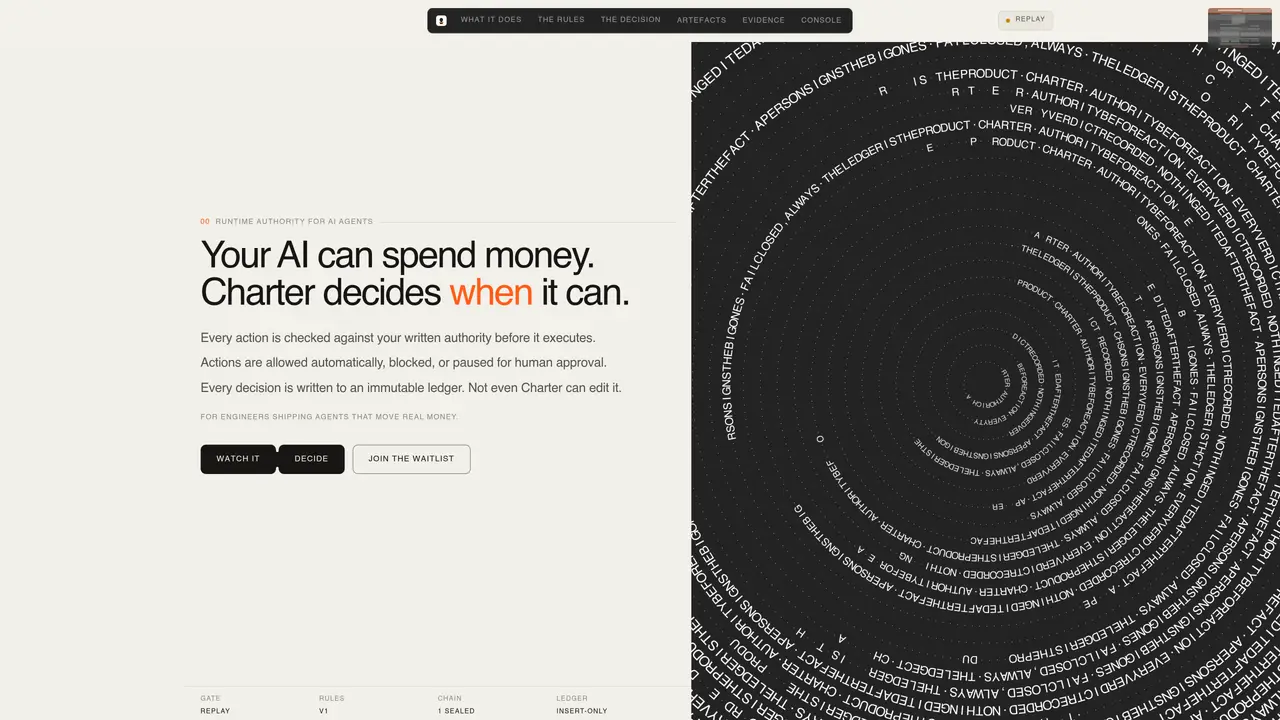
Charter provides a runtime authority and audit layer for AI agents that execute financial actions. It intercepts every proposed action and checks it against a pre-authorized charter that defines spending limits, expiry, permitted tools, and forbidden operations. The system allows, blocks, or pauses actions for human approval, recording each decision in an immutable ledger that cannot be edited or deleted. The ledger is hashed into a chain with cryptographic checkpoints, ensuring historical decisions remain verifiable even if the database role is revoked. Rules are versioned and cannot be edited in place, maintaining a consistent audit trail over time. Charter is designed for engineers deploying agents that move real money, integrating as a guard around existing functions without requiring a new agent framework or proxy layer.
Key features
- Runtime decision enforcement before action execution
- Immutable ledger with no UPDATE or DELETE permissions
- Versioned rules with historical consistency
- Human escalation via Telegram for approvals
- Cryptographic checkpoints with Ed25519 signatures
- Spending limits evaluated over rolling windows
- Policy precedence over agent-specific rules
- Compliance mapping to SOC 2, EU AI Act, and RBI IT Governance
Use cases
- Enforcing spending limits for AI agents processing refunds
- Preventing unauthorized transactions by AI agents
- Maintaining audit trails for financial decisions made by agents
Pros
- Intercepts and evaluates every action before execution
- Immutable ledger with cryptographic hashing and signed checkpoints
- Versioned rules that cannot be edited retroactively
- Supports automatic allowance, blocking, or human escalation
- Designed for financial agents with spending limits and expiry
Cons
- Waitlist-only access
- Requires integration with existing agent functions
- No free tier or self-hosted option mentioned
Frequently asked questions about Charter
What does Charter do for AI agents that handle money?
Charter acts as a runtime authority and audit layer, intercepting every proposed financial action from an AI agent and checking it against a pre-authorized charter that defines spending limits, expiry, permitted tools, and forbidden operations.
Who is Charter designed for?
Charter is designed for engineers deploying AI agents that move real money, providing a guard layer around existing functions without requiring a new agent framework or proxy layer.
How does Charter handle decisions for financial actions?
Charter allows, blocks, or pauses actions for human approval, recording each decision in an immutable ledger that cannot be edited or deleted, with every verdict hashed into a chain for verifiability.
Does Charter integrate with existing systems?
Yes, Charter integrates as a guard around existing functions, wrapping the tool or function that moves money without requiring changes to the agent framework or model.
What happens if Charter cannot make a decision?
Charter follows a 'fail closed' policy, meaning the action does not proceed if the database is unreachable, policy is missing, or the tool is not in the rulebook.
How does Charter ensure compliance with regulations?
Charter's export maps every decision to named controls under frameworks like SOC 2, the EU AI Act, and the RBI IT Governance Direction, providing evidence for audit purposes.