
OpenAI builds and deploys advanced AI models like GPT-4o for autonomous agents and workflows.

ChatDev
$0.07Starting price
0Popularity
About ChatDev
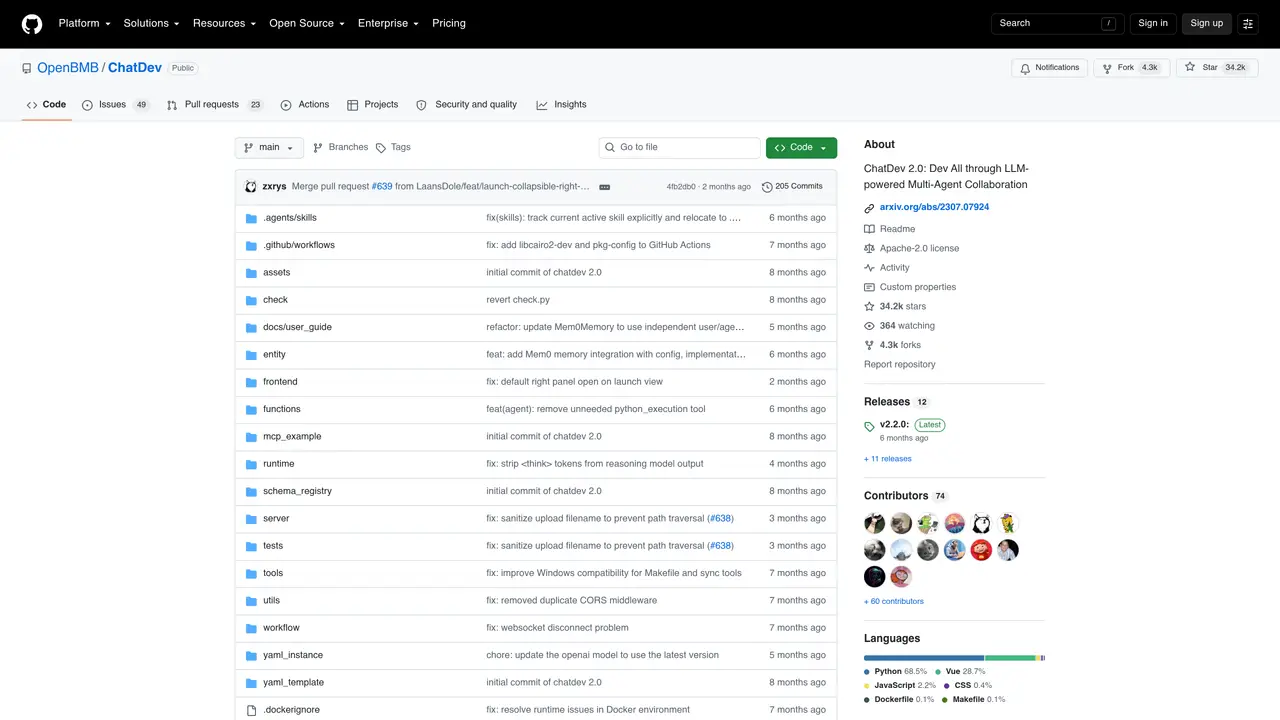
ChatDev is a virtual software company powered by intelligent agents that simulate roles such as CEO, CPO, CTO, programmer, tester, and designer. These agents collaborate to automate and streamline software development tasks, enabling collective intelligence exploration through a customizable framework based on large language models. The tool integrates with Git for version control, supports a Human-Agent-Interaction mode for reviewer involvement, and includes an Art mode for generating software-related images. Users can follow structured steps to set up their environment, build, and run software projects. The project is open-source, encouraging contributions for research and non-commercial use, with licensing details provided. Communication and collaboration are facilitated through email and GitHub discussions.
GitHub, Inc.
San Francisco, California, US · Founded 2008
- Founders
- Tom Preston-Werner, Chris Wanstrath, PJ Hyett, Scott Chacon
- Founded
- 2008
- Headquarters
- San Francisco, California, US
- Legal status
- Subsidiary of Microsoft (NASDAQ: MSFT)
Key features
- Simulates multiple software development roles (CEO, CTO, programmer, tester, etc.)
- Uses large language models for collective intelligence exploration
- Git integration for version control and collaboration
- Human-Agent-Interaction mode for reviewer involvement
- Art mode for generating software-related images
- Open-source framework with customizable setup
- Structured steps for environment setup, building, and running projects
- Encourages contributions for research and non-commercial use
Use cases
- Automating collaborative software development workflows
- Generating and testing software prototypes with AI agents
- Creating visual documentation or assets for software projects
Pros
- Enables zero-code creation of multi-agent systems for diverse tasks beyond software development
- Supports customizable agent roles and workflows through simple configuration
- Facilitates collaboration among specialized agents (e.g., CEO, CTO, Programmer) for complex projects
- Open-source and research-oriented, encouraging community contributions and non-commercial use
- Evolved from a legacy virtual software company model to a broader multi-agent orchestration platform
Cons
- Requires familiarity with multi-agent systems and workflow configuration for optimal use
- May involve computational overhead due to the orchestration of multiple agents
- Limited built-in support for proprietary or closed-source tools and services
Frequently asked questions about ChatDev
What is ChatDev and what does it do?
ChatDev is a zero-code multi-agent platform that enables users to rapidly build and execute customized multi-agent systems for tasks such as software development, data visualization, 3D generation, and deep research. It evolved from a virtual software company model to a broader orchestration platform.
Who is ChatDev designed for?
ChatDev is designed for researchers, developers, and organizations interested in leveraging multi-agent collaboration for complex tasks. It suits users who want to automate workflows without extensive coding.
How does ChatDev work?
ChatDev allows users to define agents, workflows, and tasks through simple configuration. Agents collaborate to perform specialized functions, and the platform orchestrates their interactions to achieve project goals.
What are the key features of ChatDev?
Key features include zero-code multi-agent orchestration, customizable agent roles and workflows, support for diverse tasks beyond software development, and an open-source framework for research and non-commercial use.
Does ChatDev require coding to use?
No, ChatDev is designed as a zero-code platform, allowing users to define and execute multi-agent systems through configuration rather than coding.
How can I get started with ChatDev?
Users can get started by exploring the official repository on GitHub, reviewing the documentation, and following the setup instructions to configure agents and workflows for their specific use case.