
OpenAI builds and deploys advanced AI models like GPT-4o for autonomous agents and workflows.

DeepSeek Harness
FreeStarting price
0Popularity
About DeepSeek Harness
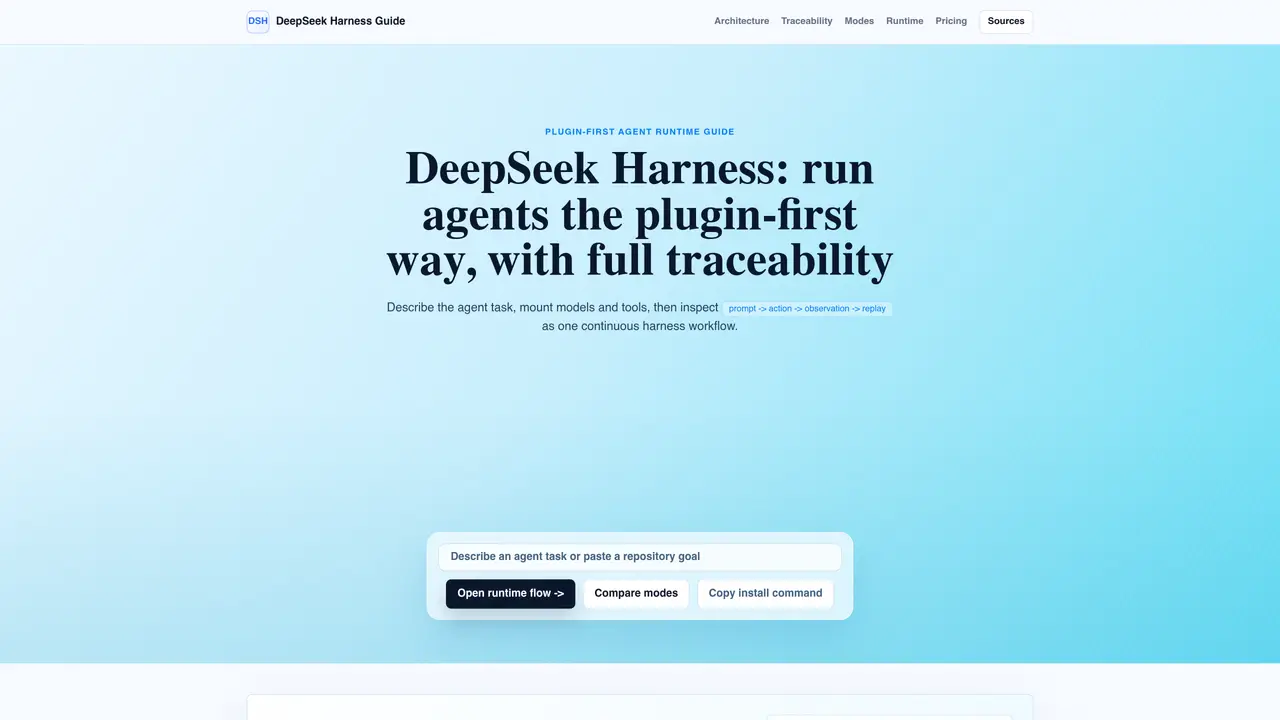
DeepSeek Harness is an open-source runtime designed to operate agent workflows through a plugin-first architecture. It allows users to describe agent tasks, mount models and tools, and inspect the entire workflow from prompt to action to observation in a continuous harness. The runtime emphasizes traceability by recording prompts, tool calls, observations, context injections, and session history for later replay and analysis. The system treats every capability—model adapters, tools, skills, session storage, sandboxing, scheduling, and user interface—as a replaceable plugin, enabling configuration-driven composition rather than hard-wired agent shells. This approach positions the harness as an operational layer that governs how models interact with real environments, including file systems, terminals, and long-running tasks. The guide provides a practical reading path for evaluating the harness, including first-run commands, mode selection, and traceability checklists, while keeping the guide itself free and only charging for optional hosted console capacity.
Key features
- Plugin-based capability mounting and swapping
- Traceable prompt-to-action-to-observation workflows
- Session history with replay and recovery capabilities
- Cordis plugin system for dependency management
- Typed tool interfaces with permission boundaries
- First-run command and checklist for quick evaluation
- Runtime page with mode selection and traceability view
- Open-source repository for inspection and modification
Use cases
- Evaluating agent frameworks with inspectable workflows
- Building modular agent systems with replaceable components
- Debugging agent behavior through recorded session traces
Pros
- Plugin-first architecture allowing modular replacement of capabilities
- Full traceability of prompts, tool calls, observations, and session history
- Open-source runtime with local and hosted execution options
- Cordis-based plugin system for dependency management
- Runtime page provides focused first-run workflow with checklist
Cons
- Hosted console capacity requires separate payment through Polar
- Guide is independent and not an official DeepSeek product page
- Limited to Node.js/npm environment for local execution
- Hosted payment and checkout handled externally by Coachix Console
Frequently asked questions about DeepSeek Harness
What is DeepSeek Harness?
DeepSeek Harness is an open-source runtime designed for operating agent workflows through a plugin-first architecture. It allows users to describe tasks, mount models and tools, and inspect the entire workflow from prompt to action to observation in a continuous harness.
Who should use DeepSeek Harness?
It is intended for builders and developers who need an operational layer to govern how models interact with real environments, such as file systems, terminals, and long-running tasks, with full traceability and inspectability.
How does the pricing model work?
The guide, commands, and source notes remain free. Users only pay for optional hosted console capacity when additional resources are required, with payment processed through Coachix Console plans.
What integrations does DeepSeek Harness support?
The system treats every capability—such as model adapters, tools, skills, session storage, sandboxing, scheduling, and user interface—as a replaceable plugin, enabling flexible configuration-driven composition.
What are the limitations of DeepSeek Harness?
The tool is in a public preview phase, so its capabilities and stability may evolve. Users are advised to rely on the maintainer documentation and repository as the source of truth for accurate details.
How do I get started with DeepSeek Harness?
Start by reading the concept guide, then run the Web UI using the provided command, such as 'npx @deepseek-ai/dsh web'. The runtime page offers a first-run command, mode selection, and traceability checklist for evaluation.