
OpenAI builds and deploys advanced AI models like GPT-4o for autonomous agents and workflows.

DeepSeek Harness Guide by SpringBrand
$19Starting price
0Popularity
About DeepSeek Harness Guide by SpringBrand
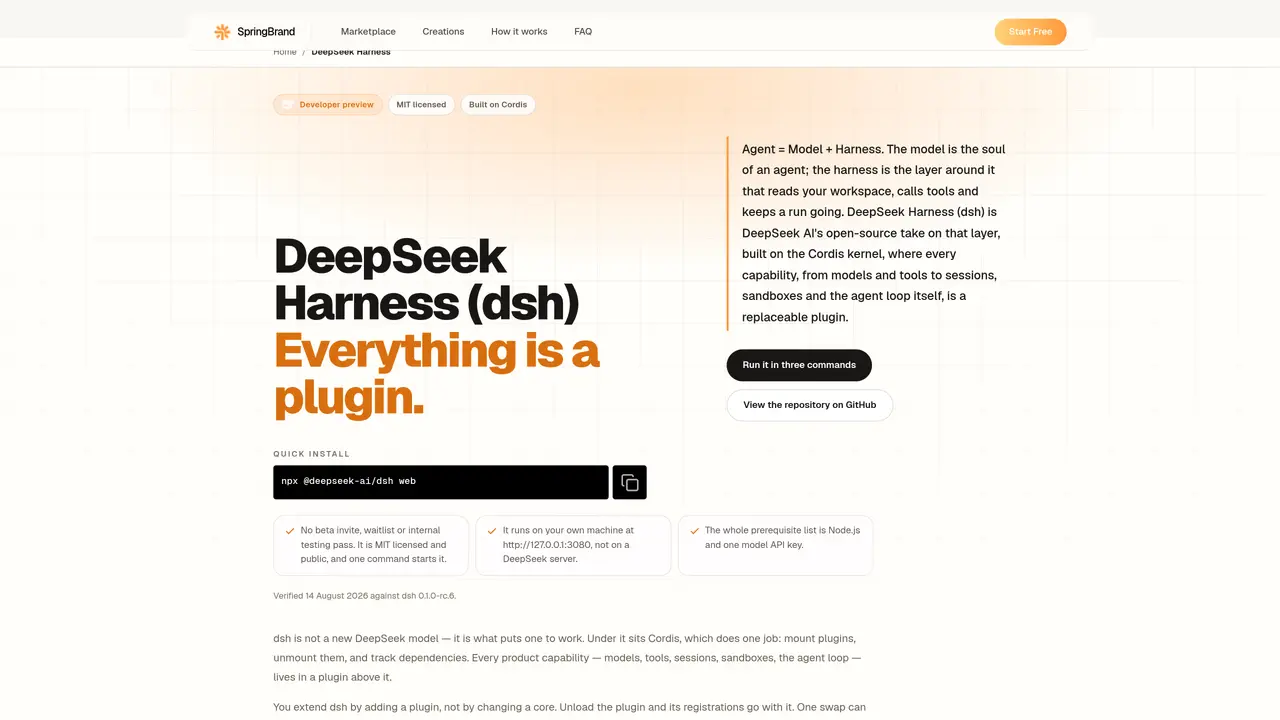
DeepSeek Harness Guide by SpringBrand is an independent explainer and resource for DeepSeek Harness (dsh), an MIT-licensed agent runtime designed to operate around an AI model rather than functioning as a model itself. The guide focuses on clarifying the architecture, runtime modes, and installation processes required to set up DeepSeek Harness locally, making it accessible for developers and teams interested in agent-based automation. It provides practical insights into configuring DeepSeek Harness through a plugin-based system, covering aspects such as models, tools, sessions, and sandboxes. The resource emphasizes the distinction between DeepSeek Harness and standalone AI models, highlighting its role in enabling ongoing agent runs by reading the workspace and invoking tools as needed. It serves as a comprehensive starting point for those looking to integrate or experiment with agent workflows using DeepSeek Harness. The guide is particularly useful for technical audiences seeking to understand the runtime environment and its capabilities for agent development.
Key features
- Explains DeepSeek Harness architecture and runtime modes
- Guides local setup and installation for agent development
- Covers plugin-based configuration for models and tools
- Describes session and sandbox management
- Clarifies differences between agent runtime and AI models
- Provides practical insights for developers
- Focuses on MIT-licensed open-source runtime
- Supports workspace interaction and tool calling
Use cases
- Learning how DeepSeek Harness operates as an agent runtime
- Setting up DeepSeek Harness locally for development and testing
- Configuring plugins for models, tools, and sandboxes in agent workflows
Pros
- Operates as a plugin-based runtime, allowing modular extension of capabilities without altering core code
- Provides a workspace, tools, and session memory for AI models, enabling ongoing agent runs
- Built on Cordis, a general plugin framework, supporting flexible plugin mounting and dependency tracking
- Offers both a Web UI and headless runner for different deployment needs
- Designed for teams and developers who prefer owning their agent runtime rather than using a closed service
Cons
- Currently in developer preview with compatibility-breaking changes expected
- Not suitable for production deployments requiring API stability
- Web UI cannot be served to a network due to CLI limitations
- Requires technical setup and configuration, not a managed or hosted service
Frequently asked questions about DeepSeek Harness Guide by SpringBrand
What is DeepSeek Harness (dsh) and how does it differ from a DeepSeek model?
DeepSeek Harness (dsh) is an agent runtime framework that provides a workspace, tools, permissions, and memory for an AI model, enabling it to perform tasks beyond text generation. Unlike a model, which only emits text and decides which tool to call, dsh executes those calls, maintains session logs, and manages the agent loop.
Who should use DeepSeek Harness?
DeepSeek Harness is designed for teams that want to own their agent runtime, plugin authors building capabilities, model evaluators needing a stable tool surface, and internal platforms embedding an inspectable agent loop. It is not intended for production deployments requiring API stability or teams seeking a hosted service.
How do I install and set up DeepSeek Harness?
DeepSeek Harness can be installed using the command `npx @deepseek-ai/dsh web`, which sets up the runtime and launches a local Web UI at `http://127.0.0.1:3080`. The setup process can be handled by a coding agent, with OAuth sign-in required via a browser when prompted.
What is the role of the Cordis kernel in DeepSeek Harness?
Cordis is the plugin kernel underlying DeepSeek Harness that mounts, unmounts, and tracks dependencies of plugins. It enables dynamic extension and swapping of capabilities, such as models, tools, or sandboxes, without altering the core runtime.
Can I use plugins from the SpringBrand Marketplace with DeepSeek Harness?
Yes, the SpringBrand Marketplace offers ready-to-use capabilities that can be connected to DeepSeek Harness. Users can browse and integrate these plugins to extend the functionality of their dsh agent.
Is DeepSeek Harness stable for production use?
No, DeepSeek Harness is currently in developer preview, with compatibility-breaking changes expected. It is not recommended for production deployments that require API stability.