
OpenAI builds and deploys advanced AI models like GPT-4o for autonomous agents and workflows.

Intelligent Ops Layer
0Popularity
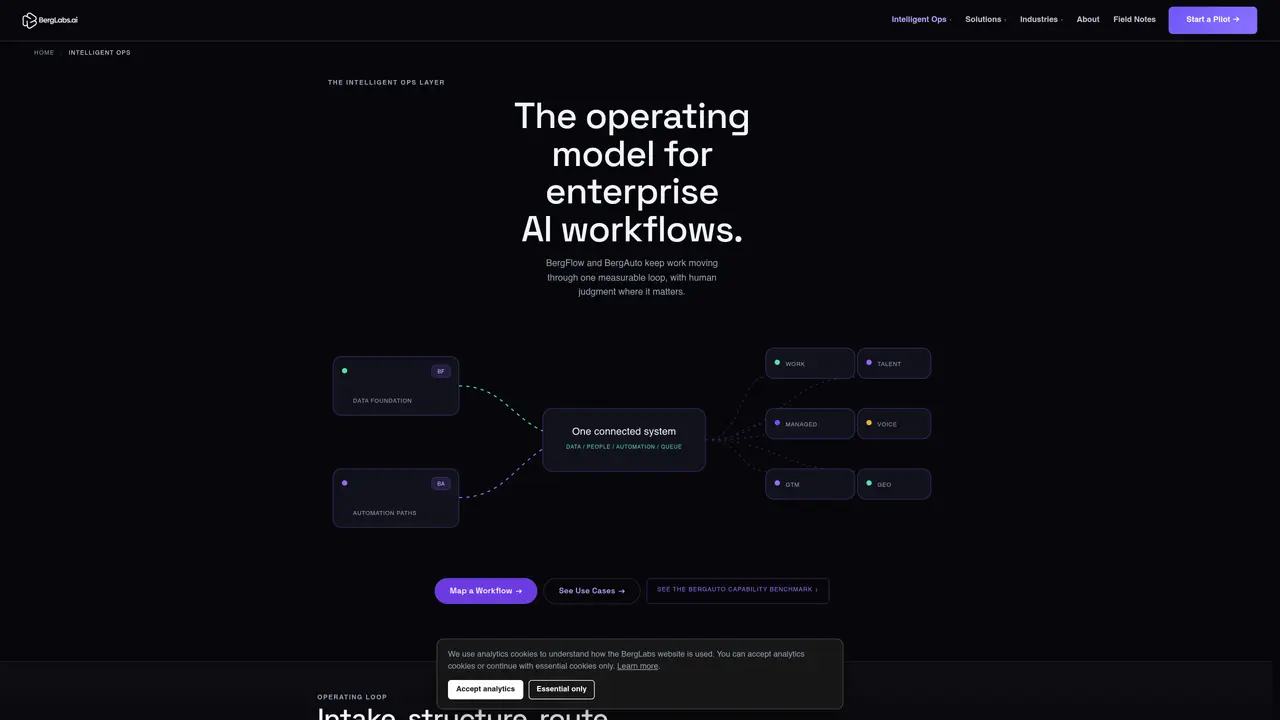
About Intelligent Ops Layer
The Intelligent Ops Layer provides a structured operating model for deploying and managing AI workflows in production environments. It integrates record control, workflow automation, and human review into a single system designed to handle operational quality at scale. The model begins with structured inputs that include context, ownership, source, SLA, and evidence, then routes work through managed queues with clear escalation paths. Each workflow step—intake, structure, route, assist, review, log, and measure—is visible and auditable, ensuring that AI outputs are validated by human judgment where needed. Two core platforms, BergFlow and BergAuto, form the foundation, while six applications—Rosterr, Quinn, Charterr, Sirenn, Radarr, and Atlass—provide specialized functions for queues, staffing, workforce management, voice processing, go-to-market intelligence, and geographic operations. The system maintains governance through role-based access, audit logs, QA sampling, and exception paths that route low-confidence or regulated decisions to human review before execution.
Key features
- Structured inputs with context, owner, source, SLA, and evidence
- Managed queues with routing, review lanes, and escalation paths
- Confidence-gated automation and human review workflows
- Audit logs and QA sampling integrated into operations
- Role-based access control for workflow governance
- Multi-format data intake (text, structured data, images, PDF, Word)
- Run ledger tracking status, step invocations, and cost per run
- Exception paths for low-confidence or regulated decisions
Use cases
- Customer operations: ticket triage, refunds, escalations, account updates
- Finance operations: invoice matching, reconciliation, approvals, vendor checks
- Sales & marketing operations: lead enrichment, campaign QA, CRM hygiene
Pros
- Combines structured inputs with managed queues and automation
- Built-in governance including audit logs and QA sampling
- Supports multi-format data intake including text, structured data, images, PDF, and Word
- Provides confidence-gated routing between automation and review paths
- Maintains a run ledger tracking status, step invocations, token usage, and cost
Cons
- Requires engagement with BergLabs for implementation
- No indication of self-service deployment options
- Limited information on pricing or licensing models
- Appears to focus on enterprise-scale workflows only
Frequently asked questions about Intelligent Ops Layer
What is the Intelligent Ops Layer?
The Intelligent Ops Layer is an operating model for deploying and managing AI workflows in production environments. It combines structured inputs, managed queues, automation, human review, and auditable records into a single system designed to ensure operational quality at scale.
Who should use the Intelligent Ops Layer?
The tool is designed for enterprises that need to operationalize AI workflows with governance, auditability, and human oversight. It suits functions like customer operations, finance, sales and marketing, HR, legal, and IT where operational quality directly impacts outcomes.
How does the Intelligent Ops Layer handle automation and human review?
The system automates repeatable steps with clear confidence thresholds, while routing low-confidence, regulated, ambiguous, or high-impact decisions to human reviewers. Automation boundaries are explicit and adjustable within the workflow.
What platforms and applications make up the Intelligent Ops Layer?
The system is built on two core platforms: BergFlow for record control and BergAuto for workflow automation. Six applications—Rosterr, Quinn, Charterr, Sirenn, Radarr, and Atlass—provide specialized functions for queues, staffing, workforce management, voice processing, go-to-market intelligence, and geographic operations.
How does governance work within the Intelligent Ops Layer?
Governance is embedded into the workflow through role-based access, audit logs, QA sampling, and exception paths that route regulated or uncertain decisions to human review before execution. Every automated and reviewed action is recorded with evidence for audit and reporting.
What kind of workflows can be mapped using the Intelligent Ops Layer?
The system supports workflows with volume, exceptions, systems integration, and measurable outcomes. Common use cases include ticket triage, refunds, invoice matching, lead enrichment, and geographic operations, among others.