
OpenAI builds and deploys advanced AI models like GPT-4o for autonomous agents and workflows.
Kessa
0Popularity
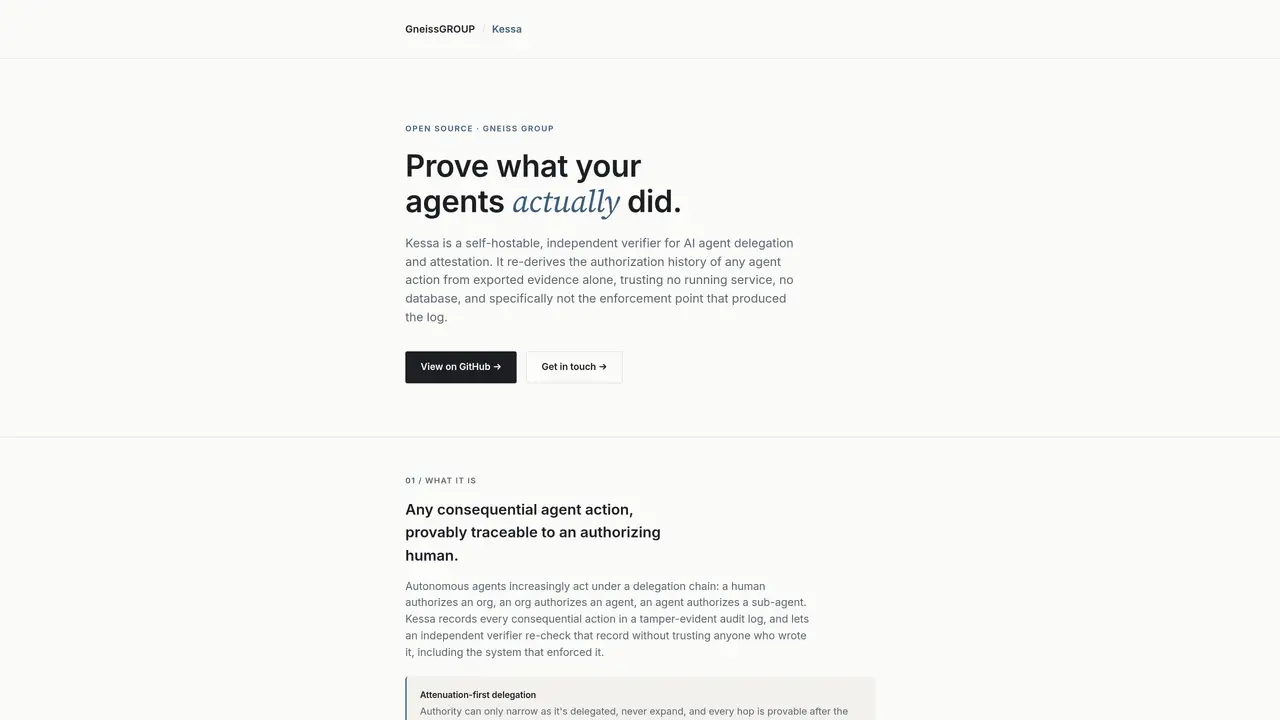
About Kessa
Kessa is a tool designed to verify the actions of AI agents by re-deriving their authorization history from exported evidence. It operates independently of any running service, database, or enforcement point, ensuring that the verification process does not rely on the system that produced the log. The tool is built for organizations that require keeping agent governance within their own trust boundary, as it is self-hostable and does not depend on hosted services. Kessa uses open standards such as did:web, verifiable credentials, and standard cryptographic primitives to inherit the web’s trust model. It enforces attenuation-first delegation, meaning authority can only narrow as it is delegated, and every step in the chain is provable after the fact. The system is designed to be independent at build time, with a dependency closure that avoids AGPL-tier packages.
Key features
- Re-derives authorization history from exported evidence
- Tamper-evident audit log for consequential agent actions
- Supports did:web and verifiable credentials
- Enforces attenuation-first delegation
- Independent verifier with near-stdlib dependency closure
- Build-time enforcement of AGPL-tier package restrictions
- Offline verification capability
- Public repository with active development
Use cases
- Verifying AI agent actions for compliance and governance
- Ensuring provable delegation chains in autonomous systems
- Self-hosted agent governance for organizations with strict trust boundaries
Pros
- Self-hostable with no dependency on hosted services
- Uses open standards like did:web and verifiable credentials
- Independent verification without trusting the enforcement system
- Attenuation-first delegation ensures provable authority narrowing
- Open source with AGPL-3.0 and Apache-2.0 licensing options
Cons
- AGPL-3.0-only licensing for core components may limit adoption
- No public hosted service available, requiring self-hosting effort
- Limited to offline verification with no network dependencies
Frequently asked questions about Kessa
What does Kessa do?
Kessa is a self-hostable verifier for AI agent delegation and attestation. It re-derives the authorization history of agent actions from exported evidence alone, ensuring verification does not rely on the system that produced the log or any running service.
Who is Kessa designed for?
Kessa is designed for organizations that require keeping agent governance within their own trust boundary, particularly those needing independent verification of agent actions without relying on external hosted services.
How does Kessa ensure independence in verification?
Kessa operates independently by using open standards like did:web, verifiable credentials, and standard cryptographic primitives. It enforces attenuation-first delegation, where authority can only narrow as it is delegated, and every step is provable after the fact.
Can Kessa be used offline?
Yes, Kessa's verification process can run offline. The tool allows users to clone the repository, disconnect from the network, and re-derive every verdict from signed evidence alone without dependencies.
What licensing options are available for Kessa?
Kessa's core components are licensed under AGPL-3.0-only, while the independent verifier and plugin interfaces are Apache-2.0. Organizations unable to meet AGPL terms may discuss a commercial license by contacting sales@gneiss-group.com.
How can I get started with Kessa?
To get started, visit the Kessa GitHub repository to clone the codebase. The tool is publicly available, and users can begin verification by running 'kessa verify' offline with signed evidence. For further assistance, contact info@gneiss-group.com.