
OpenAI builds and deploys advanced AI models like GPT-4o for autonomous agents and workflows.

kubbi
$19/mStarting price
857Monthly visits
0Popularity
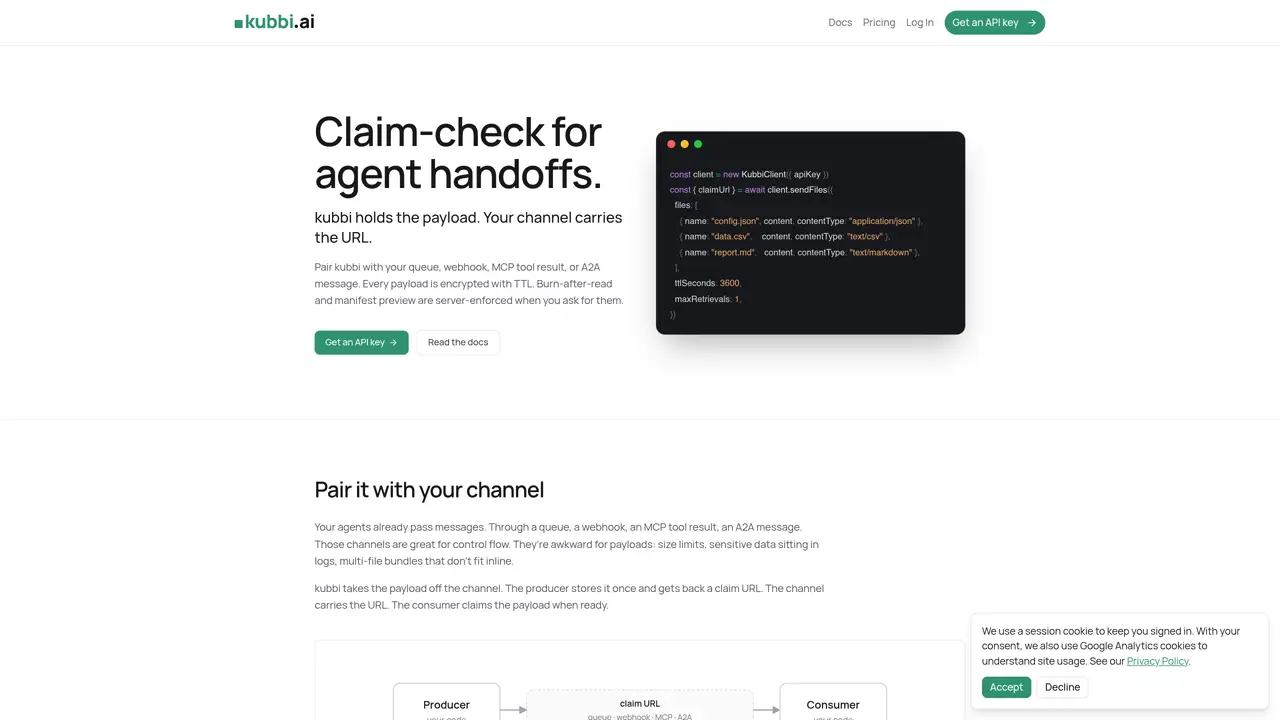
About kubbi
kubbi is a secure handoff layer for AI agents that enables the safe transfer of sensitive payloads or multi-file bundles between agents or humans. Producers upload files, set time-to-live (TTL) and retrieval limits, and generate encrypted claim links. Consumers then retrieve the payload on their schedule, with features like burn-after-read, metadata preview, and revoke controls to minimize data exposure. The tool enforces AES-256 encryption with key rotation, ensuring robust security for transient data in automated agent pipelines. kubbi supports integration into AI workflows through MCP/A2A tool compatibility, Python and TypeScript SDKs, and a REST API, making it suitable for one-time tokens, configurations, secrets, and other ephemeral data exchanges. Its design prioritizes minimal exposure and controlled access, reducing the risk of data leaks in agent-to-agent or human-to-agent communications.
Key features
- Temporary, encrypted claim links for secure data transfer
- TTL and retrieval limit controls for payload access
- Burn-after-read functionality to prevent data retention
- Metadata preview before retrieval
- Revoke controls to invalidate access at any time
- AES-256 encryption with key rotation
- MCP/A2A tool support for AI workflow integration
- Python and TypeScript SDKs
- REST API for broader compatibility
- Designed for transient data like tokens, configs, and secrets
Use cases
- Securely pass sensitive configurations between AI agents in automated pipelines
- Transfer multi-file bundles with controlled access and revocation options
- Enable human-to-agent data handoffs with minimal exposure risk
Pros
- Server-enforced security features like burn-after-read and TTL expiration reduce manual configuration errors
- Supports multi-file bundles and large payloads without size limitations of channels like queues or webhooks
- AES-256-GCM encryption with per-payload IV and auth tag ensures robust data protection at rest
- Provides manifest preview for consumers to verify payloads before retrieval, minimizing unnecessary access
- Offers TypeScript, Python, and REST API interfaces, including MCP/A2A tool compatibility for seamless integration
Cons
- Requires producers to manage API keys for authentication, adding a layer of credential handling
- Terminal states (expired, burned, deleted) rely on server-side enforcement, which may not suit all compliance frameworks
- Payload retrieval is asynchronous, which could introduce latency in time-sensitive workflows
Frequently asked questions about kubbi
What does kubbi do?
kubbi acts as a secure handoff layer for AI agents, storing encrypted payloads and providing claim URLs for retrieval. It enforces time-to-live (TTL) expiration, burn-after-read policies, and manifest previews to minimize data exposure during agent-to-agent or human-to-agent communications.
Who is kubbi best suited for?
kubbi is designed for teams using AI agents that need to transfer sensitive or multi-file payloads across trust boundaries, such as cross-vendor agent interactions, shared channels, or large data packages that exceed channel size limits.
How does kubbi integrate with existing workflows?
kubbi integrates via TypeScript, Python, or REST API, and supports MCP/A2A tool compatibility. Producers send payloads to kubbi and receive a claim URL, which they pass through their existing channels (queues, webhooks, MCP tool results, or A2A messages). Consumers then claim the payload using the URL.
What security measures does kubbi enforce?
kubbi encrypts payloads at rest using AES-256-GCM with per-payload IV and auth tags. It also enforces TTL expiration, burn-after-read policies, and revoke controls, ensuring minimal data exposure during transit and storage.
Can kubbi handle multi-file bundles?
Yes, kubbi supports sending and retrieving multi-file bundles, making it suitable for complex data packages that cannot be transmitted inline through channels like queues or webhooks.
How do I get started with kubbi?
To get started, obtain an API key from kubbi's website, then use the provided SDKs (TypeScript or Python) or REST API to send payloads and generate claim URLs. Consumers can retrieve payloads using the claim URL without needing an API key.
kubbi Website Engagement
Last Update: 9 days ago
Total Monthly Visits
0
Bounce Rate
0%
Visit Duration (avg)
—
Pages Per Visit
0
Country Rank
—
Unknown
Global Rank
—