
Summarizes, extracts, and rewrites content from files.

VaultGuard
€9Starting price
0Popularity
About VaultGuard
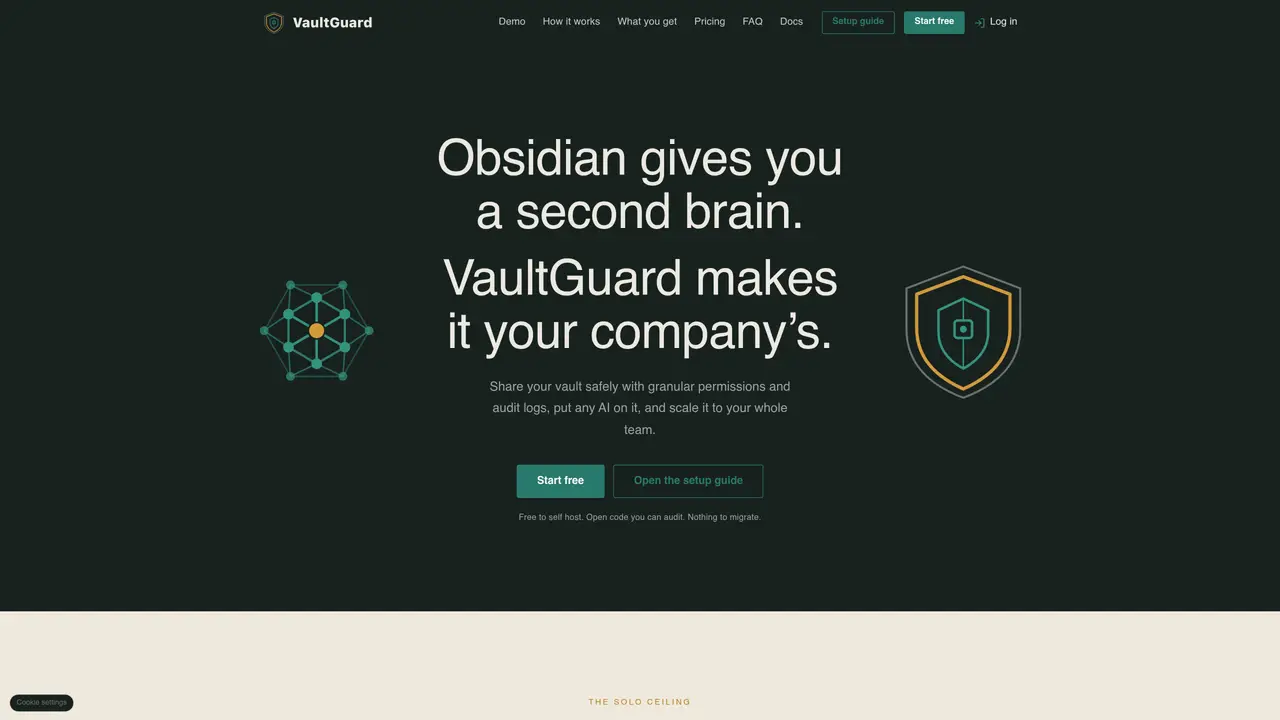
VaultGuard extends Obsidian vaults into a shared, encrypted company knowledge base with granular permissions and audit trails. It enables teams to collaborate on the same markdown notes without migrating content or changing workflows. The tool integrates with existing AI models through a single gateway that enforces per-file permissions and logs every access, reducing token usage by up to 90 percent compared to scanning entire libraries. Setup requires installing a plugin and answering configuration questions, after which sharing, permissions, and AI access can be activated within minutes. All data remains encrypted on user devices before syncing, and the system supports offline work with automatic sync when connectivity returns. The platform offers both managed cloud hosting and a self-hosted community edition deployable on AWS using Terraform.
Key features
- Per-file permissions and access control
- Audit logs for all sync, share, and permission changes
- Single AI gateway with permission enforcement
- Offline-first encrypted sync
- In-Obsidian admin interface for team management
- Template and preset system for quick onboarding
- AES 256 GCM encryption for data at rest and in transit
- Markdown export capability at any time
Use cases
- Small teams running knowledge bases in Obsidian that need safe sharing
- Companies wanting to connect AI assistants to internal documentation
- Organizations seeking audit-ready access controls for sensitive notes
Pros
- Granular file-level permissions with audit logging
- Supports offline work with automatic encrypted sync
- Single gateway for connecting multiple AI models while respecting permissions
- Self-hosted option with open-source code
- No migration required from existing Obsidian vaults
Cons
- Requires Obsidian as the base platform
- Community edition limited to 100 users
- No free cloud tier beyond self-hosting
- Setup requires AWS knowledge for self-hosting
Frequently asked questions about VaultGuard
What does VaultGuard do?
VaultGuard turns an Obsidian vault into a shared, encrypted company knowledge base with granular permissions and audit trails. It allows teams to collaborate on the same markdown notes without migrating content or changing workflows.
Who is VaultGuard designed for?
VaultGuard is designed for teams already using Obsidian who need to safely share knowledge, enforce permissions, and integrate AI tools without rebuilding their workflows or migrating data.
How does VaultGuard handle AI integration?
VaultGuard connects any AI model through a single gateway that enforces per-file permissions and logs every access, reducing token usage by optimizing AI reads to only the necessary content.
Can VaultGuard be self-hosted?
Yes, VaultGuard offers a self-hosted Community edition deployable on AWS using Terraform, with the same encryption and per-file permissions as the managed cloud version.
What encryption does VaultGuard use?
VaultGuard uses AES 256 GCM encryption, applied to data both on the user's device and in the cloud, ensuring end-to-end security for shared and stored content.
How do I get started with VaultGuard?
Start by installing the VaultGuard plugin on your Obsidian vault, then follow the setup guide to configure sharing, permissions, and AI access in minutes without migrating existing content.