
OpenAI builds and deploys advanced AI models like GPT-4o for autonomous agents and workflows.

MemHub
$29/moStarting price
0Popularity
About MemHub
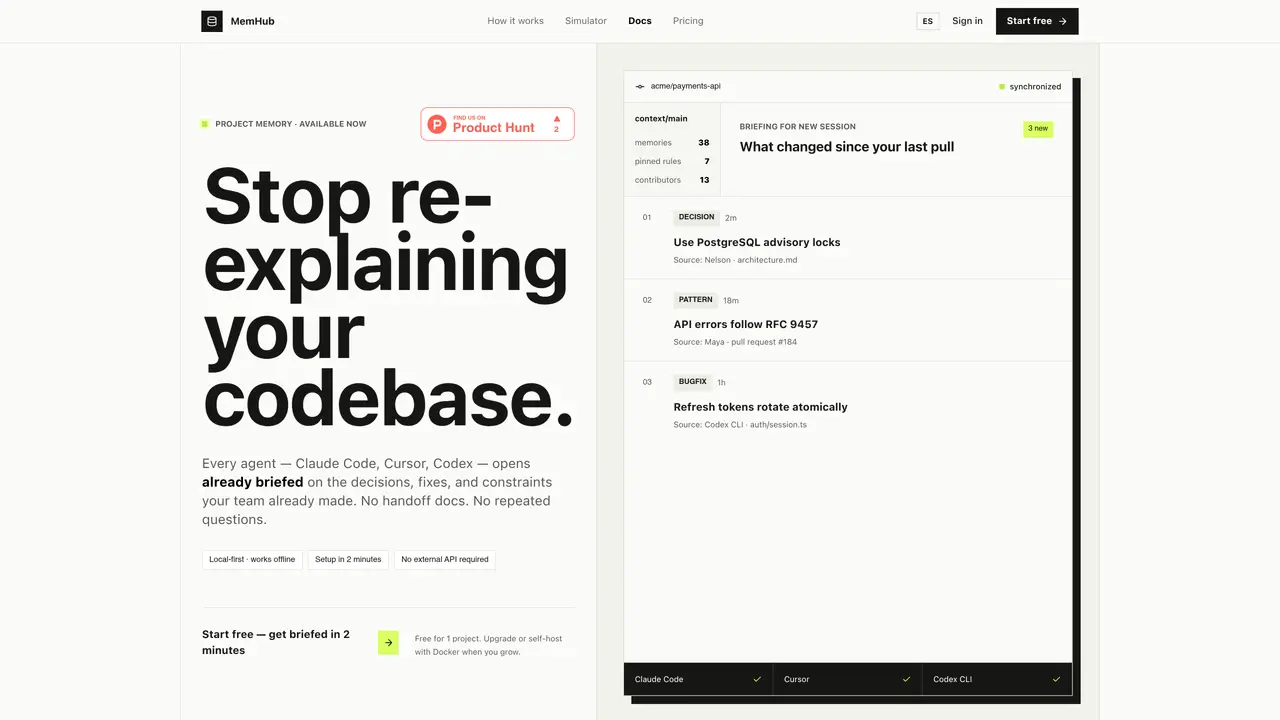
MemHub provides a shared memory layer that persists decisions, fixes, and constraints across AI coding sessions. It captures context automatically from terminals, pull requests, and editors without requiring additional documentation or context-switching. The system uses a local SQLite outbox for offline operation and syncs project-scoped memories with provenance tracking when online. Each new session starts pre-briefed with changes since the last pull, reducing onboarding time and preventing context loss when terminals close. The tool integrates with popular AI agents like Claude Code, Cursor, Codex, Windsurf, and Cline via an MCP server, requiring only a single command to connect. It supports self-hosting with Docker configurations for PostgreSQL 16 and pgvector, and offers local-first operation with optional cloud synchronization for team collaboration. The pricing model includes a free tier for individual developers and a paid team plan with additional features like hybrid search and audit history.
Key features
- SQLite outbox for local memory storage
- Project-scoped memory synchronization
- Provenance tracking (author, timestamp, git reference)
- MCP server for agent integration
- Lexical and semantic search capabilities
- Auto-rules injector for agent guidance
- PostgreSQL 16 and pgvector support for self-hosting
- Git author and provenance audit history
Use cases
- Onboarding new developers to an existing codebase
- Maintaining consistency across AI coding agent sessions
- Reducing repetitive explanations in pull requests
Pros
- Local-first operation with offline capability
- Automatic capture of decisions and context from existing workflows
- Provenance tracking for who made changes and when
- Integration with multiple AI coding agents via MCP server
- Self-hosting option available
Cons
- Free tier limited to one project
- Team plan required for cloud synchronization
- No explicit support for non-code artifacts like design files
Frequently asked questions about MemHub
What is MemHub and what does it do?
MemHub provides a shared memory layer that persists decisions, fixes, and constraints across AI coding sessions. It automatically captures context from terminals, pull requests, and editors, allowing AI agents like Claude Code or Cursor to start pre-briefed with relevant project history.
Who is MemHub designed for?
MemHub is designed for engineering teams and individual developers who use AI coding agents and want to eliminate repetitive context-building. It suits teams collaborating on shared codebases or projects requiring persistent memory of technical decisions.
How does MemHub handle offline work?
MemHub uses a local SQLite outbox to store captured context offline. When offline, writes are committed to the local outbox and automatically synchronized with the shared memory once connectivity is restored.
Can MemHub be self-hosted?
Yes, MemHub supports self-hosting with Docker configurations for PostgreSQL 16 and pgvector. The repository includes setup guides for self-hosting environments like Easypanel.
Does MemHub require an external embedding API?
No, MemHub does not require an external embedding API by default. It supports full-text search initially and allows users to connect locally hosted models like Ollama or configure remote providers later.
How do I get started with MemHub?
Getting started with MemHub takes about 2 minutes. Users can begin with a free tier for individual projects or upgrade to a team plan for additional features. Setup involves installing the MemHub CLI and connecting an MCP-compatible AI agent.