
OpenAI builds and deploys advanced AI models like GPT-4o for autonomous agents and workflows.

MemoFS Cloud
$15Starting price
0Popularity
About MemoFS Cloud
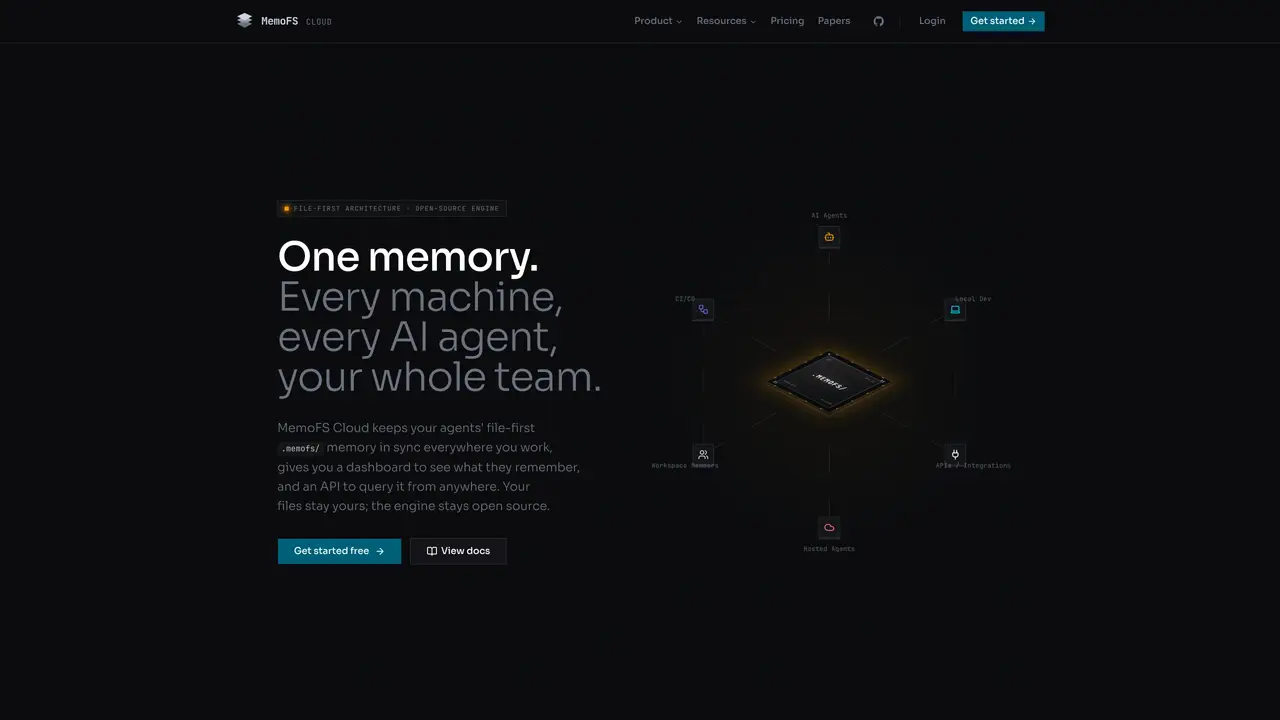
MemoFS Cloud provides a shared, versioned file-first memory plane for AI agents and teams. It keeps a canonical .memofs/ directory synchronized across local machines, cloud environments, CI/CD pipelines, and hosted agents using a local-first architecture backed by an open-source engine. The system captures pre-sync snapshots before each push, enabling one-click rollback and preventing silent overwrites. Memory is stored as plain markdown files under .memofs/, allowing direct inspection, search, or git tracking without proprietary formats. The cloud service acts as a secure replica rather than the sole copy, with TLS-encrypted, content-addressed blobs and fine-grained scoped API keys for access control. Teams can share a single workspace with per-seat billing, while individual developers use a free tier with limited storage and connectors. The platform supports ingestion from GitHub and Notion, and upcoming features include a memory intelligence dashboard for deduplication, trust scoring, and semantic consolidation.
Key features
- File-first .memofs/ directory with plain markdown storage
- Pre-sync snapshots and one-click rollback
- Content-addressed blobs with SHA-256 hashing
- Scoped API keys for fine-grained access control
- Connectors for GitHub and Notion
- Real-time memory webhooks
- Per-seat billing for team workspaces
- Memory export as JSON snapshots
Use cases
- Synchronizing AI agents' memory across multiple machines and teammates
- Sharing team context in a single workspace with per-seat billing
- Integrating memory recall in CI/CD pipelines and serverless environments
Pros
- File-first architecture with plain markdown storage
- Local-first sync with cloud as secure replica
- Pre-sync snapshots enable rollback and prevent silent overwrites
- Content-addressed blobs with SHA-256 hashing
- Connectors for GitHub and Notion ingestion
Cons
- No free tier beyond 500 MB storage
- Limited connectors (Linear coming soon)
- No hosted runtime available yet
- Memory intelligence features marked as 'soon'
Frequently asked questions about MemoFS Cloud
What is MemoFS Cloud and what problem does it solve?
MemoFS Cloud provides a shared, versioned file-first memory plane for AI agents and teams, keeping a canonical .memofs/ directory synchronized across local machines, cloud environments, CI/CD pipelines, and hosted agents. It solves the problem of divergent, invisible, and unreachable memory by ensuring all agents and teammates access the same, up-to-date context.
Who is MemoFS Cloud designed for?
MemoFS Cloud is designed for users of AI agents such as Claude Code, Cursor, Codex, OpenCode, research tools, or custom agents, as well as teams working with shared workspaces. It also supports developers running agents in CI/production environments and those building AI applications or agents.
How does MemoFS Cloud handle security and privacy?
MemoFS Cloud stores memory locally as plain markdown files and uses the cloud only as a secure replica. Sync blobs are TLS-encrypted and content-addressed via SHA-256, with fine-grained scoped API keys for access control. Users retain full control over their data and can permanently erase it.
What integrations does MemoFS Cloud support?
MemoFS Cloud supports ingestion from GitHub and Notion via connectors, pulling issues, PRs, discussions, README files, pages, databases, and workspace content. Linear integration is coming soon. These connectors automate the transfer of external data into the .memofs/ directory.
How do I get started with MemoFS Cloud?
To get started, initialize a project with 'memofs init', which creates the .memofs/ directory and registers the project with MemoFS Cloud. Then use 'memofs cloud sync push' to upload changes and 'memofs cloud sync pull' to sync across other machines or environments.
What are the upcoming features in MemoFS Cloud?
Upcoming features include a memory intelligence dashboard for deduplication, trust scoring, semantic consolidation, agent activity timeline, and knowledge graph capabilities. These features aim to help users understand, verify, and manage their memory more effectively.