OpenAI builds and deploys advanced AI models like GPT-4o for autonomous agents and workflows.

OpenViking
104KMonthly visits
34Popularity
About OpenViking
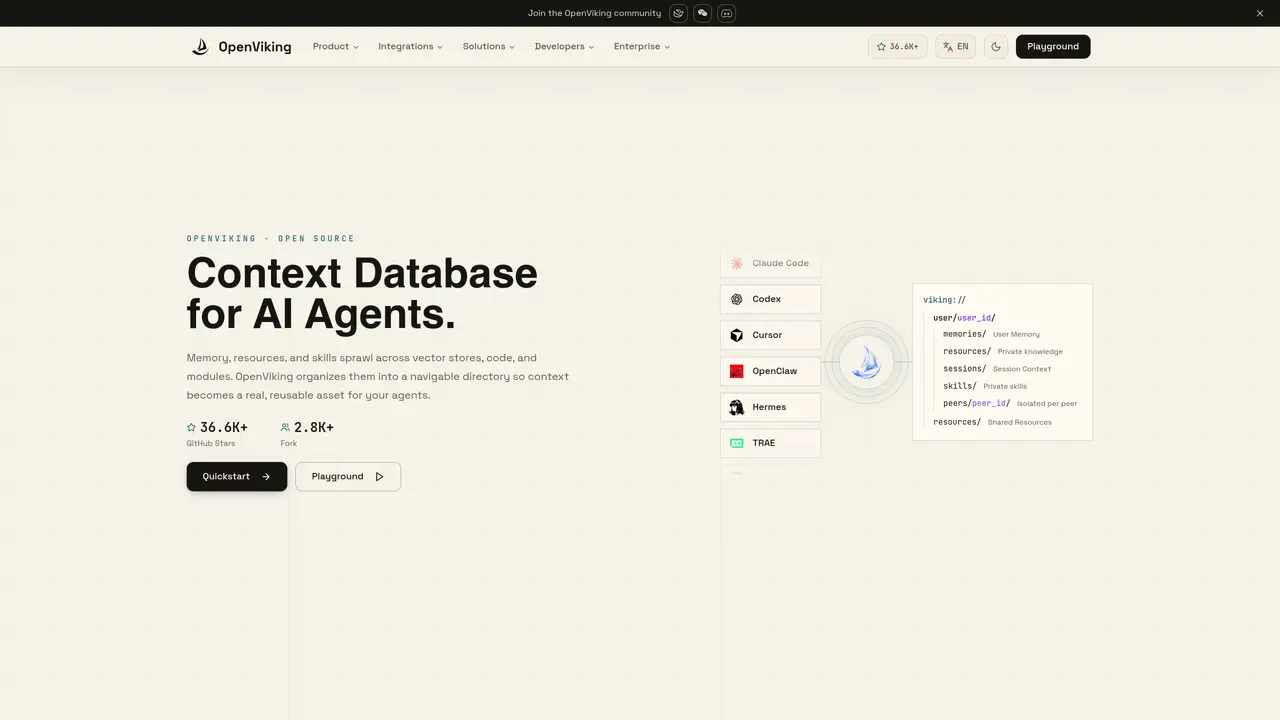
OpenViking is a context file system designed for AI agents, transforming long-lived memory into addressable files and folders with metadata. It standardizes how agents store, index, and retrieve knowledge across tasks and tools, improving reliability, grounding, and collaboration. Teams mount a project namespace, stream artifacts from agents and tools into folders, tag them with metadata, and let indexers build search over time. Downstream agents resolve paths or queries to fetch minimal, relevant context, then write results back for the next step. It suits AI platform teams building orchestrated agents, retrieval-augmented applications, and long-running automations that require durable memory. It helps research engineering groups compare runs reproducibly, customer-facing product teams ground responses in audited artifacts, and operations automate repetitive knowledge tasks. It’s equally useful for single-agent assistants that must recall prior work and for multi-agent systems coordinating across tools, services, and data silos.
Key features
- Hierarchical namespaces with typed artifacts and metadata for precise, policyable context
- Pluggable indexing for lexical and embedding search with relevance-ranked retrieval
- Deterministic addressing, lightweight versioning, and lineage for reproducibility and audits
- Event hooks and subscriptions to notify pipelines as new artifacts land
- Simple CRUD API for creating, listing, reading, searching, and linking context
- Console view showing project namespaces with folders, artifacts, metadata, and search results
- Multi-agent memory sharing across tools and services
- Retrieval-augmented workflows with compact, relevant context slices
Use cases
- Grounding customer-facing AI responses in audited artifacts for reliability
- Automating repetitive knowledge tasks in operations with durable memory
- Comparing experimental runs reproducibly in research engineering workflows
Pros
- Standardizes long-lived memory into addressable files and folders with metadata for AI agents
- Improves reliability and grounding by organizing and indexing knowledge across tasks and tools
- Enables reproducible comparisons of agent runs and audited artifacts for research and customer-facing teams
- Supports both single-agent assistants and multi-agent systems coordinating across tools and data silos
- Facilitates durable memory and collaboration in orchestrated agent workflows
Cons
- May introduce complexity for teams unfamiliar with file-based memory systems
- Requires setup and maintenance of a project namespace and indexing infrastructure
- Dependency on consistent metadata tagging for effective search and retrieval
Frequently asked questions about OpenViking
What is OpenViking and what problem does it solve?
OpenViking is a context database for AI agents that transforms long-lived memory into addressable files and folders with metadata. It standardizes how agents store, index, and retrieve knowledge across tasks and tools, improving reliability and grounding.
Who should use OpenViking?
OpenViking suits AI platform teams building orchestrated agents, retrieval-augmented applications, and long-running automations. It also helps research engineering groups, customer-facing product teams, and operations teams automate repetitive knowledge tasks.
How does OpenViking work with AI agents?
Teams mount a project namespace, stream artifacts from agents and tools into folders, tag them with metadata, and let indexers build search over time. Downstream agents resolve paths or queries to fetch minimal, relevant context and write results back for subsequent steps.
Does OpenViking support multi-agent systems?
Yes, OpenViking is designed to support multi-agent systems coordinating across tools, services, and data silos, enabling collaboration and shared memory.
What are the typical use cases for OpenViking?
Typical use cases include reproducible agent run comparisons, grounding customer-facing responses in audited artifacts, and automating repetitive knowledge tasks in operations.
How do I get started with OpenViking?
To get started, mount a project namespace, configure agents and tools to stream artifacts into folders, and set up metadata tagging and indexing for search functionality.
OpenViking Website Engagement
Last Update: 9 days ago
Total Monthly Visits
0
Bounce Rate
0%
Visit Duration (avg)
0.00s
Pages Per Visit
0
Country Rank
0
China
Global Rank
0
Monthly Traffic
Traffic Sources
Traffic Share By Country
- China46.3%
- United States20.8%
- Singapore17.2%
- Hong Kong4.9%
- Taiwan3.3%