
AI assistant for safe, reliable productivity with code, collaboration, and integrations.

hippocampOS
Private memory layer for AI assistants that organizes work context from emails, files and meetings
$5/moStarting price
About hippocampOS
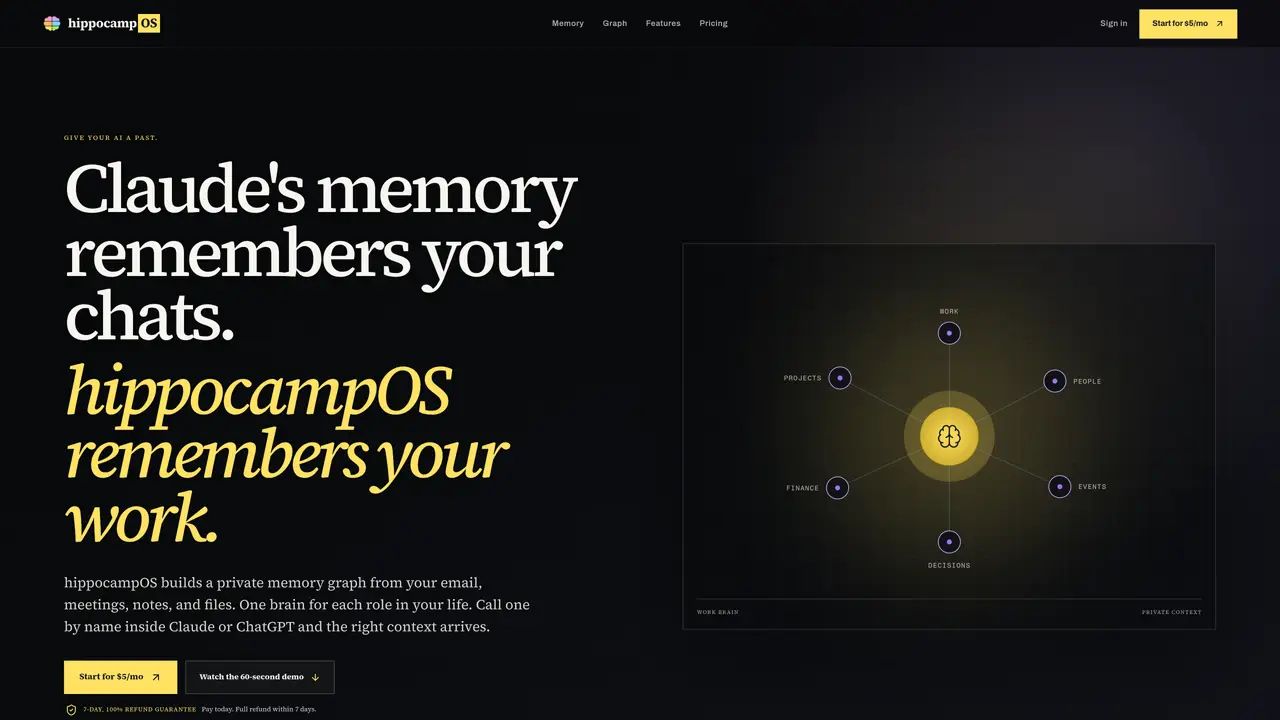
hippocampOS builds a private memory graph from email, meetings, notes and files, storing it as a separate layer that AI assistants can retrieve. Each role in a user’s life—work, personal, research—receives its own named brain, allowing the assistant to bring the correct context into conversations on demand. The system connects to existing tools such as Gmail, Notion and Google Drive, then organizes collected details into a living graph rather than a static archive. Retrieval is performed via vector search without an LLM call, returning only a small slice of relevant context to keep responses fast and usage limits intact. Users invoke a specific brain by name inside Claude or ChatGPT, receiving the accumulated context without having to reintroduce themselves each time. The memory persists across sessions, growing more useful as more data is added, and each fact retains its source for inspection and removal. The service emphasizes privacy by letting users choose what enters each brain and what remains hidden from the AI.
Key features
- Named brains for work, personal, research and client contexts
- Connectors for Gmail, Notion, Google Drive and other services
- Vector-based retrieval without LLM calls in the path
- Nightly or on-demand synchronization of data
- Inspectable memory graph with source links
- Sealed brains to prevent cross-context leakage
- Master Brain view for multi-role users
- 7-day refund guarantee
Use cases
- Maintaining separate work and personal AI contexts
- Reducing repeated explanations in long-running projects
- Keeping client work isolated from personal chats
Pros
- Creates a private memory layer separate from chat history
- Organizes context into named brains per role or project
- Retrieves only relevant slices of context to reduce token usage
- Retains source provenance for every stored fact
- Supports multiple AI assistants including Claude and ChatGPT
Cons
- Subscription-only model with no free tier
- Requires integration with specific external services
- Limited to desktop environments via browser
Frequently asked questions about hippocampOS
What is hippocampOS and how does it work?
hippocampOS builds a private memory graph from sources like email, meetings, notes, and files, storing it as a separate layer that AI assistants can retrieve. It organizes collected details into a living graph rather than a static archive, allowing users to invoke a specific brain by name inside Claude or ChatGPT to bring the correct context into conversations.
Who should use hippocampOS?
The tool is designed for individuals who juggle multiple roles—such as work, personal life, research, or client work—and want to keep contexts separate. It also suits teams that need shared context across employees to avoid re-explaining the same background repeatedly.
How does hippocampOS handle privacy and data control?
Users can choose what enters each brain and what remains hidden from the AI. Facts retain their source provenance, allowing inspection and removal, and the system emphasizes privacy by letting users control what their AI can retrieve.
What integrations does hippocampOS support?
The service connects to existing tools such as Gmail, Notion, and Google Drive, enabling users to pull context from these platforms into their private memory graph.
How does retrieval work in hippocampOS?
Retrieval is performed via vector search without an LLM call, returning only a small slice of relevant context to keep responses fast and usage limits intact. This ensures that projects do not repeatedly send their full background.
How do I get started with hippocampOS?
Users can start with a plan such as Spark, Synapse, or Cortex, depending on their needs. After signing up, they can connect their data sources and begin building their private memory graph, which becomes more useful as more data is added.