
OpenAI builds and deploys advanced AI models like GPT-4o for autonomous agents and workflows.

PraisonAI
$0.07Starting price
0Popularity
About PraisonAI
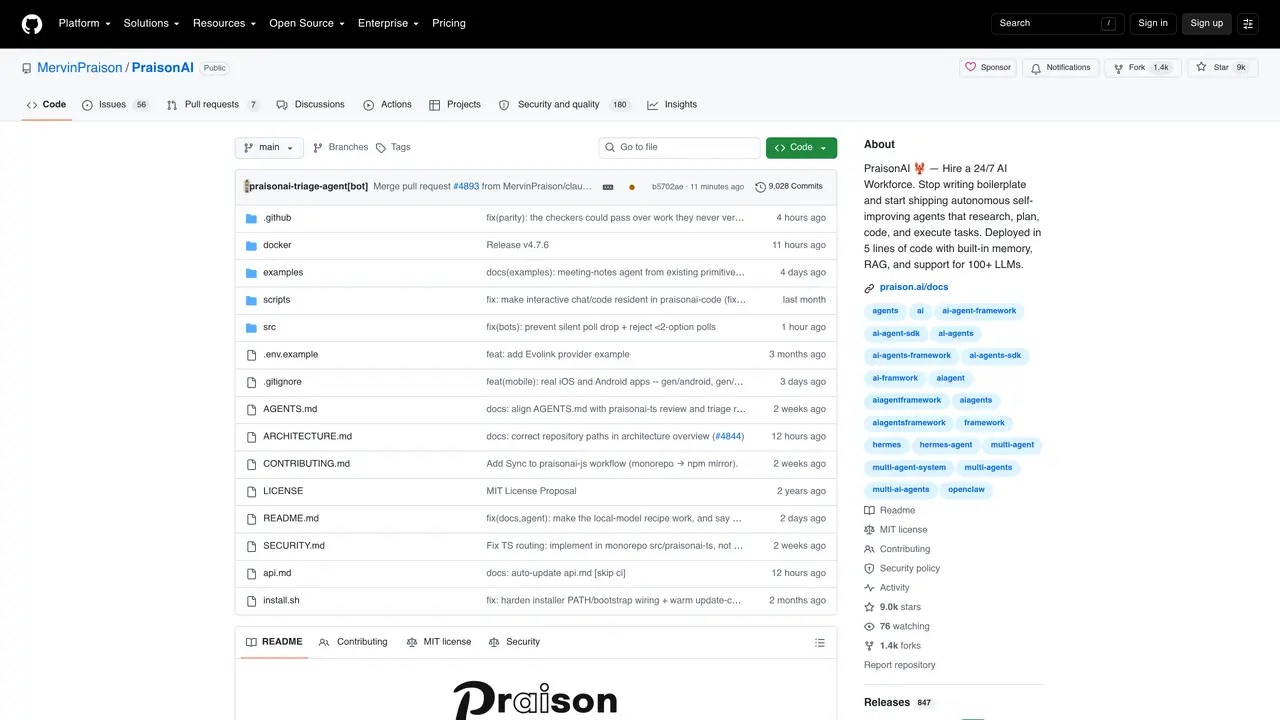
PraisonAI is an open-source low-code framework that enables users to deploy autonomous, self-improving AI agents capable of researching, planning, coding, and executing tasks across applications. The tool abstracts complex multi-agent orchestration into a streamlined interface, allowing teams to build and scale agentic workflows without extensive programming knowledge. PraisonAI integrates built-in memory and retrieval-augmented generation (RAG) to maintain context over time, while supporting over 100 LLMs for flexible task specialization. Its five-layer agent architecture provides transparency into agent behavior, making it easier to debug and optimize workflows. The framework is designed for rapid deployment, with core functionality accessible via a lightweight SDK and a simple installation process. Typical use cases include automating research and analysis, generating and debugging code, creating content at scale, and building 24/7 customer support bots across platforms like Telegram and Slack. By consolidating agent orchestration, task handoffs, and self-correction into a single platform, PraisonAI aims to reduce boilerplate development and accelerate the delivery of AI-powered solutions for teams of varying technical backgrounds.
GitHub, Inc.
San Francisco, California, US · Founded 2008
- Founders
- Tom Preston-Werner, Chris Wanstrath, PJ Hyett, Scott Chacon
- Founded
- 2008
- Headquarters
- San Francisco, California, US
- Legal status
- Subsidiary of Microsoft (NASDAQ: MSFT)
Key features
- Low-code framework for building multi-agent LLM systems
- Integration with AutoGen and CrewAI
- User interfaces for chatting with over 100 LLMs or entire codebases
- Fine-tuning LLMs with custom data
- Simplified oversight and management of AI agents
- Enhanced human-agent collaboration capabilities
- Access to a wide variety of LLMs without extensive coding
- Customizable workflows for AI-powered development
Use cases
- Automatically generating creative content, such as scripts or stories
- Managing multiple AI agents for complex tasks or workflows
- Fine-tuning LLMs with custom data for specialized applications
Pros
- Deploys autonomous multi-agent systems in as few as five lines of code
- Supports over 100 large language models (LLMs) for diverse task execution
- Built-in memory and retrieval-augmented generation (RAG) for persistent context
- Low-code framework requiring minimal technical expertise to operate
- Modular five-layer agent stack for debugging and scalability
Cons
- Primarily relies on external LLM APIs, which may introduce latency or cost
- Limited documentation clarity for advanced customization beyond basic deployment
- Self-improving agents may require oversight to prevent unintended behavior
PraisonAI videos
Frequently asked questions about PraisonAI
What is PraisonAI and what does it do?
PraisonAI is a low-code framework for deploying autonomous AI agents that can research, plan, code, and execute tasks across applications. It simplifies the creation of multi-agent systems by handling orchestration, memory, and task handoffs in a single platform.
Who is PraisonAI designed for?
The tool is designed for developers, analysts, and teams seeking to automate workflows without deep coding expertise. It suits users who need scalable, self-improving agents for tasks like research, coding, content creation, and customer support.
How do I get started with PraisonAI?
Install the lightweight SDK using a one-line command, set up your LLM API key, and define an agent with specific instructions. The framework provides templates and examples to guide initial setup and deployment.
Does PraisonAI support integrations with other tools or platforms?
Yes, PraisonAI supports integrations with over 100 LLMs and can be deployed across various platforms, including APIs, databases, and messaging services like Telegram, Discord, and Slack for customer support bots.
What are the key limitations of PraisonAI?
PraisonAI relies on external LLM APIs, which may introduce latency or costs depending on usage. Advanced customization options are limited by current documentation, and self-improving agents may require human oversight to ensure alignment with intended outcomes.
Can PraisonAI be used for workflow automation beyond simple tasks?
Yes, PraisonAI is designed for multi-step workflow automation, where agents can hand off tasks, verify results, and self-correct. Its five-layer architecture supports complex processes, making it suitable for enterprise-grade automation.