
OpenAI builds and deploys advanced AI models like GPT-4o for autonomous agents and workflows.

Streamient
$49Starting price
0Popularity
About Streamient
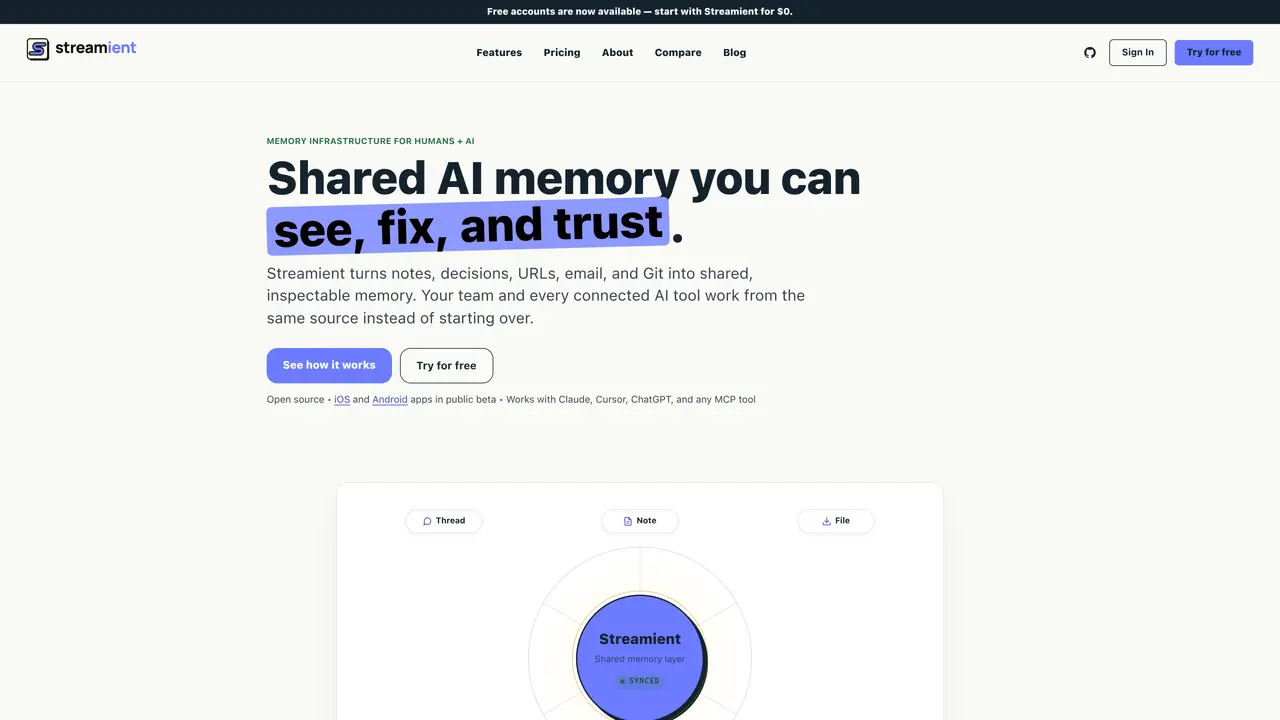
Streamient is an open-source memory infrastructure platform designed to consolidate scattered company knowledge into a unified, inspectable memory layer for AI-native teams. It transforms notes, decisions, URLs, emails, and Git repositories into a persistent store that remains accessible across sessions and clients. Team members can search, correct, and export records while connected AI tools such as Claude, Cursor, and ChatGPT retrieve the same context through MCP or API. The platform includes a knowledge graph for visualizing relationships, a browser extension for seamless capture, and self-hosting capabilities under an AGPL-3.0 license. By providing a shared memory layer, Streamient ensures consistency and context retention for both human teams and AI agents working on collaborative tasks. It supports structured knowledge capture, reusable context storage, and email thread preservation, enabling teams to maintain a verifiable and editable source of truth. The platform is built for teams that need AI memory they can control, offering an open standard for integration with various MCP-compatible tools.
Key features
- Open-source memory infrastructure under AGPL-3.0 license
- Consolidates notes, decisions, URLs, emails, and Git repositories
- Persistent memory store accessible across sessions and clients
- Searchable and editable records for team collaboration
- Knowledge graph for visualizing relationships between data
- Browser extension for capturing and storing web content
- Self-hosting support for custom deployment
- API and MCP integration for AI tools like Claude, Cursor, and ChatGPT
- Exportable records for external use or backup
Use cases
- Centralizing team knowledge for AI-native workflows
- Maintaining consistent context across AI agents and human teams
- Capturing and organizing web content via browser extension
Pros
- Open-source under AGPL-3.0 license for transparency and self-hosting
- Unified memory layer accessible to both human teams and connected AI tools
- Browser extension for seamless capture of URLs and notes from any tab
- Knowledge graph for visualizing and inspecting relationships between records
- Supports multiple MCP-compatible AI tools including Claude, Cursor, and ChatGPT
Cons
- Newer platform with evolving features and potential stability issues
- Requires technical setup for self-hosting or integration with AI tools
- Limited documentation or community support compared to established tools
Frequently asked questions about Streamient
What is Streamient and who is it designed for?
Streamient is an open-source memory layer for AI-native teams and MCP-compatible tools. It is designed for teams that need a shared, inspectable memory source for both human collaboration and AI tool integration.
How does Streamient work with AI tools like Claude or ChatGPT?
Streamient connects to AI tools such as Claude, Cursor, and ChatGPT through MCP or API, allowing these tools to retrieve and write to the same shared memory records under user permissions.
Can I self-host Streamient?
Yes, Streamient is open-source under the AGPL-3.0 license, allowing teams to self-host the platform on their own infrastructure.
What types of content can Streamient capture and store?
Streamient can capture and store notes, decisions, URLs, emails, Git repositories, and project context, all in a searchable and editable format.
Does Streamient offer a browser extension?
Yes, Streamient provides a browser extension for capturing URLs and notes directly from any tab while preserving project context and relationships.
Is there a cost to use Streamient?
Streamient offers free accounts to get started, with additional features and capabilities available depending on the user's needs and setup.