OpenAI builds and deploys advanced AI models like GPT-4o for autonomous agents and workflows.

Ten
7.8KMonthly visits
15Popularity
About Ten
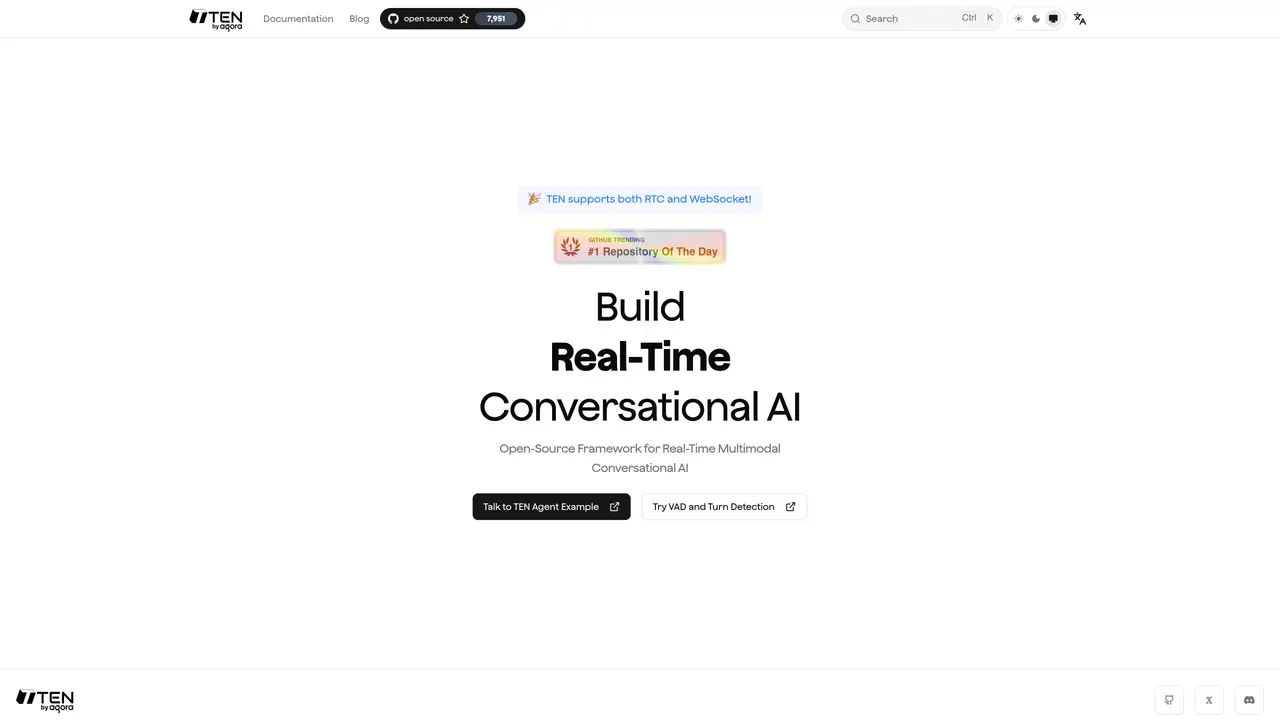
TEN is an open-source framework designed for developers to build real-time multimodal conversational AI agents capable of seeing, hearing, and speaking with users. It provides a modular architecture that integrates large language models with speech recognition, text-to-speech, vision processing, and real-time communication capabilities. The framework enables the creation of agents with natural voice interactions, visual understanding, and animated avatars, all while allowing developers to swap AI components through plug-and-play extensions without modifying code. TEN stands out for its visual graph-based configuration system, which simplifies the development process, and its support for cutting-edge real-time AI services like Gemini 2.0 Live and OpenAI Realtime. It is also compatible with platforms such as Dify and Coze, making it versatile for integration into existing workflows. Organizations looking to deploy low-latency conversational agents with multimodal capabilities will find TEN’s comprehensive AI stack particularly useful, as it combines the flexibility of open-source development with production-grade performance for applications requiring seamless human-AI interaction.
Key features
- Real-time multimodal interactions (voice, vision, text)
- Modular architecture for flexible AI component integration
- Visual graph-based configuration system
- Support for speech recognition and text-to-speech
- Compatibility with platforms like Dify and Coze
- Plug-and-play extensions for swapping AI components
- Integration with cutting-edge real-time AI services
- Open-source framework for customization and scalability
- Animated avatar capabilities for enhanced user interaction
- Low-latency performance for production-grade applications
Use cases
- Building AI customer service agents with voice and visual understanding
- Developing interactive virtual assistants with animated avatars
- Creating real-time multimodal chatbots for education or entertainment
Pros
- Open-source framework enabling full customization and control over AI agent development
- Supports real-time multimodal interactions including voice, text, and vision processing
- Modular architecture allows plug-and-play integration of AI components without code changes
- Visual graph-based configuration system simplifies development and deployment
- Compatible with advanced real-time AI services like Gemini 2.0 Live and OpenAI Realtime
Cons
- May require technical expertise to fully leverage its modular and customizable features
- Integration with existing workflows could involve additional setup complexity
- Dependence on third-party AI services may introduce variability in performance
Frequently asked questions about Ten
What is Ten and what does it do?
Ten is an open-source framework for building real-time multimodal conversational AI agents that can see, hear, and speak. It integrates large language models with speech recognition, text-to-speech, vision processing, and real-time communication capabilities.
Who is Ten designed for?
Ten is designed for developers and organizations looking to create low-latency conversational agents with multimodal capabilities. It suits teams that need flexibility, customization, and integration with existing workflows.
How does Ten integrate with other AI services?
Ten supports plug-and-play extensions for AI components, allowing developers to swap services like speech recognition or text-to-speech without modifying code. It is compatible with platforms such as Dify and Coze.
What makes Ten different from other AI agent frameworks?
Ten stands out for its visual graph-based configuration system, real-time multimodal support, and modular architecture. It also offers compatibility with cutting-edge real-time AI services like Gemini 2.0 Live and OpenAI Realtime.
Can Ten be used for production-grade applications?
Yes, Ten is designed for production-grade performance, offering a comprehensive AI stack that combines open-source flexibility with low-latency capabilities for seamless human-AI interaction.
How do I get started with Ten?
To get started, visit the Ten website to access documentation, examples, and the open-source framework. The visual graph-based configuration system provides a guided approach to building and deploying AI agents.
Ten Website Engagement
Last Update: 10 days ago
Total Monthly Visits
0
Bounce Rate
0%
Visit Duration (avg)
0.00s
Pages Per Visit
0
Country Rank
0
United States
Global Rank
0
Monthly Traffic
Traffic Sources
Traffic Share By Country
- United States45.2%
- India21.8%
- Brazil13.6%
- United Kingdom10%
- Mexico6.1%