
OpenAI builds and deploys advanced AI models like GPT-4o for autonomous agents and workflows.

TradingAgents
$0.07Starting price
0Popularity
About TradingAgents
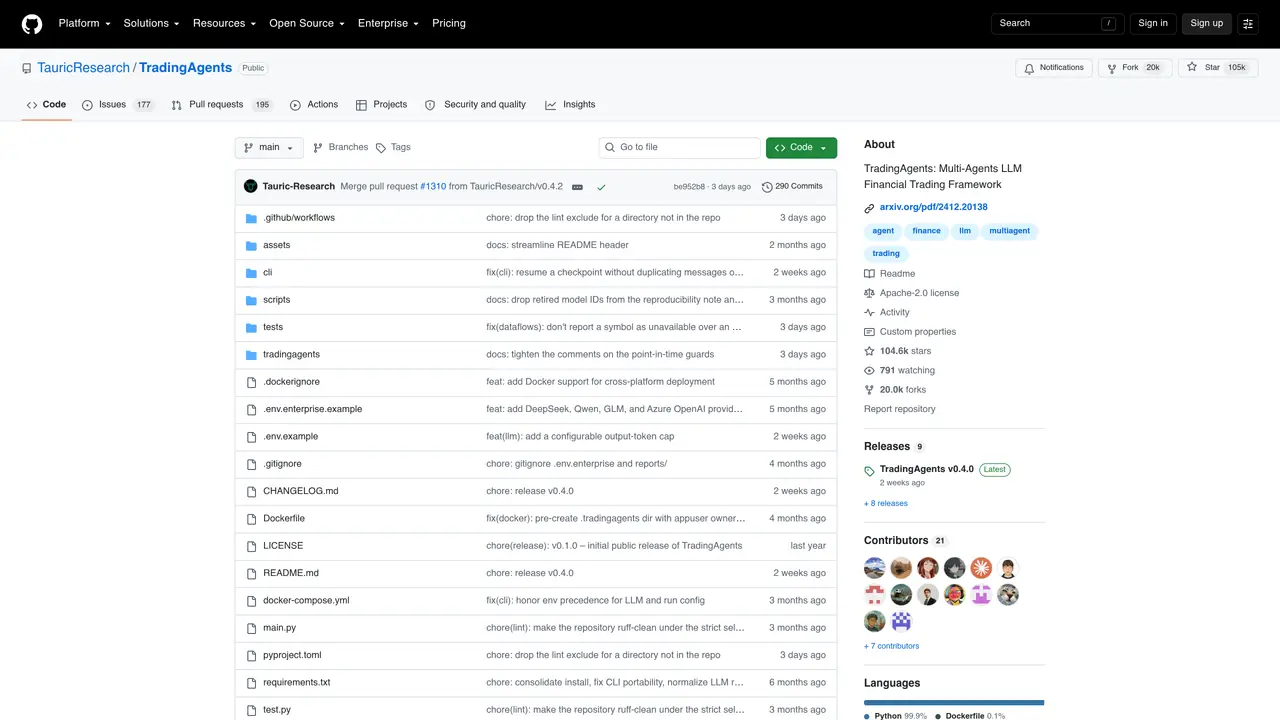
TradingAgents is an open-source multi-agent AI framework designed to simulate a hedge fund by coordinating specialized LLM-powered agents for financial trading. The system divides responsibilities across agents such as fundamental analysts, sentiment experts, technical analysts, traders, and risk managers, each contributing to a collaborative decision-making process. Agents interact through structured communication and debates, producing explainable trading signals and strategies rather than isolated model outputs. The framework supports multiple LLM providers, including OpenAI, Anthropic, Mistral, Groq, and Bedrock, allowing users to select models based on performance or cost considerations. It includes features like backtesting, persistent decision logs, checkpoint resume, and a CLI for streamlined execution. TradingAgents is aimed at researchers, quant developers, AI engineers, and advanced traders seeking to explore multi-agent systems, test trading strategies, or build intelligent financial decision-making frameworks. By modeling trading as a collaborative process, the tool demonstrates how AI can enhance financial reasoning, strategy generation, and risk management through structured interaction and role specialization.
GitHub, Inc.
San Francisco, California, US · Founded 2008
- Founders
- Tom Preston-Werner, Chris Wanstrath, PJ Hyett, Scott Chacon
- Founded
- 2008
- Headquarters
- San Francisco, California, US
- Legal status
- Subsidiary of Microsoft (NASDAQ: MSFT)
Key features
- Simulate a full AI hedge fund with multiple specialized agents
- Combine fundamental, sentiment, and technical analysis in one system
- Run collaborative decision-making workflows with agent discussions
- Evaluate strategies with backtesting and simulation tools
- Build custom trading pipelines using modular open-source components
- Leverage LLM-powered reasoning for financial data analysis
- Enable structured communication and debates between agents
- Support for customizing agent roles and workflows
- Open-source flexibility for research or production experiments
- Modular architecture for easy extension and deployment
Use cases
- Research multi-agent AI systems for financial decision-making
- Test and optimize trading strategies using AI-driven analysis
- Build autonomous trading agents with structured workflows
Pros
- Open-source framework enabling full customization and transparency
- Specialized LLM agents for distinct trading roles (research, sentiment, technical, risk)
- Structured agent communication and debate for explainable trading decisions
- Supports multiple LLM providers (OpenAI, Anthropic, Mistral, Groq, Bedrock, etc.)
- Includes backtesting, persistent decision logs, and checkpoint resume capabilities
Cons
- Requires technical expertise to set up and configure
- Dependent on external data providers and LLM APIs, which may introduce latency or costs
- Complexity may be overwhelming for users unfamiliar with multi-agent systems
TradingAgents videos
Frequently asked questions about TradingAgents
What is TradingAgents?
TradingAgents is an open-source multi-agent AI framework that simulates a hedge fund by coordinating specialized LLM-powered agents for market analysis, strategy development, and trading execution. It divides responsibilities across agents such as researchers, sentiment analysts, technical analysts, traders, and risk managers.
Who is TradingAgents designed for?
The framework is designed for researchers, quant developers, AI engineers, fintech builders, and advanced traders who want to explore multi-agent AI systems, test trading strategies, or build intelligent financial decision-making frameworks.
What LLM providers does TradingAgents support?
TradingAgents supports multiple LLM providers, including OpenAI, Anthropic, Mistral, Groq, Bedrock, NVIDIA, Kimi, and any OpenAI-compatible endpoint, with a current-generation model catalog.
Does TradingAgents include backtesting capabilities?
Yes, the framework includes backtesting features with date fidelity and persistent decision logs to evaluate trading strategies and track agent interactions.
How do agents communicate in TradingAgents?
Agents interact through structured communication and debates, enabling collaborative evaluation of market conditions and the generation of explainable trading decisions.
How can I get started with TradingAgents?
Users can install TradingAgents via the provided CLI, configure the environment using environment variables, and run the framework using supported LLM providers. Documentation and demo examples are available on the GitHub repository.