
OpenAI builds and deploys advanced AI models like GPT-4o for autonomous agents and workflows.

Vapi for FaceTime
0Popularity
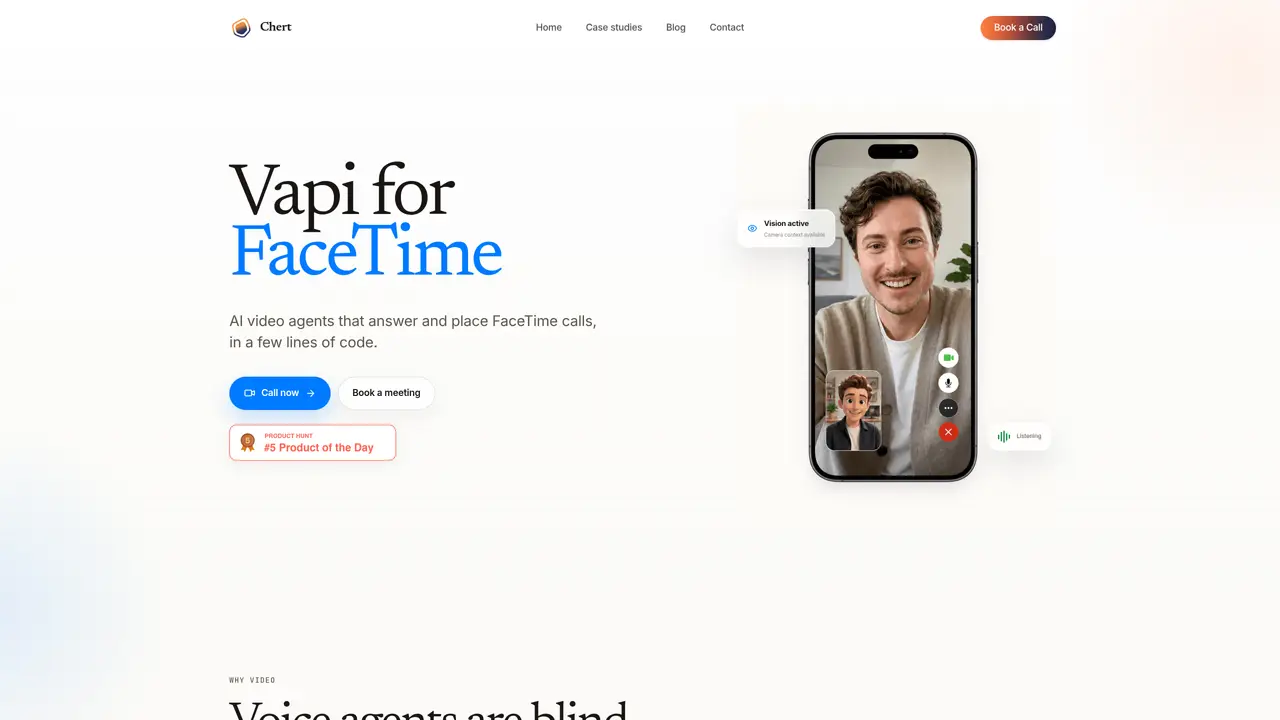
About Vapi for FaceTime
Vapi for FaceTime enables AI agents to handle FaceTime calls by processing visual context from the caller’s camera. The tool is designed for scenarios where seeing the caller’s environment or objects is essential to solving a problem. It allows users to configure an agent with specific instructions, voice, avatar, and framing before deployment. The system operates through a controlled private preview, requiring provisioned FaceTime lines and explicit authorization for live calls. A browser-based preview is available for testing agent behavior, including prompt responses, voice, microphone handling, and avatar rendering, without placing actual calls. The tool is positioned for use cases such as remote support, field service, telehealth intake, guided onboarding, visual inspections, and customer success workflows.
Key features
- Camera context integration for visual problem-solving
- Agent configuration (instructions, voice, avatar, framing)
- Browser-based preview for testing
- Provisioned FaceTime line assignment
- Real-time model selection
- Managed line control plane
- Prompt and behavior customization
- Test workflows for inbound and outbound calls
Use cases
- Remote support where visual context is critical
- Field service assistance with equipment inspection
- Telehealth intake with visual patient context
Pros
- Processes visual context from caller’s camera
- Configurable agent instructions, voice, and avatar
- Browser preview for testing without live calls
- Supports bounded inbound and outbound test workflows
- Designed for scenarios requiring visual problem-solving
Cons
- Not generally available; limited to controlled private preview
- Live execution requires provisioned FaceTime lines and explicit authorization
- Accepting mode for inbound calls not enabled by default
- FaceTime API not yet generally available
Frequently asked questions about Vapi for FaceTime
What is Vapi for FaceTime?
Vapi for FaceTime enables AI agents to answer and place FaceTime calls, using the caller’s camera context to understand visual information. It is designed for scenarios where seeing the caller’s environment or objects is essential to solving a problem.
Who should use Vapi for FaceTime?
The tool is positioned for use cases such as remote support, field service, telehealth intake, guided onboarding, visual inspections, and customer success workflows where visual context is critical.
Can I test an agent without placing a FaceTime call?
Yes, a browser-based preview is available to test agent behavior, including prompt responses, voice, microphone handling, and avatar rendering, without placing actual calls.
Does Vapi for FaceTime support inbound and outbound calls?
The control plane supports bounded inbound and outbound test workflows, while live execution requires provisioned FaceTime lines and explicit authorization.
What can I configure in Vapi for FaceTime?
Users can configure assistant instructions, realtime model, voice, avatar, framing, publishing state, and managed line assignment before deployment.
Is the FaceTime API generally available?
No, Chert is onboarding the FaceTime product through a controlled private preview while production media and line readiness are validated.