
Generate captions, optimize content, and enhance with custom images for maximum engagement.
46M visits/mo-10%#3 Image & Design

Processes live or recorded video and audio to give AI agents real-time multimodal understanding and actionable context.
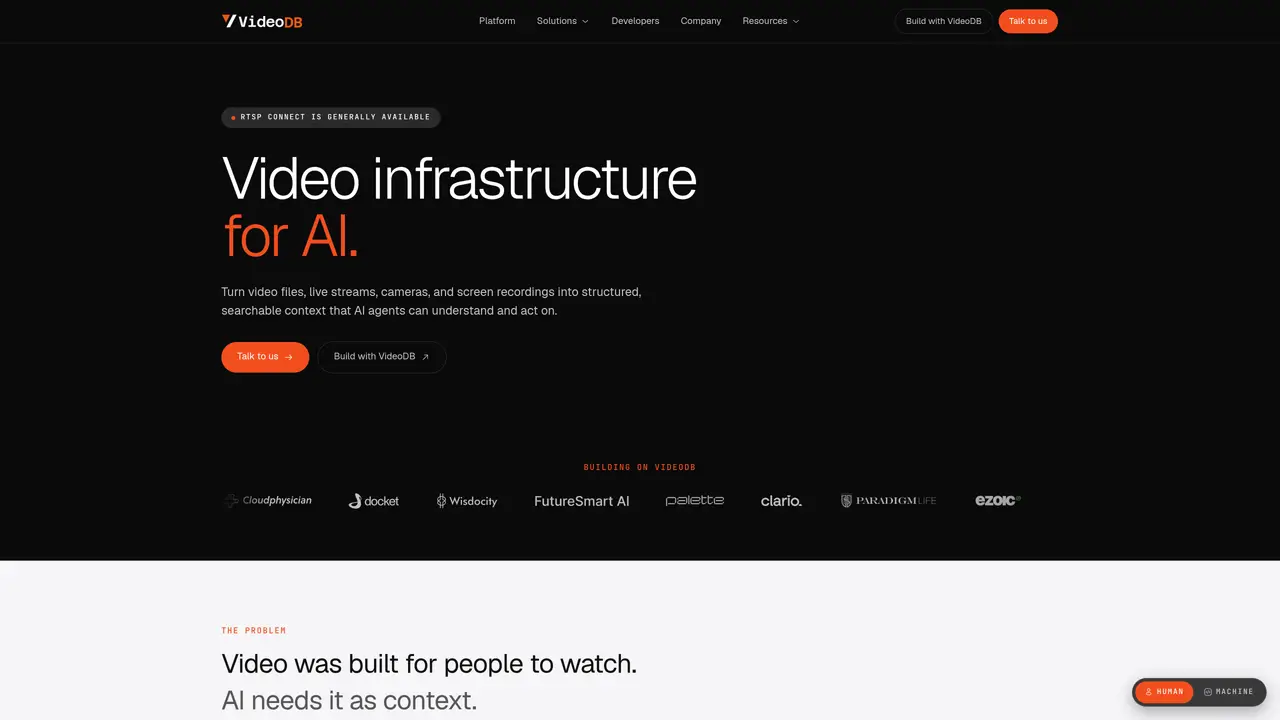
VideoDB acts as a perception layer for AI agents, enabling them to process and understand video and audio inputs. It ingests both live and recorded media, automatically transcribing speech and extracting visual context to build multimodal vector indexes. The tool streams low-latency context to AI agents, allowing them to semantically search media, recall specific moments, trigger alerts, and perform programmatic edits or actions. Developers integrate VideoDB into agentic workflows such as meeting copilots, screen-aware pair programming assistants, monitoring systems, and media automation pipelines. By offloading heavy media processing tasks, VideoDB provides real-time multimodal understanding while offering SDKs and APIs for seamless integration with any LLM or large vision model. It also prioritizes enterprise-grade security and scalability for production environments.
VideoDB turns video files, live streams, cameras, and screen recordings into structured, searchable context that AI agents can understand and act on. It provides real-time multimodal understanding by ingesting media, transcribing speech, extracting visual context, and building persistent vector indexes.
VideoDB is designed for developers and organizations building AI agents that need to process, understand, and act on video and audio inputs. It suits teams working with meeting copilots, screen-aware assistants, monitoring systems, media automation, and training data pipelines.
VideoDB connects to any large language model or vision model through its SDKs and APIs. It offloads heavy media processing tasks, providing real-time multimodal context to agents while allowing them to trigger actions, search media, or retrieve specific moments.
VideoDB supports ingestion of video files, live streams, RTSP cameras, screen recordings, and other continuous footage. It can process both archived and live media for applications requiring real-time or retrospective understanding.
Yes, VideoDB is built for production environments and includes enterprise-grade security and scalability. It supports deployment across cloud, VPC, and edge environments, with features like persistent memory, custom indexes, and low-latency retrieval.
Teams can start by installing the SDK or using the API to connect video sources and integrate with their preferred AI models. VideoDB provides documentation, guides, and examples to help developers build and deploy agentic workflows quickly.
videodb.io · third-party estimates from Similarweb
Last 4 months · grows by one month every month
Share of visits by channel
Share of visits · estimated visits
Automation & Agents · Sep 2026
Traffic figures are third-party estimates, good for scale and trends; they can differ from a company's own numbers. Updated monthly.
We use essential cookies to run aitoolnavio™, and optional cookies to analyze traffic and measure our marketing. You choose what we use — optional cookies stay off unless you turn them on. See our Privacy Policy.
One short email a week: fresh tools worth trying, honest takes and the updates that actually matter. No spam, unsubscribe any time.
Generate captions, optimize content, and enhance with custom images for maximum engagement.
Build conversational forms, capture rich responses, and automate follow-ups with AI-powered surveys and workflows.
Automate code, research, and documents using agents.
AI-powered IDE for autonomous coding tasks and agentic development workflows
Source, match, and manage talent with predictive analytics for effortless recruiting.
Automate workflow, optimize operations, and detect potential issues with this efficient AI-driven solution.
Transforms thoughts into actions, enhancing productivity and efficiency.
AI Recruitment engine to hire top global talent
All-in-one team productivity platform combining chat, docs, video meetings, workflows, and AI tools in one place.
Personal assistant that coordinates tasks across apps and devices via text or call
AI automation and agent-building platform with 3,000+ app integrations
AI job search copilot that matches roles to skills, optimizes resumes for ATS, generates cover letters, and autofills applications with real-time insights.
Matched on what this tool does — grouped by the job you would be replacing.
matches Ingests live or recorded video and audio · Streams low-latency context to AI agents · Supports real-time multimodal understanding
Real-time voice, video, and AI infrastructure platform with WebRTC SDKs and Pipecat for developers building conversational agents.
API and SDK platform for embedding AI voice agents, real-time audio/video calls, and interactive live streaming into apps.
API to programmatically join, record, stream, and transcribe Zoom, Google Meet, and Microsoft Teams calls with real-time transcripts and per-participant speaker labels.
Adds conversational voice and video AI to applications
matches Automatic transcription and visual context extraction · Builds multimodal vector indexes for semantic search · Multimodal video indexing (visual, audio, text)
matches Builds multimodal vector indexes for semantic search · Enables programmatic media editing and actions · Multimodal extraction (speech transcription, speaker diarization, visual descriptions, sound analysis)
An AI video intelligence platform for indexing, searching, summarizing, and querying video libraries via web app and APIs.
Search videos, generate results, and optimize searches using advanced machine learning algorithms.
AI-powered video search that locates exact moments using natural language, images, or examples across large video libraries.
AI-powered platform that transforms video, audio, and image libraries into searchable, timestamped metadata and embeddings for precise discovery and analysis.
Streamlines AI data retrieval for efficient processing.
API platform that converts video and audio into structured, LLM-ready data for developers building video-aware AI applications.
A fully managed AI retrieval and RAG infrastructure for fast, accurate multimodal search across text, PDFs, images, and structured data.
Open-source multimodal RAG framework that processes PDFs, Office files, images, tables, equations, and charts into queryable knowledge systems.