
OpenAI builds and deploys advanced AI models like GPT-4o for autonomous agents and workflows.
WAR
₹499 /moStarting price
0Popularity
About WAR
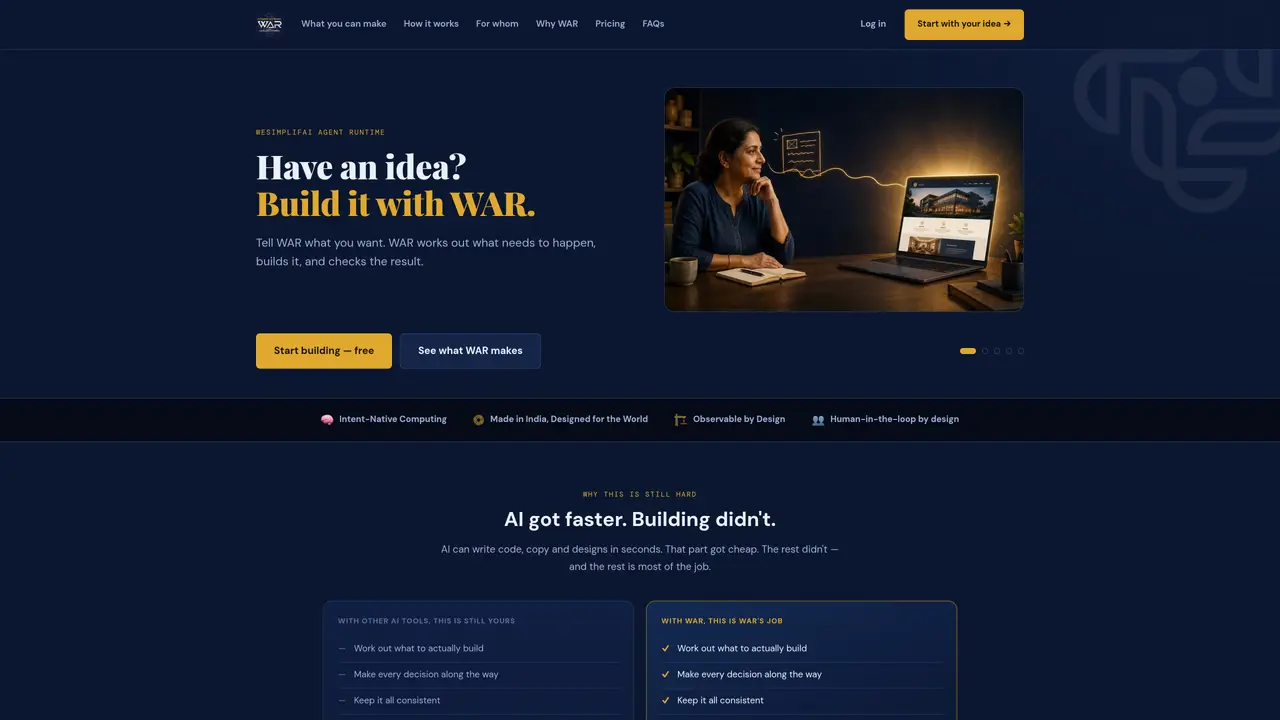
WAR is an agent runtime that transforms user intent into functional outputs such as websites, documents, and software components. It accepts plain descriptions of goals and automatically determines the necessary steps, decisions, and integrations to produce a usable result. The tool is designed to handle the entire process from idea to outcome, including planning, execution, consistency checks, and validation. It supports a range of outputs including business websites, landing pages, proposals, pitch decks, resumes, and project management boards. WAR operates with human oversight built in, allowing users to review and approve decisions at each stage. It emphasizes observable, explainable builds and avoids the need for manual prompt engineering or re-prompting cycles. The system is marketed as intent-native, meaning it prioritizes understanding and executing user intent over generating language outputs.
Key features
- Intent clarification sessions
- Real-time build execution with progress tracking
- Multi-provider AI integration
- Version history and rollback
- Team collaboration features
- Custom domain support
- Audit logs and compliance tools
- Explainable build decisions
Use cases
- Building a business website from a high-level description
- Drafting a client proposal with scope, timeline, and pricing
- Creating a pitch deck for investor presentations
Pros
- Handles entire workflow from idea to working artifact
- No manual prompt engineering required
- Produces real, functional outputs rather than mockups
- Human-in-the-loop oversight for decision review
- Observable and explainable build process
Cons
- Limited to predefined project types
- No free tier beyond basic exploration
- Requires active project management for complex outputs
- Outputs may still need manual refinement for edge cases
Frequently asked questions about WAR
What is WAR and what does it do?
WAR is an agent runtime that transforms user intent into functional outputs such as websites, documents, and software components. It accepts plain descriptions of goals and automatically determines the necessary steps, decisions, and integrations to produce a usable result.
Who is WAR designed for?
WAR is designed for individuals and teams who need to turn ideas into tangible outputs without managing the technical or decision-making process themselves. It suits users who want to focus on their goals rather than prompt engineering or manual execution.
How does WAR work?
WAR works by interpreting user intent, assembling the required resources, and executing the necessary steps to produce a result. It handles planning, execution, consistency checks, and validation, with human oversight built in for review and approval at each stage.
What types of outputs can WAR generate?
WAR can generate a variety of outputs, including business websites, landing pages, proposals, pitch decks, resumes, cover letters, executive summaries, company research, test cases, pricing strategies, project management boards, and flashcard decks.
Does WAR require prompt engineering or re-prompting?
No, WAR is designed to be intent-native, meaning it prioritizes understanding and executing user intent without requiring manual prompt engineering or re-prompting cycles.
Can WAR be used for existing projects, such as auditing a website?
Yes, WAR can audit existing websites by analyzing them for trust, friction, and unanswered objections that may impact conversion. It provides actionable insights to improve the page.