
OpenAI builds and deploys advanced AI models like GPT-4o for autonomous agents and workflows.

e-volv
$29/moStarting price
0Popularity
About e-volv
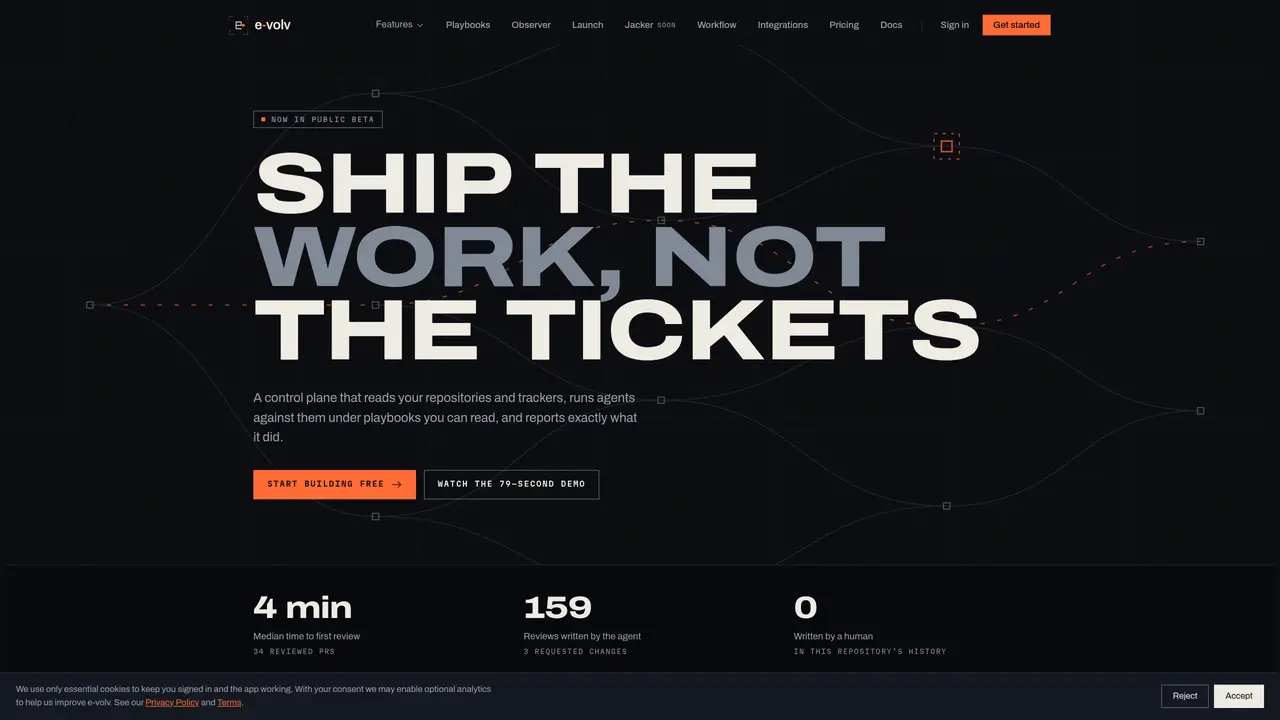
e-volv provides a control plane that reads repositories and issue trackers, executes AI agents under configurable playbooks, and reports each step’s outcome. Workflows are built on a visual canvas with seventeen node types, including triggers, multi-agent sessions, CI dispatch, and ticket actions. Published workflows can run on events from seven providers (GitHub, GitLab, Bitbucket, Azure DevOps, Jira, Linear, ClickUp) or on schedules and slash commands. Each run records duration, token usage, and cost per step, with outputs addressable to downstream nodes. The platform supports custom agents via MCP servers, sandboxed execution, and token budgeting with alerts. Observability features include audit logs, execution dashboards, and feature flags. Pre-built playbooks cover code review, CI triage, security scanning, and documentation updates.
Key features
- Visual workflow canvas with seventeen node types
- Multi-agent sessions using MCP servers
- Token budgeting with per-workflow limits and alerts
- Audit logs for every trigger, decision, and action
- Feature flags with project-level controls
- Seven supported git and ticket providers
- Pre-built playbooks for code review, CI, and security
- Sandboxed agent execution environment
Use cases
- Automating pull request reviews and triage
- Enforcing code quality and security checks
- Generating release documentation from merged changes
Pros
- Visual workflow builder with seventeen node types
- Multi-agent sessions with MCP server support
- Token budgeting and cost tracking per step
- Supports seven git and ticket providers
- Pre-built playbooks for common SDLC tasks
Cons
- No free tier beyond Starter plan limits
- Requires published workflows to trigger actions
- Limited AI runs per plan tier
Frequently asked questions about e-volv
What is e-volv and what does it do?
e-volv is an AI-native SDLC automation platform that acts as a control plane for engineering teams. It reads repositories and issue trackers, executes AI agents under configurable playbooks, and reports each step’s outcome. The platform automates workflows across the software development lifecycle, including code review, CI triage, and documentation updates.
Who is e-volv designed for?
e-volv is designed for engineering teams looking to automate repetitive tasks in their software development lifecycle. It suits teams that want to shift focus from managing tickets to delivering work, while maintaining visibility and control over automated processes.
How does e-volv integrate with existing tools?
e-volv integrates with popular development and collaboration tools such as GitHub, GitLab, Bitbucket, Azure DevOps, Jira, Linear, and ClickUp. It also supports AI model providers like OpenAI, Anthropic, Azure OpenAI, and AWS Bedrock, as well as other services like Figma, Datadog, Notion, and Confluence.
Can I customize the AI agents used in e-volv?
Yes, e-volv supports custom agents via MCP servers, allowing teams to define their own tools and sandboxed execution environments. This enables safe and tailored automation for specific workflows and use cases.
What observability features does e-volv provide?
e-volv offers detailed observability features, including audit logs, execution dashboards, and feature flags. Each workflow run records duration, token usage, and cost per step, with outputs addressable to downstream nodes for transparency and debugging.
How do I get started with e-volv?
To get started, you can build workflows on a visual canvas with seventeen node types, including triggers, agents, and CI dispatch. The platform allows you to draft workflows without immediate impact, and you can publish them once configured. A 79-second demo is available to see the product in action.