
OpenAI builds and deploys advanced AI models like GPT-4o for autonomous agents and workflows.

Revolte
$0.01Starting price
3.6KMonthly visits
9Popularity
About Revolte
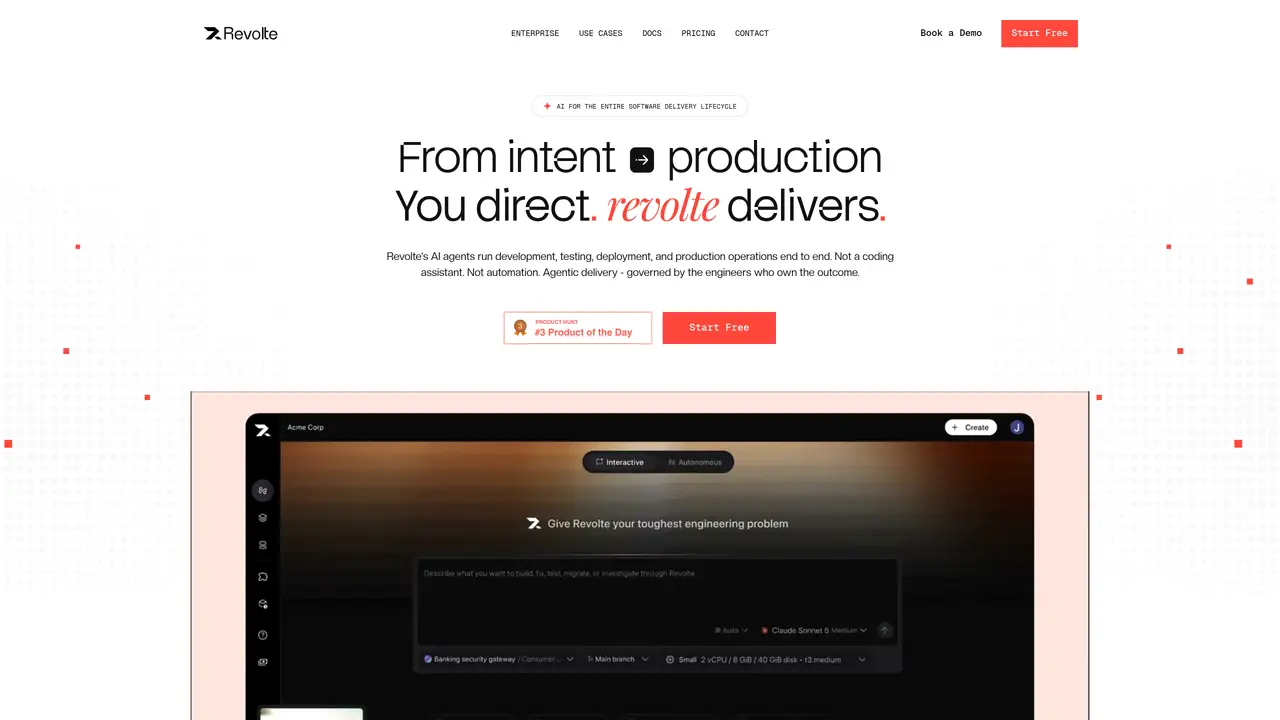
Revolte is an AI-powered software delivery lifecycle (SDLC) platform designed to automate the entire process from intent to production using autonomous AI agents. Unlike traditional coding assistants or basic automation tools, Revolte focuses on agentic delivery, where AI agents manage development, testing, deployment, and runtime operations while keeping engineers in control. The platform integrates seamlessly with common development tools such as Jira, Git, and Figma, and provides platform-as-code YAML, a CLI, and delivery intelligence dashboards for monitoring and governance. Teams use Revolte to accelerate release cycles, automate repetitive delivery tasks, and improve system observability and reliability without sacrificing auditability or control. Engineers define requirements and approve outcomes, while Revolte executes the tasks with full visibility and traceability at every step. The platform is particularly suited for engineering teams shipping production software who need both speed and compliance in their delivery processes. Revolte’s governance model ensures that every agent action is logged and auditable, with human review gates for high-risk decisions, making it a reliable choice for regulated environments.
Key features
- Autonomous AI agents for planning, code generation, testing, deployment, and operations
- Integration with Jira, Git, and Figma
- Platform-as-code YAML for defining delivery workflows
- CLI for interacting with the platform
- Delivery intelligence dashboards for monitoring and observability
- Engineer-in-the-loop review and governance controls
- Automation of repetitive delivery tasks
- Acceleration of release cycles
- Improved system reliability and observability
Use cases
- Automating CI/CD pipelines to reduce manual intervention
- Accelerating feature delivery while maintaining quality and compliance
- Freeing engineering teams to focus on high-value product decisions
Pros
- Autonomous AI agents handle end-to-end software delivery tasks, reducing manual effort.
- Maintains engineer oversight and governance with audit trails for every action.
- Integrates with existing development tools like Jira, Git, and Figma.
- Provides real-time observability and delivery intelligence for monitoring.
- Supports compliance and traceability requirements with detailed logging.
Cons
- May require initial setup and configuration to align with existing workflows.
- Dependence on AI agents introduces potential risks if governance is not properly enforced.
Frequently asked questions about Revolte
What does Revolte do?
Revolte automates the entire software delivery lifecycle using AI agents, handling planning, code generation, testing, deployment, and operations while maintaining engineer oversight for review and governance.
Who is Revolte for?
Revolte is designed for engineering teams that ship production software and require both speed and compliance in their delivery processes, including those in regulated environments.
How does Revolte integrate with existing tools?
Revolte integrates with common development tools such as Jira, Git, and Figma, and provides platform-as-code YAML, a CLI, and delivery intelligence dashboards for monitoring and control.
What kind of governance does Revolte provide?
Revolte maintains a governance model where every agent action is logged and auditable, with human review gates for decisions above a risk threshold, ensuring traceability and compliance.
Can Revolte be used for legacy system modernization?
Yes, Revolte supports application modernization by incrementally modernizing legacy systems as part of its end-to-end delivery lifecycle automation.
How do I get started with Revolte?
You can start by booking a demo or signing up for a free trial on the Revolte website to see the platform in action and explore its features.
Revolte Website Engagement
Last Update: 9 days ago
Total Monthly Visits
0
Bounce Rate
0%
Visit Duration (avg)
0.00s
Pages Per Visit
0
Country Rank
0
India
Global Rank
0
Monthly Traffic
Traffic Sources
Traffic Share By Country
- India60.4%
- United States20.7%
- Pakistan13.3%
- United Kingdom5.6%