
Generate captions, optimize content, and enhance with custom images for maximum engagement.
46M visits/mo-10%#3 Image & Design

Automates software development workflows by handling code merges, reviews, and analytics to speed up development cycles.
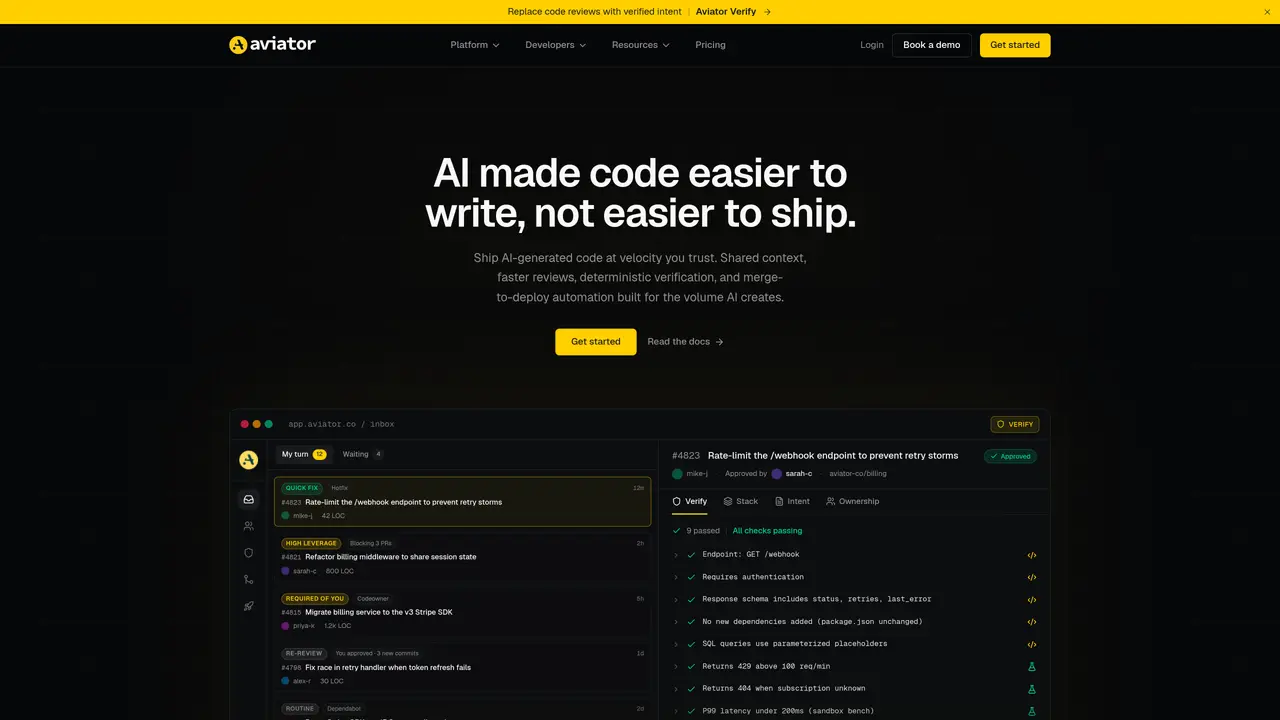
Aviator is a developer productivity platform designed to streamline software development workflows. It automates repetitive tasks, manages code merges, and facilitates efficient code reviews while providing actionable analytics. Built by ex-Google engineers, the platform supports both monorepo and microservice architectures and integrates seamlessly with existing toolchains. Engineering teams use Aviator to eliminate workflow bottlenecks, improve code quality, and accelerate development cycles. By reducing process overhead, it allows developers to focus more on creative problem-solving and less on manual coordination. The tool is tailored for engineering teams seeking to optimize their development processes without overhauling their current systems.
Aviator streamlines software development workflows by automating code reviews, verifying intent, and managing merge-to-deploy processes, particularly for AI-generated code. It helps engineering teams ship faster while maintaining code quality and reliability.
Aviator is tailored for engineering teams, from individual developers to large enterprises, especially those using monorepos or microservices. It suits teams looking to optimize development velocity without overhauling their existing systems.
Aviator is CI/CD-agnostic and works with your existing toolchain, including GitHub, Slack, and other development platforms. It supports on-prem deployment and meets compliance standards like SOC 2 Type II.
Aviator offers free tools for individual developers and full platform access for teams shipping at volume. Pricing scales with team size and usage, with options for enterprise plans and on-prem deployments.
Aviator replaces manual code reviews with verified intent and deterministic verification, ensuring AI-written code meets predefined acceptance criteria before merging. It also auto-groups PRs and routes them to the right reviewers.
Yes, Aviator is built to support monorepos, including stacked PRs and parallel merge queues that target affected components. It handles high volumes of PRs efficiently while keeping the main branch stable.
aviator.co · third-party estimates from Similarweb
Last 4 months · grows by one month every month
Share of visits by channel
No measurable traffic from Paid Referrals or Mail.
Share of visits · estimated visits
Other countries: 53.2%
Automation & Agents · Sep 2026
Traffic figures are third-party estimates, good for scale and trends; they can differ from a company's own numbers. Updated monthly.
We use essential cookies to run aitoolnavio™, and optional cookies to analyze traffic and measure our marketing. You choose what we use — optional cookies stay off unless you turn them on. See our Privacy Policy.
One short email a week: fresh tools worth trying, honest takes and the updates that actually matter. No spam, unsubscribe any time.
Generate captions, optimize content, and enhance with custom images for maximum engagement.
Build conversational forms, capture rich responses, and automate follow-ups with AI-powered surveys and workflows.
Automate code, research, and documents using agents.
AI-powered IDE for autonomous coding tasks and agentic development workflows
Source, match, and manage talent with predictive analytics for effortless recruiting.
Automate workflow, optimize operations, and detect potential issues with this efficient AI-driven solution.
Transforms thoughts into actions, enhancing productivity and efficiency.
AI Recruitment engine to hire top global talent
All-in-one team productivity platform combining chat, docs, video meetings, workflows, and AI tools in one place.
Personal assistant that coordinates tasks across apps and devices via text or call
AI automation and agent-building platform with 3,000+ app integrations
AI job search copilot that matches roles to skills, optimizes resumes for ATS, generates cover letters, and autofills applications with real-time insights.
Matched on what this tool does — grouped by the job you would be replacing.
matches Facilitates structured code reviews · Provides actionable analytics and insights · Reduces workflow bottlenecks
Automates code reviews and suggests optimizations via CLI or GitHub app to speed up development cycles.
AI-powered code review tool that scans pull requests to detect bugs and breaking changes before deployment.
Create tailored unit tests, configure and run tests with one click, seamlessly integrate with existing development environment.
Automates code verification with real-time feedback and seamless integration.
matches Automates repetitive software development tasks · Manages code merges efficiently · Supports monorepo and microservice architectures
matches Code generation, editing, and visualization
AI-powered IDE that converts natural language prompts into structured specs, designs, and tested code for developers.
Automates software development tasks like coding, debugging, and project management to boost productivity and accelerate development cycles.
AI-driven SDLC platform that automates software delivery from planning to production using autonomous agents while keeping engineers in the loop for review and governance.
Open-source system that turns Claude Code into a multi-agent development platform with reusable skills and structured workflows.
Transform ideas into fully functional applications with Lovable, a groundbreaking AI tool.
Open-source AI coding assistant that generates, debugs, and manages code directly in VS Code and JetBrains to save time and reduce errors.
AI coding assistant that writes, debugs, refactors, and automates code tasks using natural language in terminals, IDEs, or web interfaces.
AI coding assistant that generates and explains code from natural language descriptions to speed up development and reduce errors.