AI-powered website builder that generates a professional site in under a minute and includes tools for content, SEO, and analytics.
52M visits/mo+0.7%#4 Coding & Development

AI-powered IDE that converts natural language prompts into structured specs, designs, and tested code for developers.
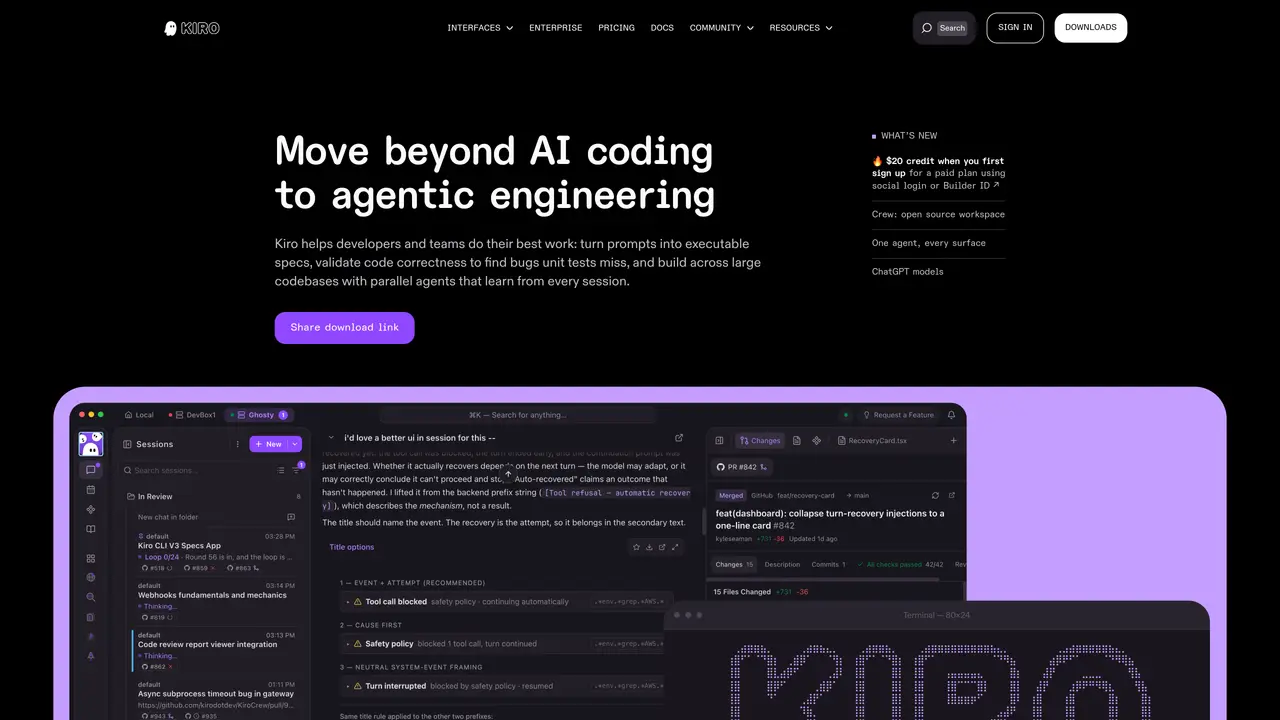
Kiro AI is an AI-driven integrated development environment designed to transform raw ideas into organized software by generating clear plans, designs, and tested code. It streamlines workflows by automating repetitive tasks and interpreting project goals, making it particularly useful for developers working with complex codebases. The tool integrates with local development environments, enabling seamless collaboration between AI-generated outputs and manual coding efforts. By delivering spec-driven workflows, Kiro AI helps teams maintain consistency and clarity throughout the development process. It is tailored for programmers, AI engineers, QA testers, and DevOps professionals who need to accelerate development cycles while ensuring production-readiness. The platform also supports entrepreneurs and developers looking to quickly prototype or expand existing projects with minimal manual intervention.
Kiro AI moves beyond basic AI coding by enabling agentic engineering, where prompts are transformed into executable specifications, architectural designs, and sequenced tasks. It uses parallel agents to implement these tasks while validating code correctness through property-based testing to catch edge cases missed by unit tests.
Kiro AI is designed for developers, AI engineers, QA testers, DevOps professionals, entrepreneurs, and even non-coders looking to prototype or expand projects. It is particularly useful for those working with large codebases or requiring spec-driven workflows for maintainable code.
Kiro AI checks requirements for contradictions and gaps using automated reasoning before implementation. It then validates behavior with property-based tests, which assert rules across all inputs rather than just a few examples, ensuring robustness beyond traditional unit tests.
Yes, Kiro AI integrates with local development environments, supports Open VSX extensions, themes, and VS Code settings in its IDE, and works with over 500 popular CLIs. It also supports standards like Agent Client Protocol (ACP), AGENTS.md, Skills.md, and MCP for broader tool compatibility.
Kiro AI allows users to choose models like Anthropic Claude, open-weight models, or use Auto mode, which selects the best model based on task complexity, balancing quality, latency, and cost. This flexibility ensures optimal performance for different types of development tasks.
Kiro AI operates on a credit-based pricing model with no daily or weekly rate limits and pre-paid overages, enabling continuous coding without unexpected billing interruptions. The model is designed to align with usage patterns rather than fixed time-based constraints.
kiro.dev · third-party estimates from Similarweb
Last 4 months · grows by one month every month
Share of visits · estimated visits
Other countries: 46.4%
How people reach this site from other AI tools
22K a month · 0.7% of all visits
Coding & Development · Sep 2026
Traffic figures are third-party estimates, good for scale and trends; they can differ from a company's own numbers. Updated monthly.
We use essential cookies to run aitoolnavio™, and optional cookies to analyze traffic and measure our marketing. You choose what we use — optional cookies stay off unless you turn them on. See our Privacy Policy.
One short email a week: fresh tools worth trying, honest takes and the updates that actually matter. No spam, unsubscribe any time.
AI-powered website builder that generates a professional site in under a minute and includes tools for content, SEO, and analytics.
AI-powered coding platform that uses agents to plan, write, and test software with real-time feedback and verifiable artifacts.
Automate code, research, and documents using agents.
AI-powered code assistant that generates, reviews, optimizes, and debugs code with natural language prompts and editor integrations.
AI assistant for safe, reliable productivity with code, collaboration, and integrations.
AI-powered IDE for autonomous coding tasks and agentic development workflows
Privacy-focused AI chatbot that generates uncensored text, code, images, and translations without storing conversations or requiring an account.
A free web-based AI chatbot and agent for writing, coding, research, and content creation with multilingual support.
Write & run code in 50+ languages, auto-complete with AI, and code faster with an intuitive interface.
An IDE that automates legacy-to-modern code migration using autonomous coding agents.
AI models that return typed decisions with calibrated confidence for software automation
Practice coding challenges, improve technical skills, get detailed explanations, compare performance with peers.
Matched on what this tool does — grouped by the job you would be replacing.
matches Converts natural language prompts into structured software specifications · Generates designs and tested code from project goals · Supports spec-driven workflows for consistency
Turns plain-English ideas into engineering-grade specs, scoped tasks, and production-ready prompts by analyzing codebases and generating tests.
Turn ideas into full-stack web apps fast with Capacity's AI development tool.
AI-powered product development platform that turns feature ideas into structured specs, tickets, and code-ready execution steps for software teams.
AI copilot that converts rough ideas into spec-driven UI designs and exports Figma files or React+Tailwind code.
matches Converts natural language prompts into structured software specifications · Generates designs and tested code from project goals · Automates repetitive development tasks
matches Automates test regeneration on file save · Automates repetitive development tasks
Open-source AI coding assistant that generates, debugs, and manages code directly in VS Code and JetBrains to save time and reduce errors.
AI coding assistant that writes, debugs, refactors, and automates code tasks using natural language in terminals, IDEs, or web interfaces.
AI coding assistant that autonomously fixes bugs, writes tests, and creates pull requests to streamline development workflows.
AI-powered tool that automatically generates API and unit tests by capturing real application data, reducing manual effort and catching bugs early.
AI testing platform that auto-generates unit, integration, and API tests from live traffic and codebase context for engineering teams.
Automate test case generation in 10 mins, customize test cases, and use an intuitive interface for easy testing.
Create tailored unit tests, configure and run tests with one click, seamlessly integrate with existing development environment.