
OpenAI builds and deploys advanced AI models like GPT-4o for autonomous agents and workflows.

Mowgli
$15Starting price
167Monthly visits
0Popularity
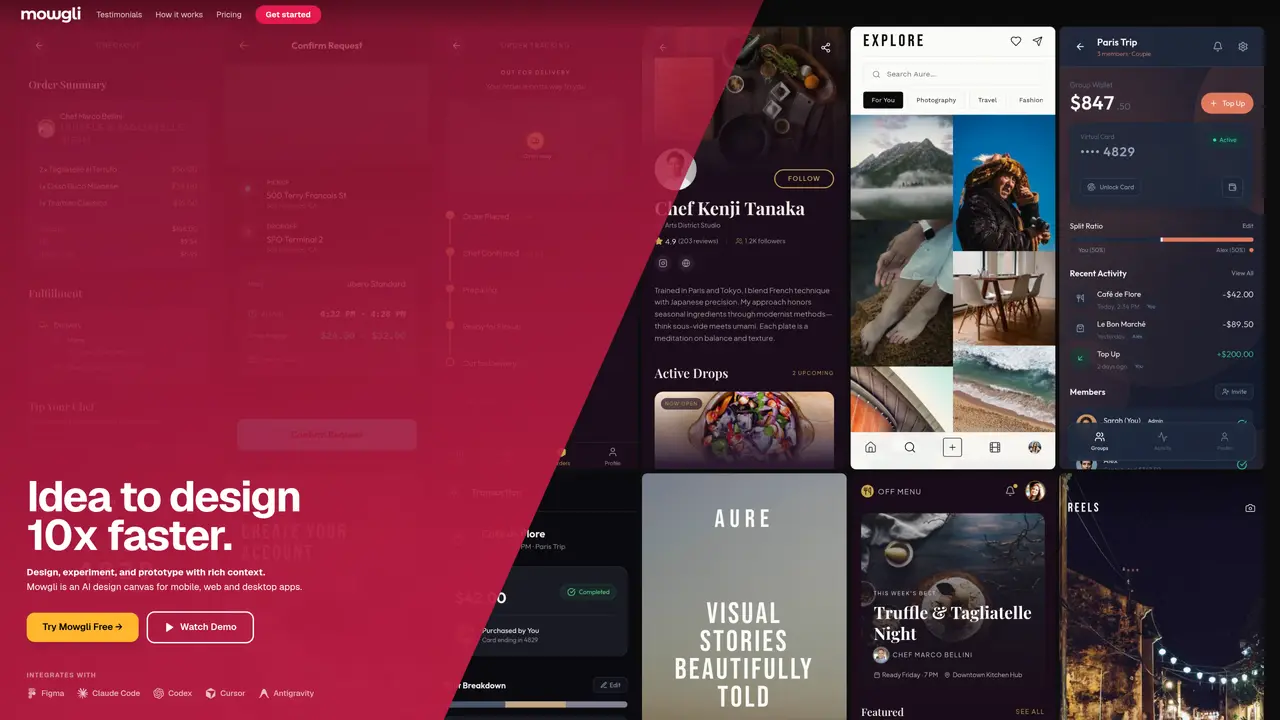
About Mowgli
Mowgli is an AI-powered design assistant that transforms early-stage product concepts into structured specifications and polished user interfaces. It begins with a guided questionnaire to capture requirements, then automatically generates user journeys, data models, and themed UI components. Designers, product managers, and founders can refine outputs using natural-language prompts, iterating quickly without manual mockups. The tool produces high-fidelity screens and exports them as Figma files, React+Tailwind code, or an optimized master prompt for further development. By bridging the gap between ideation and execution, Mowgli accelerates the design-to-development workflow while maintaining consistency and reducing iterative guesswork. It is positioned as a copilot for teams that need to move from back-of-napkin sketches to production-ready assets with minimal friction.
Key features
- Guided questionnaire to capture product requirements
- Auto-generation of user journeys and data models
- Themed UI component creation
- Natural-language editing for iterative refinement
- Figma file export
- React+Tailwind code export
- Master prompt export for development handoff
- High-fidelity screen generation
Use cases
- Turning rough product ideas into structured specs and UI designs
- Accelerating design-to-dev handoffs for founders and PMs
- Iterating on UI concepts using natural-language prompts
Pros
- Transforms early-stage product concepts into structured specifications and polished UI designs
- Supports real-time collaboration and sharing for team workflows
- Maintains deep product context through a spec-driven approach
- Enables rapid iteration with natural-language prompts and surgical tweaks
- Provides multiple export options, including Figma files, React+Tailwind code, and optimized prompts for coding agents
Cons
- May require initial setup time to import existing products or define requirements
- Dependence on AI-generated outputs may necessitate manual review for precision
- Limited to digital product design (mobile, web, desktop) and may not suit non-digital projects
Mowgli videos
Frequently asked questions about Mowgli
What is Mowgli and who is it designed for?
Mowgli is an AI-powered design tool that accelerates the transition from product ideas to high-fidelity designs. It is designed for designers, product managers, founders, and teams who need to prototype, iterate, and handoff digital products efficiently.
How does Mowgli work?
Users start by describing their idea through a guided questionnaire or import existing designs. Mowgli then generates user journeys, data models, and high-fidelity screens, which can be refined using natural-language prompts. The tool maintains a synchronized spec and supports real-time collaboration.
Can Mowgli integrate with other tools I use?
Yes, Mowgli integrates with Figma for design handoff and supports connections to coding agents like Claude Code, Codex, and Cursor for automated code generation. It also allows manual exports to Figma or React+Tailwind code.
What types of projects can Mowgli handle?
Mowgli is tailored for mobile, web, and desktop applications. It supports the entire design process, from ideation and prototyping to handoff, and includes features for exploring themes, flows, and states.
How do I get started with Mowgli?
Users can start from scratch by describing their product idea or import existing designs from Figma or codebases. Mowgli guides users through a scoping questionnaire to build a spec and generate designs.
Does Mowgli support team collaboration?
Yes, Mowgli includes built-in real-time collaboration features, allowing teams to work together on designs, share outputs, and maintain synchronized project context.
Mowgli Website Engagement
Last Update: 9 days ago
Total Monthly Visits
0
Bounce Rate
—
Visit Duration (avg)
0.00s
Pages Per Visit
0
Country Rank
—
Unknown
Global Rank
—