GitHub hosts HunyuanVideo, Tencent's open-source framework for large-scale video generation models, enabling AI-driven video creation.

APIDNA
FreeStarting price
882Monthly visits
0Popularity
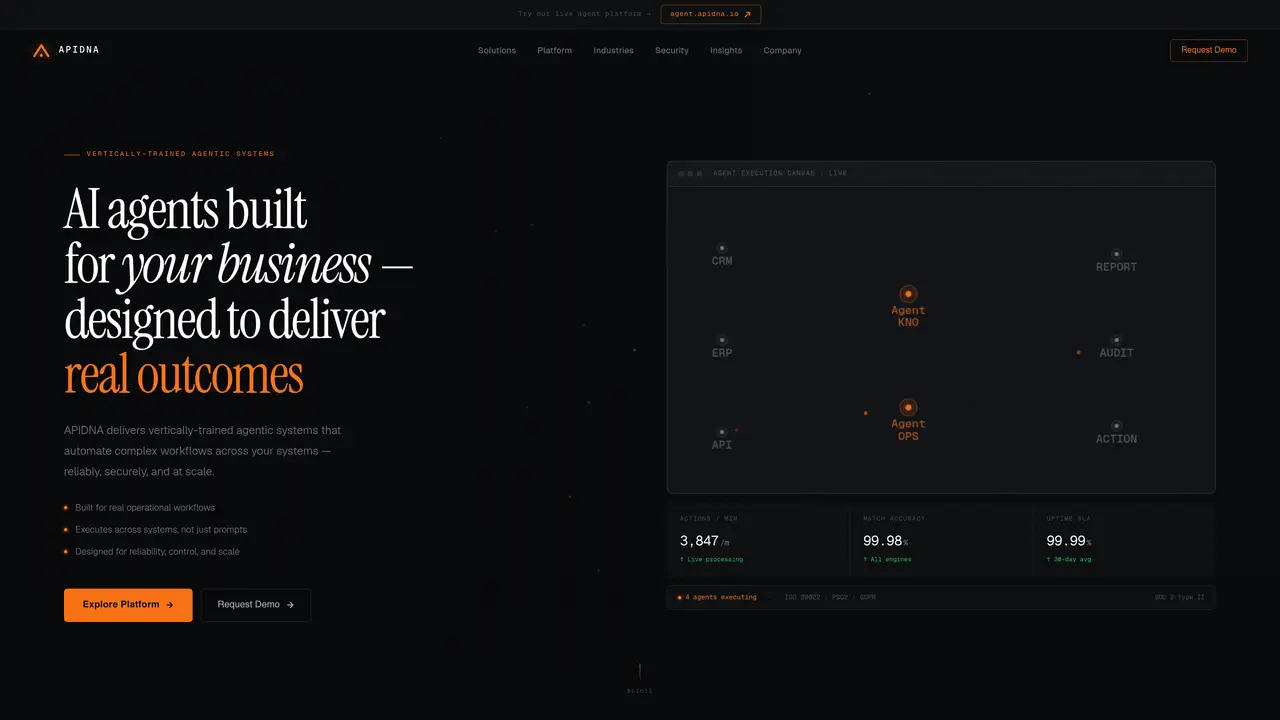
About APIDNA
APIDNA is a web-based AI platform designed for developers, systems integrators, and citizen developers who need to automate API integrations between software systems. It leverages autonomous AI agents to reduce manual integration work across the full lifecycle, from initial integration and mapping to testing and monitoring. Users can connect to service providers using single endpoints or Postman/OpenAPI collections, then map requests and responses with natural language instructions. The platform generates API client code modules to speed up implementation and runs end-to-end tests to validate request/response structures and mapping accuracy. Real-time monitoring and detailed logs provide observability and troubleshooting capabilities. APIDNA is particularly useful for teams looking to streamline API integrations without extensive manual coding or configuration.
Key features
- Agent-driven API integration mapping
- Natural language instructions for payload restructuring
- Automated API client code generation
- End-to-end testing and validation
- Real-time monitoring and logging
- Integration via single endpoints or Postman/OpenAPI collections
- Field renaming, merging, and splitting capabilities
- Freemium pricing with Professional and Enterprise tiers
Use cases
- Automating API integrations between SaaS applications
- Accelerating development with generated API client code
- Monitoring and troubleshooting API integrations in real time
Pros
- Vertically-trained AI agents tailored to specific workflows and industries for higher reliability
- Executes across multiple systems (APIs, ERPs, databases) without manual bridging or middleware
- Built-in monitoring, governance frameworks, and full audit trails for enterprise compliance
- Supports multi-step workflow automation and agent orchestration for complex operations
- Designed for real-world operational complexity with high match accuracy and uptime SLAs
Cons
- May require domain-specific training for optimal performance in custom workflows
- Limited flexibility for users seeking general-purpose AI solutions
- Enterprise-focused features may introduce complexity for smaller teams
- Dependent on existing system integrations for full cross-platform execution
Frequently asked questions about APIDNA
What does APIDNA do?
APIDNA builds and operates vertically-trained AI agents designed to automate complex workflows across enterprise systems, including APIs, databases, and legacy infrastructure. The platform focuses on reliability, governance, and real-world execution rather than generic AI demos.
Who is APIDNA suitable for?
APIDNA is designed for businesses and teams that need to automate operational workflows with high reliability and compliance, such as financial services, healthcare, or logistics. It suits organizations with complex system integrations and regulatory requirements.
How does APIDNA ensure reliability and security?
APIDNA includes built-in monitoring, governance frameworks, human-in-the-loop oversight, and full audit trails for every agent action. The platform is SOC 2 Type II compliant and designed to meet strict enterprise governance and security standards.
Can APIDNA integrate with existing systems and APIs?
Yes, APIDNA agents execute across APIs, ERPs, databases, and legacy infrastructure without requiring middleware or manual bridging. They can connect to service providers using single endpoints or Postman/OpenAPI collections.
What industries does APIDNA support?
APIDNA provides vertically-trained agentic systems tailored to specific industries, including financial services (e.g., ISO 20022, PSD2, DORA), healthcare, and logistics. The platform is designed to handle domain-specific workflows and regulatory contexts.
How do I get started with APIDNA?
To get started, users can request a demo or explore the platform’s live agent execution canvas. APIDNA’s process involves defining workflows, training agents for specific tasks, and deploying them with built-in monitoring and governance controls.
APIDNA Website Engagement
Last Update: 9 days ago
Total Monthly Visits
0
Bounce Rate
0%
Visit Duration (avg)
—
Pages Per Visit
0
Country Rank
—
Unknown
Global Rank
0