OpenAI builds and deploys advanced AI models like GPT-4o for autonomous agents and workflows.

XRack
0Popularity
About XRack
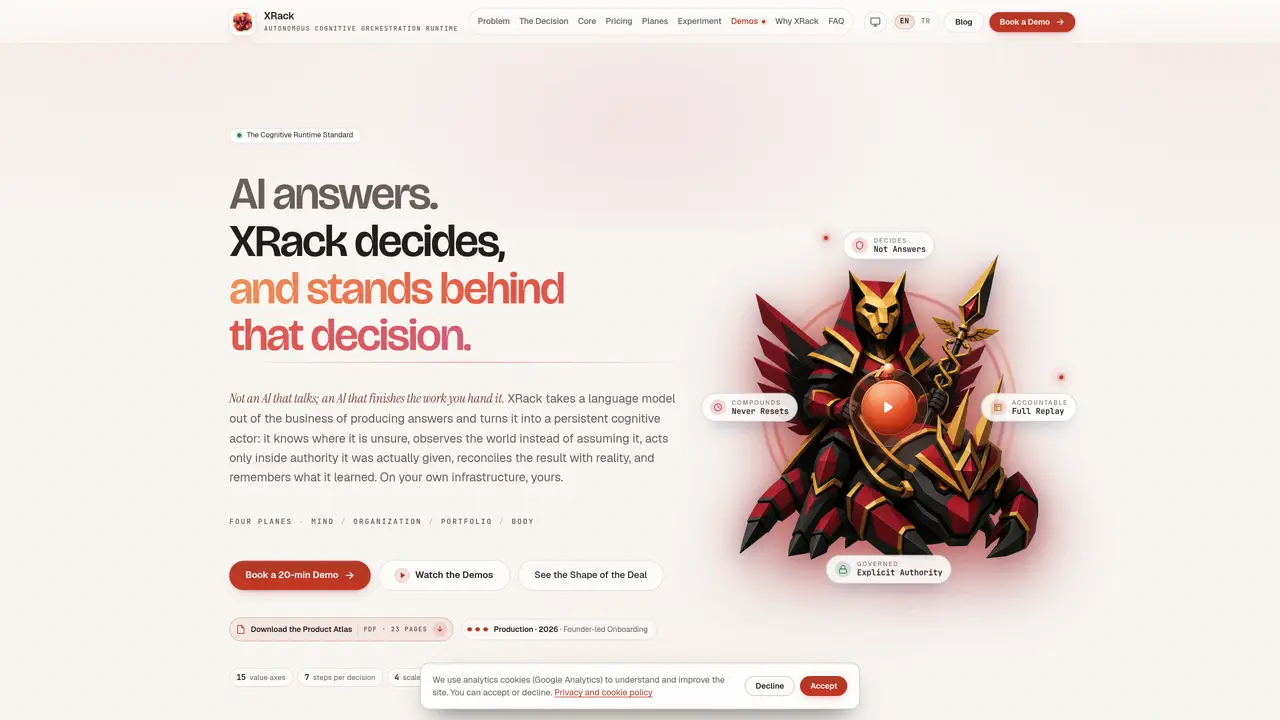
XRack is a self-hosted runtime that transforms language models into persistent cognitive actors capable of making and executing decisions rather than merely producing answers. It operates within explicitly defined authority, records every step of the decision process, and verifies outcomes against real-world data, ensuring accountability and traceability. The system is designed to handle complex workflows across four organizational scales—Mind, Organization, Portfolio, and Body—while maintaining full replayability of decisions. It supports multiple large language models, including OpenAI, Anthropic, Mistral, and local options, and integrates with enterprise communication channels such as Slack, Microsoft Teams, and email. XRack emphasizes sovereignty by keeping all data and cognition within the user’s infrastructure, including air-gapped environments, and avoids third-party dependencies in the reasoning path. The runtime is governed by short-lived capability tokens to enforce explicit authority at each action, and it compounds experience over time to improve decision quality without resetting context.
Key features
- Persistent cognitive actor with memory
- Four organizational scales (Mind/Organization/Portfolio/Body)
- OpenAI-compatible REST API
- MCP-native integration
- Slack, Teams, Telegram, Discord, Google Chat, and email support
- BYO LLM with no token markup
- Air-gap capable deployment
- Explicit authority governance
Use cases
- Automated refund processing with legal defensibility
- Regulated financial transaction authorization
- Compliance-driven decision logging for audits
Pros
- Self-hosted appliance with air-gap capability
- Full decision replayability and traceability
- Explicit authority enforcement via capability tokens
- Supports multiple LLMs including local models
- Interoperates with enterprise communication platforms
Cons
- No free tier or open pricing details
- Requires on-premises or private cloud deployment
- Limited to supported communication integrations
XRack videos
Frequently asked questions about XRack
What is XRack and how does it differ from standard AI tools?
XRack transforms language models into persistent cognitive actors that make and execute decisions rather than just producing answers. It records every step of the decision process, verifies outcomes against real-world data, and maintains full replayability, ensuring accountability and traceability.
Who should use XRack?
XRack is designed for organizations that need to delegate real work to AI agents, particularly those handling tasks with legal, financial, or operational consequences. It suits CISOs, heads of platform, and teams requiring sovereign, governed, and provable decision-making.
How does XRack ensure accountability in decision-making?
XRack enforces explicit authority through short-lived capability tokens, records every decision step, and verifies outcomes against real-world data. This ensures decisions are traceable, defensible, and compliant with frameworks like the EU AI Act and NIST AI RMF.
Can XRack integrate with existing enterprise communication tools?
Yes, XRack integrates with enterprise communication channels such as Slack, Microsoft Teams, Telegram, Discord, Google Chat, and email, allowing agents to act within familiar workflows.
What models does XRack support?
XRack supports multiple large language models, including OpenAI, Anthropic, Mistral, Bedrock, Gemini, Ollama, and local options. It is model-agnostic and can operate with self-hosted or third-party LLMs.
How does XRack handle data sovereignty and security?
XRack operates as a self-hosted appliance, keeping all data and cognition within the user’s infrastructure, including air-gapped environments. It avoids third-party dependencies in the reasoning path and supports BYO-key encryption.