Automate complex processes, leverage real-time analytics, customize workflow with powerful tools.

StageHand
FreeStarting price
36KMonthly visits
26Popularity
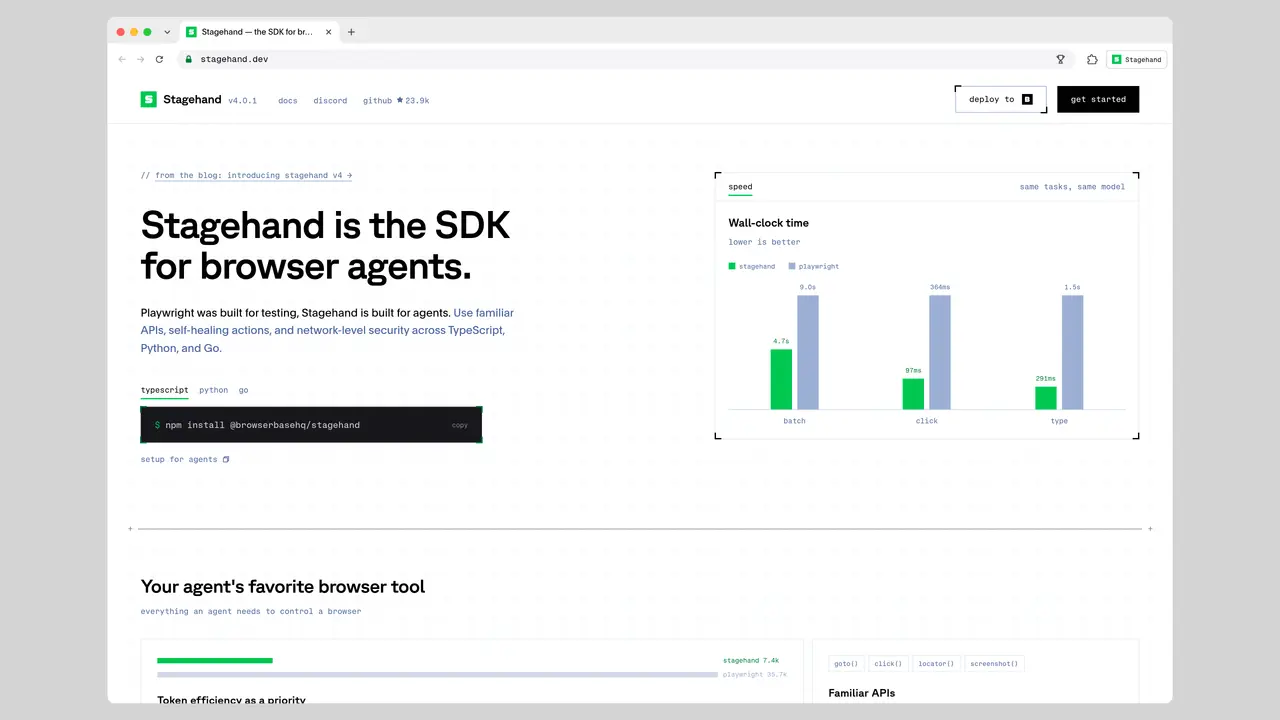
About StageHand
StageHand is an open-source AI tool that turns plain-language prompts into browser actions, letting users automate repetitive web tasks without writing complex scripts. It acts as a browser agent that can navigate pages, fill forms, click buttons, and extract structured data from websites. Developers and non-developers alike can use it to replace manual browsing with reliable automation workflows. The tool is designed for scraping, testing, monitoring, and integrating live web data into other systems. By translating instructions into browser commands, StageHand reduces the time spent on routine web interactions and lowers the barrier to building custom automation pipelines. It is especially useful for teams that need to keep internal or public websites updated or monitored without constant human oversight.
Key features
- Prompt-driven browser control
- Open-source and self-hostable
- Web navigation and form filling
- Structured data extraction
- Multi-tab support
- Headless and headed modes
- Session persistence
- REST API for integration
- JavaScript-free setup
- Lightweight runtime
Use cases
- Automate repetitive web scraping tasks
- Build custom browser-based workflows from prompts
- Monitor websites for changes and extract updates
Pros
- Built for AI agents with familiar Playwright-style APIs (goto, click, locator, screenshot)
- Self-healing actions that adapt when websites change, reducing maintenance overhead
- Runs as a browser extension for minimal latency and direct page control
- Supports TypeScript, Python, and Go for cross-language flexibility
- Optimized for token efficiency with trimmed accessibility trees for faster agent performance
Cons
- Requires technical setup for integration, which may pose a barrier for non-developers
- Limited to browser automation, so it may not replace all types of web scraping or testing tools
- Dependency on browser extensions could introduce compatibility constraints in some environments
Frequently asked questions about StageHand
What is StageHand and who is it designed for?
StageHand is an SDK for browser agents that enables control of web browsers through familiar APIs. It is designed for developers and AI agents that need to automate web tasks reliably, offering features like self-healing actions and network-level security.
How does StageHand differ from tools like Playwright?
StageHand is optimized for AI agents rather than testing, with features like agent-optimized page context, self-healing actions, and built-in support for complex DOM structures such as out-of-process iframes and closed Shadow DOMs.
What programming languages does StageHand support?
StageHand provides a complete browser driver across TypeScript, Python, and Go, allowing developers to write automation scripts in their preferred language.
Does StageHand support natural language instructions for browser actions?
Yes, StageHand allows agents to control browsers using natural language commands through methods like `act` and `extract`, translating instructions into browser actions.
What are some key features of StageHand for production use?
StageHand includes self-healing primitives, batched commands, deep locators for nested iframes, WebMCP support, clipboard access, and built-in OpenTelemetry tracing for observability.
How does StageHand handle changes in website structure?
StageHand uses self-healing actions that detect changes in website structure and automatically adjust how actions are performed, improving reliability when sites evolve.
StageHand Website Engagement
Last Update: 9 days ago
Total Monthly Visits
0
Bounce Rate
0%
Visit Duration (avg)
0.00s
Pages Per Visit
0
Country Rank
0
United States
Global Rank
0
Category Rank
#0
Programming & Developer Software
Monthly Traffic
Traffic Sources
Traffic Share By Country
- United States36%
- Vietnam10.3%
- Brazil8.9%
- Italy8.2%
- India6.6%