
Unify customer data, automate workflows, and scale experiences with Einstein AI, Copilot, and Data Cloud in one CRM platform.

Eventual AI
9.3KMonthly visits
16Popularity
About Eventual AI
Eventual AI is an AI-powered tool designed to help businesses make sense of their requirements quickly and easily. It takes a declarative approach, allowing business leaders and engineers to start with a high-level overview of their business domains and then dive into details to refine their use-cases. Utilizing its natural language processing capabilities, Eventual AI helps turn abstract ideas into concrete solutions that consider the business goals, tenets, and policies. With its intuitive and user-friendly design, Eventual AI gives businesses the power to quickly explore possibilities and streamline their processes. It’s the perfect tool for anyone looking to save time and resources while getting the most out of their requirements. Eventual AI can automate tedious requirements gathering processes with its natural language processing capabilities. It streamlines business processes with its intuitive user-friendly design, allowing users to quickly explore possibilities. This tool is ideal for businesses that want to make sense of their requirements quickly and easily.
Key features
- Automate requirements gathering processes
- Streamline business processes
- Quickly explore possibilities
- Declarative approach
- Natural language processing capabilities
- Intuitive user-friendly design
Use cases
- Requirements gathering for businesses
- Streamlining business processes for increased efficiency
- Exploring possibilities and opportunities in business
Pros
- Open-source data engine (Daft) optimized for high-frequency, unstructured sensor data
- Native support for video and lidar data in standard formats (e.g., mp4, jpeg)
- Semantic indexing of perception data for complex temporal and action-oriented queries
- Direct GPU feeding at line rate to maximize model flops utilization (MFU)
- No custom formats or ETL pipelines required, reducing engineering overhead
Cons
- Primarily focused on Physical AI and sensor data, limiting broader applicability
- Requires technical expertise to leverage advanced features like semantic indexing and temporal queries
- Open-source nature may demand additional setup and maintenance effort
Frequently asked questions about Eventual AI
What is Eventual AI and what problem does it solve?
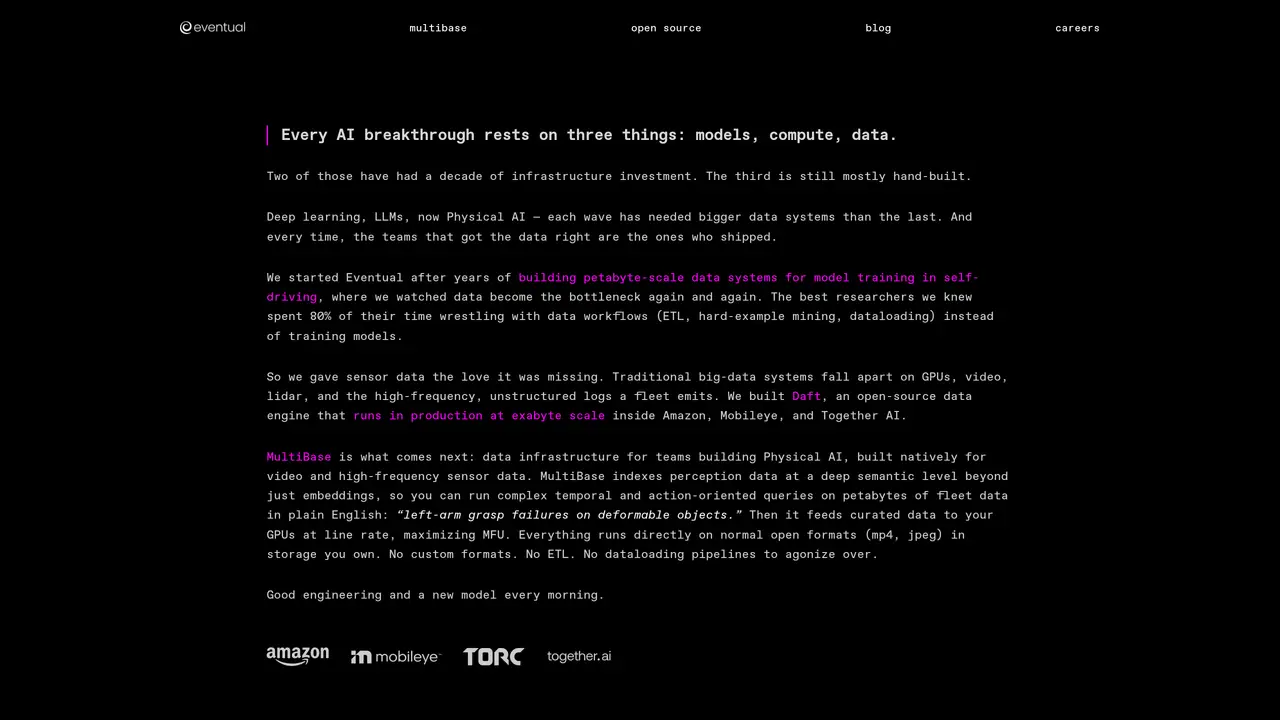
Eventual AI provides data infrastructure designed for teams building Physical AI, addressing challenges in handling high-frequency sensor data, video, and unstructured logs. It aims to reduce the time spent on data workflows like ETL and dataloading, allowing researchers and engineers to focus more on model training and innovation.
Who is Eventual AI intended for?
Eventual AI is intended for teams working with Physical AI, particularly those dealing with large-scale sensor data, video, and high-frequency logs. This includes researchers, engineers, and organizations in fields like autonomous systems and robotics.
How does Eventual AI handle data storage and processing?
Eventual AI uses Daft, an open-source data engine, to process and index perception data at a semantic level. It supports complex temporal and action-oriented queries on petabytes of data in plain English, and runs directly on standard open formats like mp4 and jpeg without requiring custom formats or ETL pipelines.
What are the key features of Eventual AI's MultiBase?
MultiBase indexes perception data beyond embeddings, enabling complex queries on high-frequency sensor data. It feeds curated data to GPUs at line rate to maximize MFU, and operates on data stored in standard open formats within the user's own storage infrastructure.
Does Eventual AI require custom data formats or pipelines?
No, Eventual AI does not require custom data formats or ETL pipelines. It works directly with standard open formats such as mp4 and jpeg, eliminating the need for data conversion or complex dataloading workflows.
How can I get started with Eventual AI?
To get started with Eventual AI, users can explore the open-source Daft engine or learn more about MultiBase through the resources available on the Eventual website, including the blog and product documentation.
Eventual AI Website Engagement
Last Update: 9 days ago
Total Monthly Visits
0
Bounce Rate
0%
Visit Duration (avg)
0.00s
Pages Per Visit
0
Country Rank
0
United States
Global Rank
0
Category Rank
#0
Human Resources
Monthly Traffic
Traffic Sources
Traffic Share By Country
- United States79.3%
- India20.7%