An AI-driven experience management platform for enterprises to collect multi-channel feedback, analyze structured and unstructured data, and deliver actionable insights.
Cebra
7.3KMonthly visits
14Popularity
About Cebra
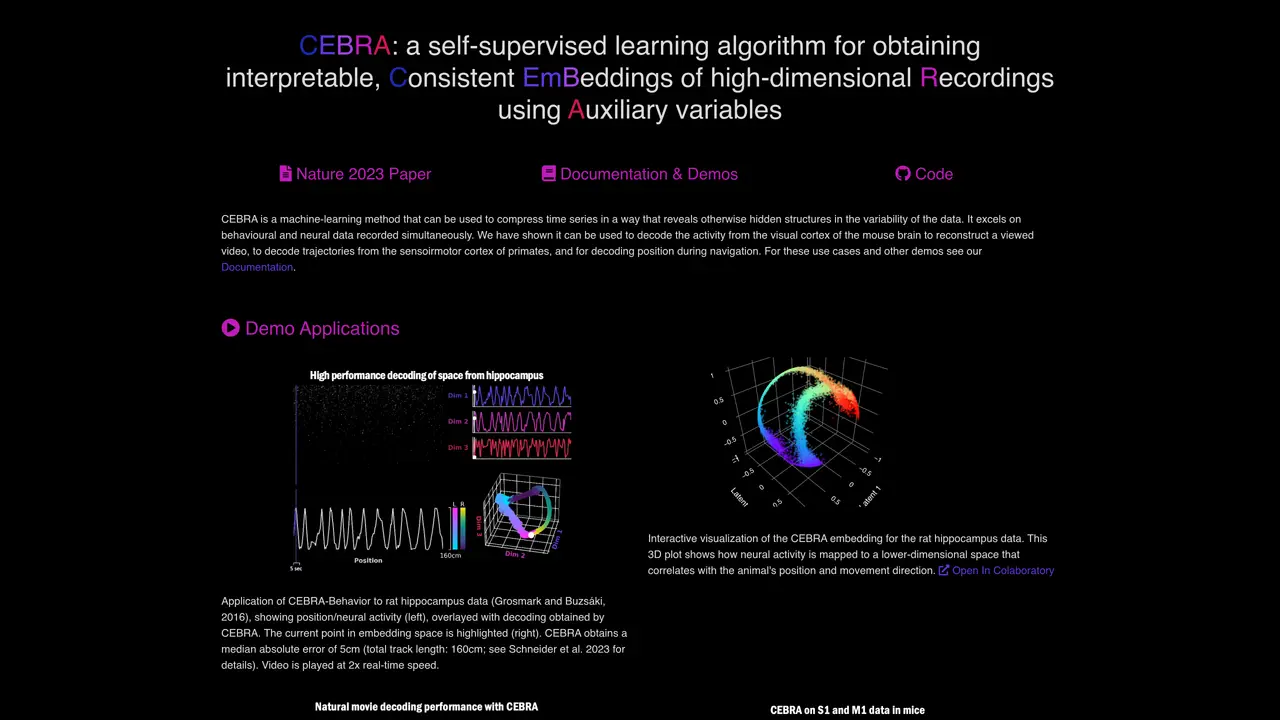
CEBRA is a powerful machine learning tool that enables scientists to unlock the mysteries of behavior and neural activity. It uses advanced non-linear techniques to generate consistent and high-performance latent spaces from joint behavioural and neural data recorded simultaneously. This allows researchers to map behavioural actions to neural activity, enabling them to gain a better understanding of neural dynamics during adaptive behaviours and uncover underlying correlations of behaviour. CEBRA’s neural latent embeddings can be used for both hypothesis testing and discovery-driven analysis. It is incredibly versatile, with users able to customize parameters and settings to fit their research needs. It is also user-friendly, with an intuitive interface and streamlined workflows that make it simple to use. With CEBRA, scientists have the power to generate data-driven insights and uncover the hidden mechanisms of behaviour. CEBRA can be used for a variety of applications, including discovering correlations between behavior and neural activity, uncovering hidden mechanisms of behavior, and generating data-driven insights. It is particularly useful for researchers who need to analyze complex behavioral and neural data sets.
Key features
- Generates consistent and high-performance latent spaces from joint behavioural and neural data
- Maps behavioral actions to neural activity
- Enables hypothesis testing and discovery-driven analysis
- Customizable parameters and settings
- Intuitive interface and streamlined workflows
- User-friendly for researchers with varying levels of expertise
Use cases
- Discovering correlations between behavior and neural activity in research studies
- Uncovering hidden mechanisms of behavior in complex systems
- Generating data-driven insights to inform decision-making in fields such as neuroscience and psychology
Pros
- Generates interpretable and consistent latent embeddings from high-dimensional time-series data
- Supports both hypothesis-driven and discovery-driven analysis modes
- Validated across diverse datasets including calcium imaging, electrophysiology, and behavioral recordings
- Enables accurate decoding of neural activity into behavioral correlates, such as reconstructing viewed videos from visual cortex activity
- Compatible with multi-session datasets and applicable across species and behavioral tasks
Cons
- Requires simultaneous behavioral and neural recordings for optimal performance
- Patent pending may limit non-academic use without prior agreement
- Demands computational resources for processing large-scale neural datasets
Frequently asked questions about Cebra
What is CEBRA and what does it do?
CEBRA is a self-supervised machine learning algorithm designed to generate interpretable latent embeddings from high-dimensional time-series data, particularly behavioral and neural recordings. It compresses complex data to reveal hidden structures and correlations, enabling decoding of neural activity and behavioral actions.
Who is CEBRA suitable for?
CEBRA is tailored for researchers in neuroscience, computational biology, and related fields who analyze joint behavioral and neural datasets. It supports both hypothesis-driven and discovery-driven analyses across species and experimental setups.
How does CEBRA work with neural and behavioral data?
CEBRA jointly uses behavioral and neural data to produce consistent and high-performance latent spaces. It can operate in supervised or self-supervised modes, leveraging auxiliary variables to map behavioral actions to neural activity and uncover neural dynamics.
What types of data can CEBRA analyze?
CEBRA excels with simultaneous behavioral and neural recordings, including calcium imaging, electrophysiology, 2-photon, Neuropixels, and primate sensorimotor data. It has been validated for tasks like navigation, visual cortex decoding, and motor/somatosensory cortex analysis.
Can CEBRA be used for decoding tasks?
Yes, CEBRA’s latent embeddings can be used for decoding tasks, such as reconstructing viewed videos from visual cortex activity or predicting position during navigation. Its embeddings enable high-accuracy decoding across diverse datasets.
How can I get started with CEBRA?
CEBRA’s official implementation is available on GitHub, where users can access documentation, demos, and code. The tool is designed for flexibility, allowing customization of parameters to fit specific research needs.
Cebra Website Engagement
Last Update: 9 days ago
Total Monthly Visits
0
Bounce Rate
0%
Visit Duration (avg)
0.00s
Pages Per Visit
0
Country Rank
0
United States
Global Rank
0
Category Rank
#0
Biology
Monthly Traffic
Traffic Sources
Traffic Share By Country
- United States85.2%
- Japan14.8%