An AI-driven experience management platform for enterprises to collect multi-channel feedback, analyze structured and unstructured data, and deliver actionable insights.

Dremio
$0.20Starting price
117KMonthly visits
34Popularity
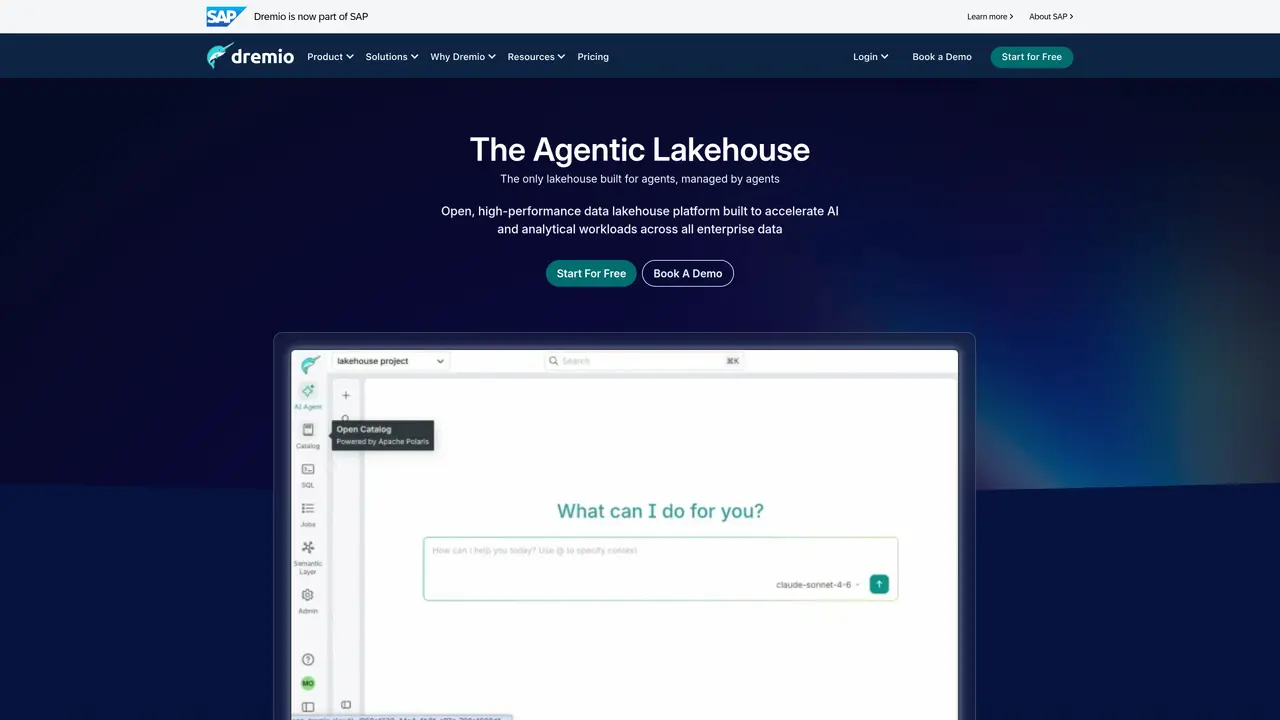
About Dremio
Dremio is an open, high-performance lakehouse platform designed to accelerate AI and analytical workloads across enterprise data. It serves as a unified analytics platform that connects AI agents and analytics tools to an intelligent query engine, semantic layer, open catalog, and governed data sources. The platform enables organizations to federate queries across any data source—including relational databases, NoSQL systems, and cloud warehouses—without moving data, while supporting structured, semi-structured, and unstructured data formats. Dremio’s architecture is built for agents, offering native integration with AI tools through MCP and CLI access, allowing coding agents to interact directly with the lakehouse. Autonomous management features observe query patterns to automatically optimize performance, cluster resources on demand, and reduce redundant compute through caching. End-to-end access controls ensure that permissions and security policies travel with the data, from client to source, supporting fine-grained, role-based governance. The platform is available as a fully managed cloud service or self-managed software deployable on Kubernetes, on-premises, or in the cloud, catering to organizations of varying sizes and technical maturity. By centralizing data access and semantics, Dremio empowers teams to derive accurate insights, accelerate decision-making, and scale analytics workloads efficiently across industries such as financial services, manufacturing, life sciences, and retail.
Dremio
Santa Clara, United States · Founded 2015
- Founder
- Tomer Shiran
- Founded
- 2015
- Headquarters
- Santa Clara, United States
Key features
- Access and integrate data from multiple sources
- Build interactive dashboards and custom reports
- Real-time collaboration and sharing
- Intuitive data exploration tools
- Support for relational, NoSQL, and cloud data warehouses
- Secure and fast data processing
- Flexible deployment options
- Centralized data management
Use cases
- Creating interactive dashboards for business performance tracking
- Building custom reports for financial or operational analysis
- Enabling real-time collaboration on data insights across teams
Pros
- Unified access to structured, semi-structured, and unstructured data across diverse sources without data movement
- Built-in AI agent connectivity for tools like Claude, ChatGPT, and Gemini via MCP integration
- Autonomous management features that optimize queries and scale infrastructure automatically
- End-to-end access controls that enforce role-based permissions across the entire data pipeline
- Supports both managed cloud and self-managed deployment options for flexibility
Cons
- Requires familiarity with lakehouse architectures and Apache Iceberg for full utilization
- Complexity of setup and configuration may demand dedicated technical expertise
- Dependency on Kubernetes for self-managed enterprise deployments
Frequently asked questions about Dremio
What is Dremio and what does it do?
Dremio is an open lakehouse platform that connects AI agents and analytics tools to an intelligent query engine, semantic layer, and governed data sources. It enables unified access to enterprise data without moving it, supports multi-format data, and provides autonomous management for performance optimization.
Who should use Dremio?
Dremio is designed for organizations that need to accelerate AI and analytical workloads across diverse data sources, including data teams, AI practitioners, and business analysts seeking self-service insights and governed data access.
How does Dremio integrate with AI agents?
Dremio offers native MCP integration to connect AI agents like Claude, ChatGPT, and Gemini, as well as a CLI for coding agents such as Claude Code. The platform enables agents to query data directly while inheriting user identity and access controls automatically.
What deployment options does Dremio offer?
Dremio provides a fully managed cloud service called Dremio Cloud and a self-managed option called Dremio Enterprise, which runs on Kubernetes and can be deployed on-premises, in the cloud, or in hybrid environments.
Does Dremio support access controls and governance?
Yes, Dremio enforces end-to-end access controls with fine-grained, role-based permissions that travel with the data from client to source. OAuth tokens flow through credential vending to every data source, ensuring consistent governance.
How do I get started with Dremio?
Users can begin with Dremio Community Edition for local or server-based query engines, explore the Developer Hub for documentation and resources, or contact Dremio for access to Dremio Cloud or Enterprise based on their needs.
Dremio Website Engagement
Last Update: 9 days ago
Total Monthly Visits
0
Bounce Rate
0%
Visit Duration (avg)
0.00s
Pages Per Visit
0
Country Rank
0
United States
Global Rank
0
Category Rank
#0
Programming & Developer Software
Monthly Traffic
Traffic Sources
Traffic Share By Country
- United States21.2%
- India6.1%
- Germany4.5%
- Brazil4%
- Denmark3.5%