An AI-driven experience management platform for enterprises to collect multi-channel feedback, analyze structured and unstructured data, and deliver actionable insights.

Google Cloud Dataflow
0Popularity
About Google Cloud Dataflow
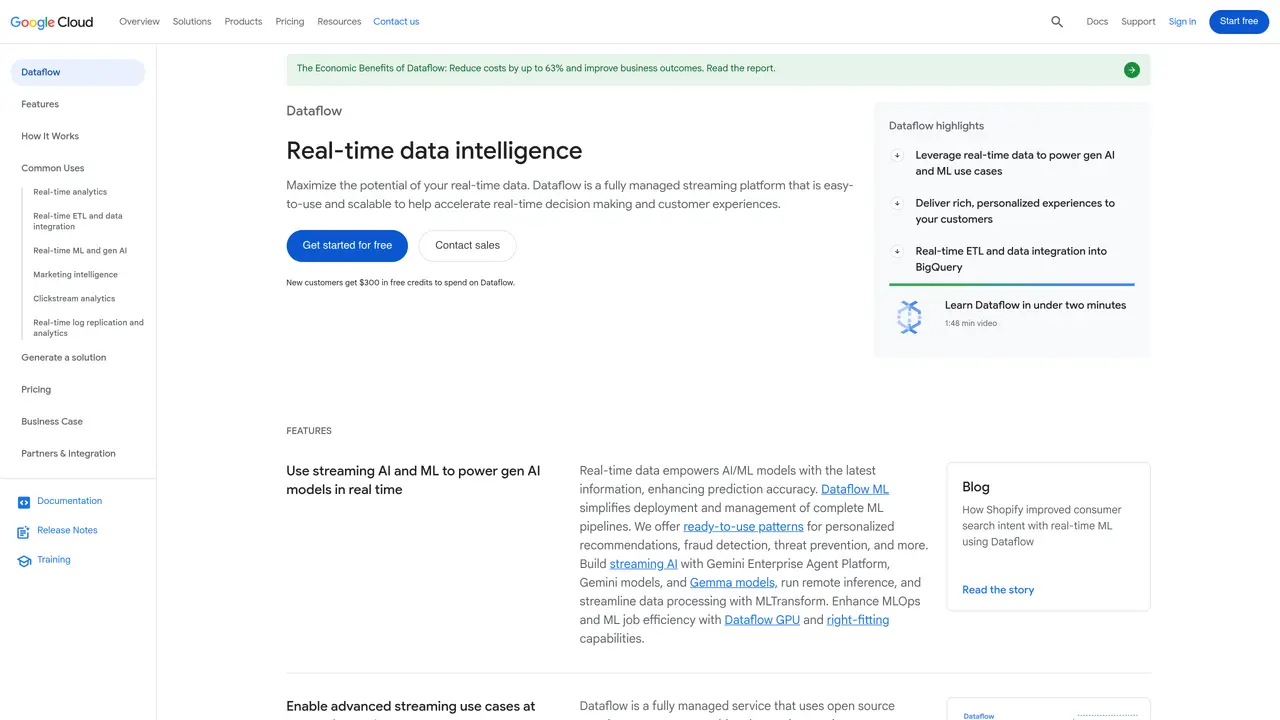
Google Cloud Dataflow is an efficient and powerful tool for transforming and processing large datasets. It enables developers and businesses to build data-driven pipelines, quickly process large datasets, and create real-time streaming applications with ease. Google Cloud Dataflow is designed for scalability, allowing businesses to process data of any size, with low latency and high throughput. It also uses machine learning models to optimize data processing performance, so that businesses get the best performance out of their data. Additionally, it supports a range of programming languages, such as Python, Java and Go, and provides an intuitive UI for configuring and managing data pipelines. With Google Cloud Dataflow, businesses can be sure that their data is processed quickly, accurately, and securely. It is an ideal solution for businesses that need to process large datasets in a timely manner, with reliable performance and security.
Key features
- Create real-time streaming applications
- Process large datasets quickly and securely
- Optimize data processing performance with ML models
- Supports multiple programming languages (Python, Java, Go)
- Intuitive UI for configuring and managing data pipelines
- Scalable to process data of any size
Use cases
- Real-time analytics and reporting
- Data integration and processing for large datasets
- Machine learning model training and deployment
Pros
- Fully managed service with automatic scaling and resource provisioning
- Supports both batch and streaming data processing pipelines
- Integrates seamlessly with other Google Cloud services like BigQuery, Pub/Sub, and Cloud Storage
- Offers flexible programming models including Apache Beam SDKs for Java, Python, and Go
- Provides built-in fault tolerance and exactly-once processing guarantees
Cons
- Can incur higher costs for large-scale or long-running pipelines
- Learning curve for configuring complex data pipelines and optimizing performance
- Limited control over underlying infrastructure compared to self-managed solutions
Frequently asked questions about Google Cloud Dataflow
What is Google Cloud Dataflow used for?
Google Cloud Dataflow is a fully managed service for building and executing data processing pipelines, including batch and real-time streaming analytics. It enables users to transform and analyze large datasets efficiently while maintaining low latency and high throughput.
Who should use Google Cloud Dataflow?
Dataflow is designed for developers, data engineers, and businesses that need to process large-scale datasets or build real-time analytics pipelines. It suits organizations requiring scalable, secure, and high-performance data processing solutions.
How does Google Cloud Dataflow handle data processing?
Dataflow automates resource provisioning and scaling, optimizing performance through machine learning models. It supports both batch and streaming data pipelines and allows users to define transformations using familiar programming languages like Java, Python, and Go.
Does Google Cloud Dataflow integrate with other Google Cloud services?
Yes, Dataflow integrates seamlessly with Google Cloud services such as BigQuery, Pub/Sub, Cloud Storage, and AI Platform. It also supports Apache Beam SDKs for broader ecosystem compatibility.
What are the main limitations of Google Cloud Dataflow?
Dataflow may require familiarity with data processing concepts and Apache Beam programming models. Costs can scale with usage, particularly for high-volume streaming pipelines, and complex pipelines may need careful optimization to balance performance and expense.
How can I get started with Google Cloud Dataflow?
To get started, users can access Dataflow through the Google Cloud Console, use the Apache Beam SDK to define pipelines, and deploy them to the managed service. Google provides documentation, tutorials, and sample pipelines to facilitate onboarding.