An AI-driven experience management platform for enterprises to collect multi-channel feedback, analyze structured and unstructured data, and deliver actionable insights.

Wolfram Language
0Popularity
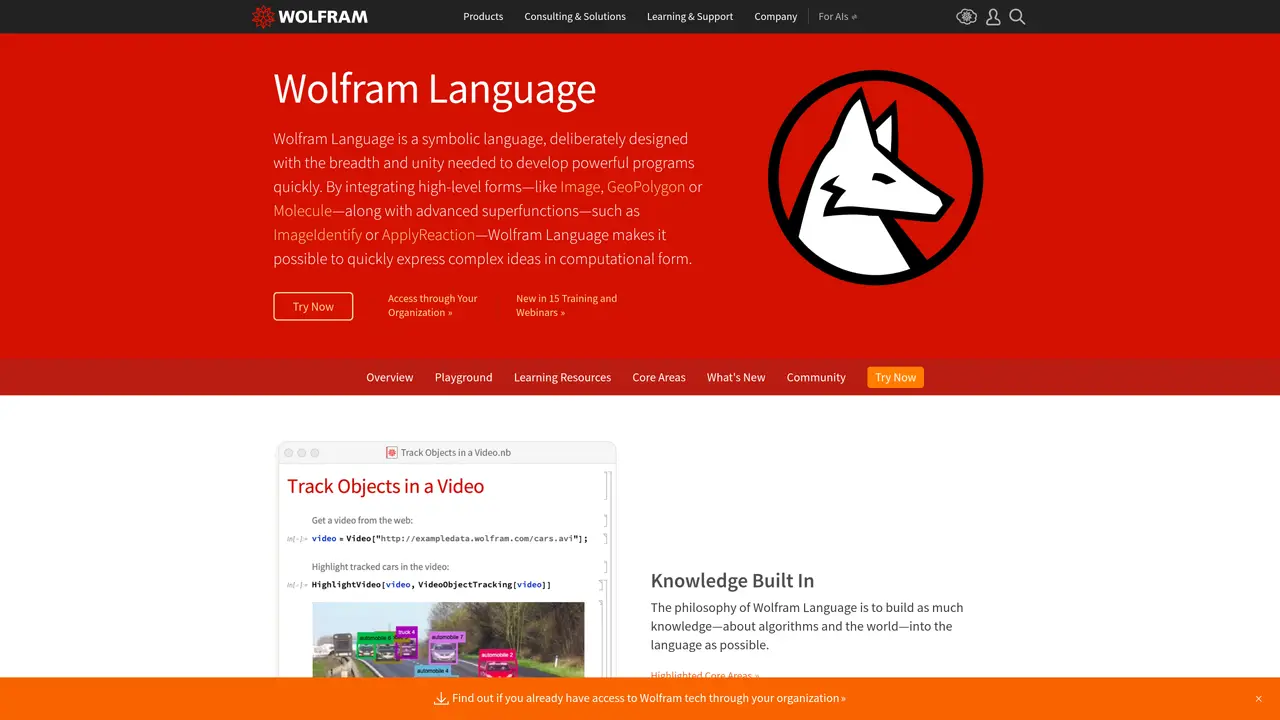
About Wolfram Language
Wolfram Language is a revolutionary programming language designed to make it easier than ever to analyze and solve complex problems. It is the perfect choice for anyone looking to get the most out of their data. With its intuitive syntax and powerful algorithms, Wolfram Language provides users with access to an unprecedented level of computational intelligence. From creating sophisticated models and performing complex calculations, to generating sophisticated visualizations and automating repetitive tasks, Wolfram Language makes data analysis easier than ever before. It features built-in access to a vast array of data sources, making it ideal for a wide range of applications, from business analysis to scientific research. Wolfram Language also offers powerful tools for solving large-scale problems, such as machine learning, natural language processing, and advanced algorithms. With its powerful capabilities, Wolfram Language is a powerful tool for anyone looking to unlock the power of data.
Key features
- Automate repetitive tasks with intuitive syntax
- Generate sophisticated visualizations to analyze complex problems
- Access vast data sources for business or scientific applications
- Built-in access to machine learning, natural language processing, and advanced algorithms
- Powerful tools for solving large-scale problems
- Ideal for business analysis and scientific research
Use cases
- Business analysis: automate tasks, visualize complex problems, and access data sources
- Scientific research: create sophisticated models, perform complex calculations, and generate visualizations
- Data analysis: unlock the power of data with Wolfram Language's powerful capabilities
Pros
- Integrates computation, visualization and knowledge into a single unified language
- Provides built-in access to curated data from thousands of sources
- Supports symbolic computation alongside numerical and statistical methods
- Includes high-level functions for machine learning, image processing and natural language understanding
- Offers seamless interoperability with Wolfram|Alpha and the Wolfram Cloud
Cons
- Requires proprietary runtime and licensing for full functionality
- Steeper learning curve for users unfamiliar with symbolic programming
- Limited open-source ecosystem compared to general-purpose languages
Frequently asked questions about Wolfram Language
What is Wolfram Language?
Wolfram Language is a multi-paradigm programming language developed by Wolfram Research, designed for symbolic computation, data analysis, visualization, and algorithmic automation. It integrates computation with knowledge, providing built-in access to curated data, algorithms, and real-time information.
Who should use Wolfram Language?
Wolfram Language suits researchers, engineers, data scientists, educators, and developers who need to perform advanced computations, build models, or automate complex workflows. It is widely used in fields like mathematics, physics, finance, engineering, and artificial intelligence.
How does Wolfram Language work?
The language combines symbolic computation with a high-level, intuitive syntax, allowing users to express computations in natural, readable forms. It leverages the Wolfram Knowledgebase for real-time data access and integrates seamlessly with Wolfram|Alpha for natural language understanding and computation.
What are common use cases for Wolfram Language?
Common use cases include data analysis and visualization, mathematical modeling, algorithm development, machine learning, natural language processing, and automating scientific or engineering workflows. It is also used for creating interactive reports and dashboards.
Does Wolfram Language support integrations with other tools?
Yes, Wolfram Language supports integration with external systems through APIs, data formats like JSON and CSV, and interoperability with languages such as Python and R. It can also connect to databases, cloud services, and other computational platforms.
How do I get started with Wolfram Language?
Users can get started by downloading the Wolfram Engine or using Wolfram Cloud, which provides an online environment. Documentation, tutorials, and example notebooks are available to help new users learn the language and its capabilities.