
Automate job postings, track candidates, streamline interviews and offers, and review candidates efficiently.

JobScorer
$6Starting price
0Popularity
About JobScorer
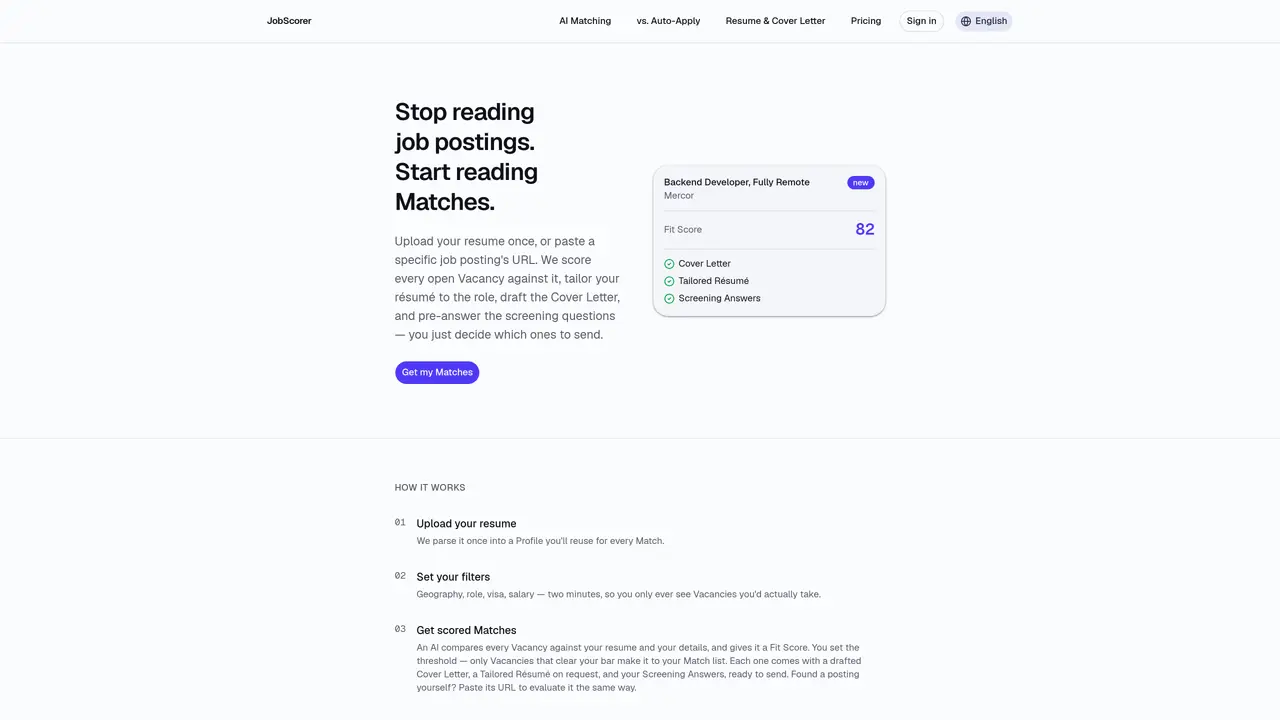
JobScorer evaluates open job postings against a user’s uploaded resume and filters to produce a list of scored matches. Each match includes a Fit Score based on an AI’s comparison of the vacancy against the user’s profile, covering factors like seniority, required skills, and role alignment. Users set a minimum Fit Score threshold to control which postings appear in their list. For each match, the tool drafts a cover letter grounded in the resume and job details, pre-answers screening questions from the user’s profile, and can generate a tailored resume that mirrors the posting’s language without altering facts. Users can also paste a job URL to evaluate postings not yet indexed by the system. The platform emphasizes transparency by explaining the reasoning behind each Fit Score and by requiring user review before any application is sent. It does not automate submissions or interact with employer systems, focusing instead on reducing the time spent reading postings and drafting initial materials.
Key features
- Resume parsing into reusable profile
- Customizable filters for geography, role, visa, and salary
- Fit Score evaluation for each job posting
- Automatic cover letter drafting per match
- Pre-answered screening questions
- On-demand tailored resume generation
- URL-based evaluation for unindexed postings
- Credit-based usage with no recurring fees
Use cases
- Evaluating job postings against a resume to identify high-fit opportunities
- Drafting application materials for targeted roles without starting from scratch
- Streamlining the application process for users who prefer to review matches before applying
Pros
- Scores job postings against a user’s resume using contextual reasoning rather than keyword matching
- Generates tailored cover letters and screening answers based on the user’s actual profile
- Allows on-demand tailored resumes that mirror job posting language without fabricating details
- Provides transparent Fit Score explanations for each match
- Offers a free beta with credits that do not expire and no subscription required
Cons
- Limited to one-time credit purchases with no free tier beyond initial 50 credits
- Requires manual review and submission by the user; no automated application process
- Tailored resume generation consumes multiple credits per use
Frequently asked questions about JobScorer
What does JobScorer do?
JobScorer evaluates open job postings against a user’s uploaded resume and filters them to produce a list of scored matches. Each match includes a Fit Score based on an AI’s comparison of the vacancy against the user’s profile, covering factors like seniority, required skills, and role alignment.
Who is JobScorer suitable for?
JobScorer is designed for job seekers who want to streamline their application process by focusing only on relevant job postings. It is particularly useful for those who prefer to review and control their applications manually rather than relying on automated submission tools.
How does JobScorer calculate the Fit Score?
The Fit Score is calculated by an AI that reads and compares the job posting with the user’s resume and profile details, reasoning about fit in a way similar to how a person would. It considers factors like seniority, tech stack overlap, and role alignment, rather than relying on simple keyword matching.
Can I evaluate job postings that aren’t already indexed by JobScorer?
Yes, users can paste a job posting’s URL to evaluate it the same way as indexed postings. JobScorer will provide a Fit Score and reasoning based on the posted content.
Does JobScorer automate job applications?
No, JobScorer does not automate submissions or interact with employer systems. It prepares materials like cover letters, tailored resumes, and pre-answered screening questions, but the user must review and send each application manually.
How does JobScorer tailor my resume and cover letter?
For each match, JobScorer drafts a cover letter grounded in the user’s resume and the job posting, ensuring it reflects genuine fit rather than a generic template. It can also tailor the resume by rewording and reordering existing content to mirror the job’s language and priorities without altering facts.