
AI chatbot for conversation, work, research, coding, and content creation.

SeekBox
$5Starting price
0Popularity
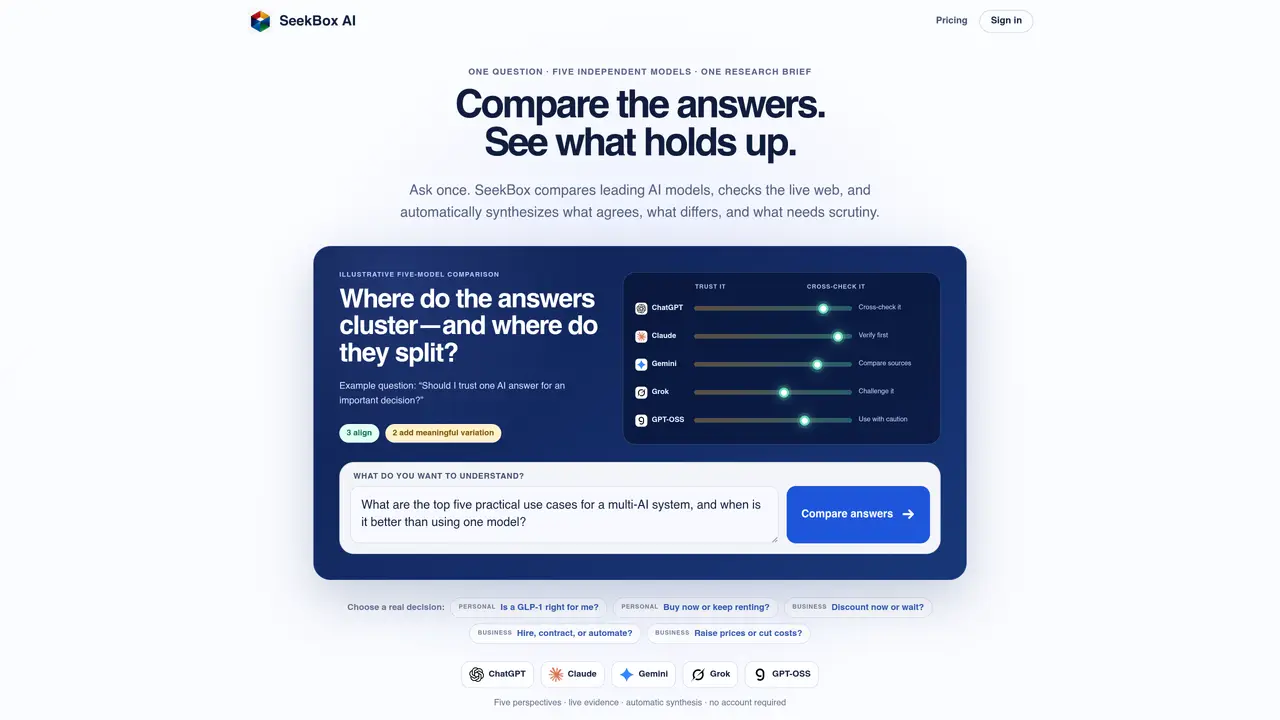
About SeekBox
SeekBox aggregates responses from multiple leading AI models—including ChatGPT, Claude, Gemini, Grok, and Meta—in a single interface, presenting their full answers side-by-side for direct comparison. The tool then cross-references these responses against live web sources to ground claims and identify inconsistencies, contradictions, or gaps in reasoning. It applies a suite of 15 built-in analytical methods, such as Fact Check, CRAAP Test, SIFT Method, Devil’s Advocate, and Logic & Bias Detection, to evaluate the responses through different lenses and perspectives. Users can explore evidence in depth, assess the reliability of sources, and uncover assumptions or biases that may influence the answers. The platform is designed to support research, decision-making, writing review, and learning by revealing how explanations vary across models, audiences, and analytical frameworks. Public comparisons can be viewed without an account, while free accounts allow users to save their work and access higher usage limits. SeekBox emphasizes transparency by making the reasoning process visible, enabling users to critically evaluate AI-generated content before relying on it.
Key features
- Parallel AI model comparison (ChatGPT, Claude, Gemini, Grok, Meta)
- Live web grounding and source verification
- 15 built-in analysis methods (Nutshell, Fact Check, CRAAP Test, SIFT, Devil's Advocate, Steel Man, Logic & Bias Detection, SWOT, Decision Matrix)
- Side-by-side answer display without blending responses
- Public answer browsing without login
- Usage tracking and transparent limits
- No-credit-card-required free account
- Annual billing options
Use cases
- Research and analysis to identify repeated claims and evidence gaps
- Decision-making by comparing recommendations, tradeoffs, and hidden assumptions
- Writing and review to test drafts against multiple perspectives and find omissions
Pros
- Compares answers from five leading AI models in parallel
- Grounds responses against live web data for real-time validation
- Includes 15 built-in analysis methods for triangulation and scrutiny
- No account required to view public comparisons
- Transparent usage limits with no overage charges
Cons
- Free plan limited to 50 live answers per month
- Live answers capped at 2 per run on Free and Starter plans
- Requires an account to save work or access higher usage tiers
- No offline or mobile application mentioned
Frequently asked questions about SeekBox
What is SeekBox and how does it work?
SeekBox sends a single question to five independent AI models (ChatGPT, Claude, Gemini, Grok, Meta) and displays their full responses side-by-side. It grounds these answers against live web sources and applies 15 built-in analysis methods to surface agreement, contradictions, assumptions, and gaps.
Who should use SeekBox?
SeekBox is designed for researchers, decision-makers, writers, and learners who need to compare multiple AI perspectives, verify claims, and analyze information through structured methods before acting or publishing.
Do I need an account to use SeekBox?
No account is required to view public comparisons. Free accounts enable saved work and higher usage limits, but basic functionality is accessible without signing up.
What analysis methods does SeekBox offer?
SeekBox provides 15 built-in analysis methods, including Fact Check, CRAAP Test, SIFT Method, Devil’s Advocate, Steel Man, Logic & Bias Detection, SWOT Analysis, and Decision Matrix to interrogate and compare AI responses.
How is SeekBox different from a regular search engine?
Unlike search engines that return ranked lists of web pages, SeekBox runs your question through multiple AI models in parallel, validates answers against live web data, and applies structured analysis methods to highlight consensus, contradictions, and gaps.
Can SeekBox help with writing and review tasks?
Yes, SeekBox can test a draft against different AI perspectives and analysis methods to identify omissions, biases, or inconsistencies before publishing, helping refine arguments and improve clarity.