Build Discord bots with words, not code

GPT-Neo
$0.07Starting price
0Popularity
About GPT-Neo
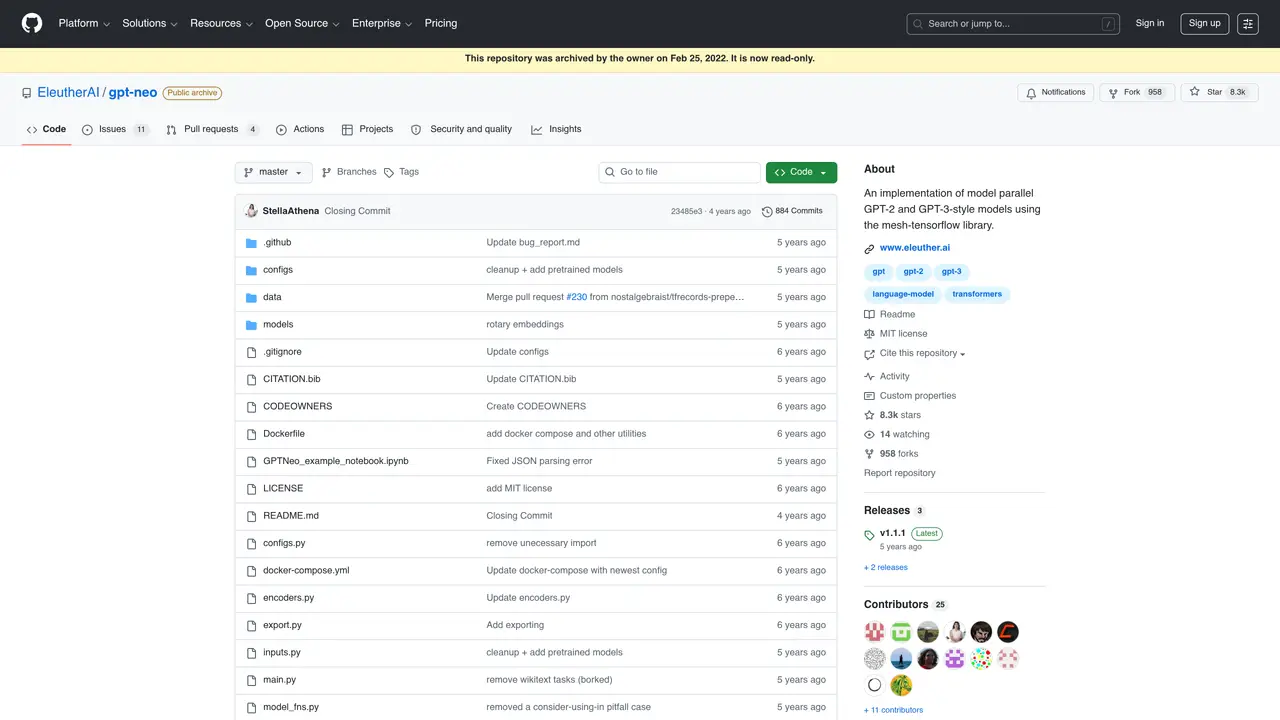
GPT-Neo is an open-source, Transformer-based language model developed by EleutherAI, designed to replicate and scale the capabilities of proprietary models such as GPT-3. The project provides researchers, developers, and organizations with a freely accessible framework to train, fine-tune, and deploy large-scale natural language processing (NLP) models without relying on closed commercial APIs. Built on a transformer architecture, GPT-Neo enables context-aware language understanding and response generation, making it suitable for building conversational AI systems, text generation tools, and automated assistants. The platform is particularly well-suited for academic research, open-source development, and organizations seeking customizable, self-hosted NLP solutions. Its modular design allows users to adapt the model for specific use cases, including chatbots, content generation, code completion, and data augmentation, while maintaining full transparency and control over the underlying model and data. GPT-Neo is released under the Apache 2.0 license, encouraging community collaboration and innovation in the field of AI-driven language modeling.
GitHub, Inc.
San Francisco, California, US · Founded 2008
- Founders
- Tom Preston-Werner, Chris Wanstrath, PJ Hyett, Scott Chacon
- Founded
- 2008
- Headquarters
- San Francisco, California, US
- Legal status
- Subsidiary of Microsoft (NASDAQ: MSFT)
Key features
- Create custom chatbots for customer service
- Automate customer interactions with natural language processing
- Build AI-driven conversational models with advanced features
- Context-aware conversation management
- Customizable interface with dynamic learning capabilities
- Intuitive user interface
Use cases
- Create custom chatbots for customer service and automate customer interactions
- Build AI-driven conversational models for various applications, such as virtual assistants or customer support systems
- Develop intelligent conversational agents that understand natural language and provide personalized responses
Pros
- Open-source implementation of GPT-2 and GPT-3-style models
- Supports model and data parallelism for scalable training
- Offers advanced features like local attention, linear attention, and mixture of experts
- Provides pre-trained models (1.3B and 2.7B parameters) trained on The Pile dataset
- Compatible with TPU and GPU for training and inference
Cons
- No longer actively maintained as of August 2021
- Inefficient at very large scales (e.g., 200B+ parameters)
- Archived repository with read-only access
- Limited official support for newer hardware or frameworks
Frequently asked questions about GPT-Neo
What is GPT-Neo and what does it do?
GPT-Neo is an open-source implementation of model and data parallel GPT-2 and GPT-3-style language models using the mesh-tensorflow library. It enables training and inference for large-scale transformer models, supporting features like local attention, linear attention, mixture of experts, and axial positional embedding.
Who should use GPT-Neo?
GPT-Neo is designed for developers, researchers, and organizations interested in experimenting with or deploying large-scale language models. It is particularly suited for those comfortable with TensorFlow and model parallelism techniques.
How do I get started with GPT-Neo?
Users can start by cloning the repository from GitHub and following the provided documentation. Pre-trained models are available for download, and a Colab notebook is provided to help set up and run the models. Training and inference are officially supported on TPUs and should also work on GPUs.
What are the key features of GPT-Neo?
Key features include model and data parallelism, support for local and linear attention mechanisms, mixture of experts architecture, axial positional embeddings, and compatibility with TPU and GPU environments. It also offers pre-trained models trained on datasets like The Pile.
Are there any limitations to using GPT-Neo?
GPT-Neo is no longer actively maintained, as development has shifted to GPT-NeoX for GPU-specific optimizations. While it can technically run training steps at very large scales (200B+ parameters), it is inefficient at those sizes. Users may need to adapt the code for their specific hardware and use cases.
Does GPT-Neo integrate with other tools or platforms?
GPT-Neo is designed to work with TensorFlow and mesh-tensorflow for model parallelism. While not explicitly mentioned, users can integrate it with other tools by adapting the codebase, and pre-trained models can be used via HuggingFace Transformers integration for easier deployment.