
Create and interact with AI companions and virtual characters using GPT-4o on Chub AI's platform.

DeepPavlov
$1Starting price
0Popularity
About DeepPavlov
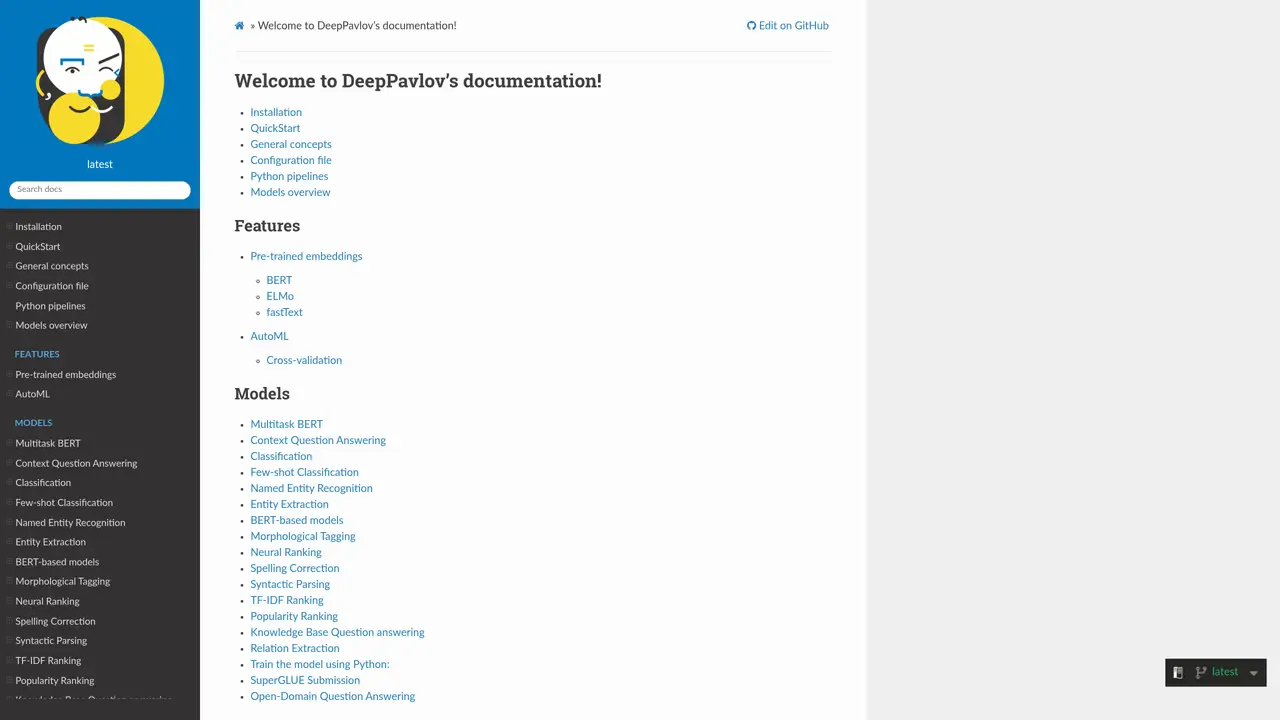
DeepPavlov is an open-source library designed for natural language processing (NLP) and dialog systems. It provides developers with a comprehensive suite of tools and techniques to create AI applications capable of understanding and interacting with humans in natural language. The library supports the development of chatbots, text classifiers, and sentiment analysis models, making it suitable for a wide range of NLP tasks. DeepPavlov includes state-of-the-art models such as BERT, GPT-2, and ELMo, alongside traditional algorithms like word2vec, tf-idf, and LSA. It also offers features for data preprocessing, model training, and evaluation, streamlining the process of building and deploying AI models. The platform is designed to be user-friendly, providing tutorials, API references, and code examples to help developers get started quickly. It is particularly useful for researchers and developers working on conversational AI, text classification, or sentiment analysis projects.
Key features
- Open-source NLP and dialog system library
- Pre-trained models including BERT, GPT-2, and ELMo
- Traditional NLP algorithms like word2vec, tf-idf, and LSA
- Data preprocessing, model training, and evaluation tools
- User-friendly tutorials, API references, and code examples
- Support for building chatbots, text classifiers, and sentiment analysis models
- State-of-the-art model integration
- Comprehensive toolkit for NLP and dialog systems
Use cases
- Developing conversational AI chatbots
- Training text classifiers for categorization tasks
- Building sentiment analysis models for customer feedback
Pros
- Supports a wide range of NLP tasks including text classification, sentiment analysis, named entity recognition, and question answering.
- Includes pre-trained models for multiple languages and tasks, reducing development time.
- Offers both traditional algorithms (e.g., TF-IDF, word2vec) and state-of-the-art models (e.g., BERT, ELMo).
- Provides a user-friendly interface with tutorials, API references, and code examples for quick onboarding.
- Supports GPU acceleration for faster model training and inference.
Cons
- Requires familiarity with Python and NLP concepts for effective use.
- Some advanced features may demand significant computational resources.
- Documentation is extensive but can be overwhelming for beginners.
Frequently asked questions about DeepPavlov
What is DeepPavlov used for?
DeepPavlov is an open-source library for building natural language processing (NLP) and dialog systems, including chatbots, text classifiers, and sentiment analysis models.
Who is DeepPavlov suitable for?
It is designed for researchers and developers working on conversational AI, text classification, sentiment analysis, or other NLP-related projects.
Does DeepPavlov support multiple languages?
Yes, DeepPavlov includes models and tools for both English and Russian, with support for additional languages in some configurations.
How do I get started with DeepPavlov?
Users can install DeepPavlov via pip, Docker, or from source, and follow the provided tutorials and documentation for setup and model training.
Can I use DeepPavlov for custom model training?
Yes, DeepPavlov allows users to train models on custom datasets using its configuration files and training pipelines.
Does DeepPavlov integrate with other tools or libraries?
DeepPavlov is designed to work with standard Python libraries and frameworks, and its modular architecture allows integration with other NLP tools.