GitHub hosts HunyuanVideo, Tencent's open-source framework for large-scale video generation models, enabling AI-driven video creation.

BERT
$0.07Starting price
0Popularity
About BERT
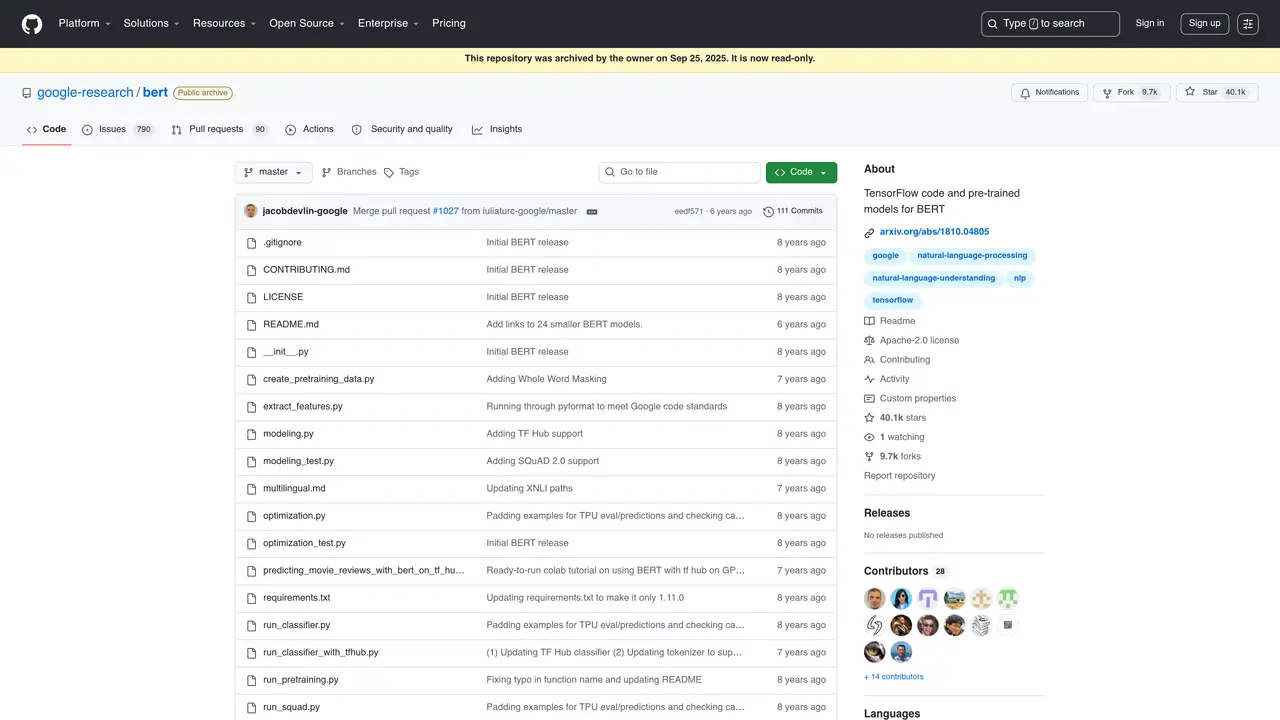
BERT is a deep learning-based natural language processing (NLP) system developed by Google. It is one of the most powerful and advanced NLP systems on the market today, allowing users to accurately and quickly process large amounts of text data. With BERT, users can quickly classify text into categories, extract information, identify entities, and more. BERT is designed to be easy to use and understand, allowing users to quickly deploy it in their own projects. It is also highly customizable, allowing users to fine-tune it to their specific needs. Additionally, BERT is open-source and free to use, making it an excellent choice for users looking to get the most out of their natural language processing projects. Thanks to its highly accurate and versatile nature, BERT is an invaluable tool for data scientists and developers who need to quickly process large amounts of text data.
GitHub, Inc.
San Francisco, California, US · Founded 2008
- Founders
- Tom Preston-Werner, Chris Wanstrath, PJ Hyett, Scott Chacon
- Founded
- 2008
- Headquarters
- San Francisco, California, US
- Legal status
- Subsidiary of Microsoft (NASDAQ: MSFT)
Key features
- Classify text into categories
- Extract useful information from text data
- Identify entities in text
- Deep learning-based natural language processing (NLP) system
- Highly customizable
- Open-source and free to use
Use cases
- Text classification for sentiment analysis or topic modeling
- Information extraction from large datasets for research or business applications
- Entity recognition in text data for named entity disambiguation or relationship extraction
Pros
- Open-source and freely available for research and commercial use
- Supports fine-tuning for custom NLP tasks
- Available in multiple model sizes, including smaller variants for resource-constrained environments
- Pre-trained models reduce the need for extensive training data
- Highly versatile for tasks like text classification, entity recognition, and question answering
Cons
- Requires significant computational resources for training and fine-tuning
- Smaller models may have lower accuracy compared to larger variants
- Complexity in implementation for users without deep learning expertise
Frequently asked questions about BERT
What is BERT and what does it do?
BERT (Bidirectional Encoder Representations from Transformers) is a pre-trained natural language processing model developed by Google that uses deep learning to understand and process text data. It is designed to perform tasks such as text classification, named entity recognition, and question answering by leveraging bidirectional context from large-scale pre-training.
Who should use BERT?
BERT is suitable for researchers, data scientists, and developers working on natural language processing tasks who require a powerful, pre-trained model to fine-tune for specific applications. It is particularly useful for those needing high accuracy in text understanding and processing.
Is BERT free to use?
Yes, BERT is open-source and available under the Apache 2.0 license, allowing users to freely use, modify, and distribute the code and models for research and commercial purposes.
How do I get started with BERT?
To get started with BERT, users can access the pre-trained models and TensorFlow code from the official GitHub repository. The repository includes scripts for fine-tuning models on custom datasets, as well as example notebooks demonstrating how to use BERT for tasks like text classification and question answering.
Can BERT be fine-tuned for specific tasks?
Yes, BERT is designed to be fine-tuned on specific downstream tasks such as text classification, sentiment analysis, or named entity recognition. The repository provides scripts and guidance for fine-tuning models using custom datasets.
Are there smaller versions of BERT available?
Yes, the repository includes 24 smaller BERT models designed for environments with limited computational resources. These models are intended for fine-tuning or knowledge distillation, where a larger model's outputs are used to train a smaller one.