
OpenAI builds and deploys advanced AI models like GPT-4o for autonomous agents and workflows.

Flair NLP
$0.07Starting price
0Popularity
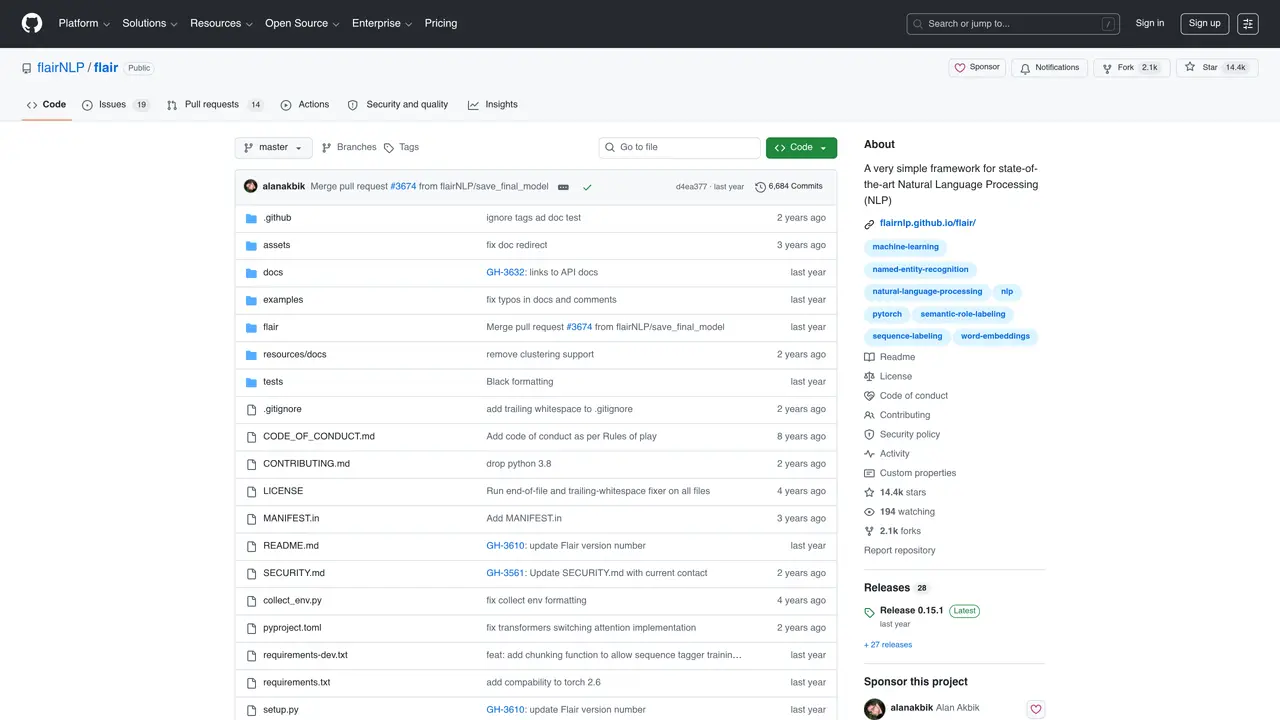
About Flair NLP
Flair NLP is an open-source natural language processing (NLP) library developed by Zalando Research, designed to simplify the creation of advanced NLP applications. It provides a unified framework for tasks such as text classification, named entity recognition, part-of-speech tagging, and sequence labeling, enabling developers to build sophisticated models with minimal effort. The library is built on top of PyTorch, offering seamless integration with modern deep learning workflows while maintaining flexibility and scalability. Flair NLP is particularly well-suited for researchers and developers who require high-performance NLP capabilities without extensive boilerplate code. It supports a wide range of pre-trained language models and embeddings, allowing users to leverage state-of-the-art techniques for tasks like document classification, sentiment analysis, and language modeling. The intuitive API and extensive documentation make it accessible to both beginners and experts, while its compatibility with popular frameworks ensures compatibility with existing machine learning pipelines.
GitHub, Inc.
San Francisco, California, US · Founded 2008
- Founders
- Tom Preston-Werner, Chris Wanstrath, PJ Hyett, Scott Chacon
- Founded
- 2008
- Headquarters
- San Francisco, California, US
- Legal status
- Subsidiary of Microsoft (NASDAQ: MSFT)
Key features
- Text classification
- Part-of-speech tagging
- Named entity recognition
- Sequence labeling
- Intuitive API
- Language model support
- Deep learning framework compatibility
Use cases
- Developing state-of-the-art NLP applications
- Building robust text classification models
- Tagging parts-of-speech in large datasets
Pros
- Open-source framework with active community and frequent updates
- Supports a wide range of NLP tasks including named entity recognition, sentiment analysis, and part-of-speech tagging
- Provides pre-trained state-of-the-art models for multiple languages
- Built on PyTorch, enabling easy integration with deep learning workflows
- Offers flexible embedding options, including Flair embeddings and transformer models
Cons
- Primarily designed for developers, requiring familiarity with Python and NLP concepts
- Limited official documentation compared to some commercial alternatives
- Performance may vary depending on the complexity of the task and hardware resources
Frequently asked questions about Flair NLP
What is Flair NLP and what does it do?
Flair NLP is an open-source natural language processing (NLP) framework designed to provide state-of-the-art models for tasks such as named entity recognition (NER), sentiment analysis, part-of-speech tagging, and text classification. It supports multiple languages and offers pre-trained models as well as tools for training custom models.
Who should use Flair NLP?
Flair NLP is suitable for developers, researchers, and data scientists who need a flexible and powerful NLP library for building applications like text analysis, information extraction, and language modeling. It is particularly useful for those familiar with Python and PyTorch.
How do I get started with Flair NLP?
To get started, install Flair using pip in a Python 3.9+ environment, then load a pre-trained model and apply it to text data. The framework provides simple APIs and examples to guide users through tasks like NER or sentiment analysis.
Does Flair NLP support multiple languages?
Yes, Flair NLP supports a rapidly growing number of languages, including English, German, Dutch, Spanish, and more. It offers pre-trained models for several languages and tasks, with additional models available on the Hugging Face model hub.
Can I train my own models with Flair NLP?
Yes, Flair NLP is built on PyTorch, allowing users to train custom models using Flair embeddings and classes. The framework provides tools and interfaces to experiment with new approaches and integrate them into existing workflows.
What are Flair embeddings and how are they used?
Flair embeddings are contextual string embeddings designed for NLP tasks. Flair provides simple interfaces to use and combine different word and document embeddings, including transformer-based models, making it easier to integrate embeddings into NLP pipelines.