GitHub hosts HunyuanVideo, Tencent's open-source framework for large-scale video generation models, enabling AI-driven video creation.

SpaCy
$1Starting price
74KMonthly visits
31Popularity
About SpaCy
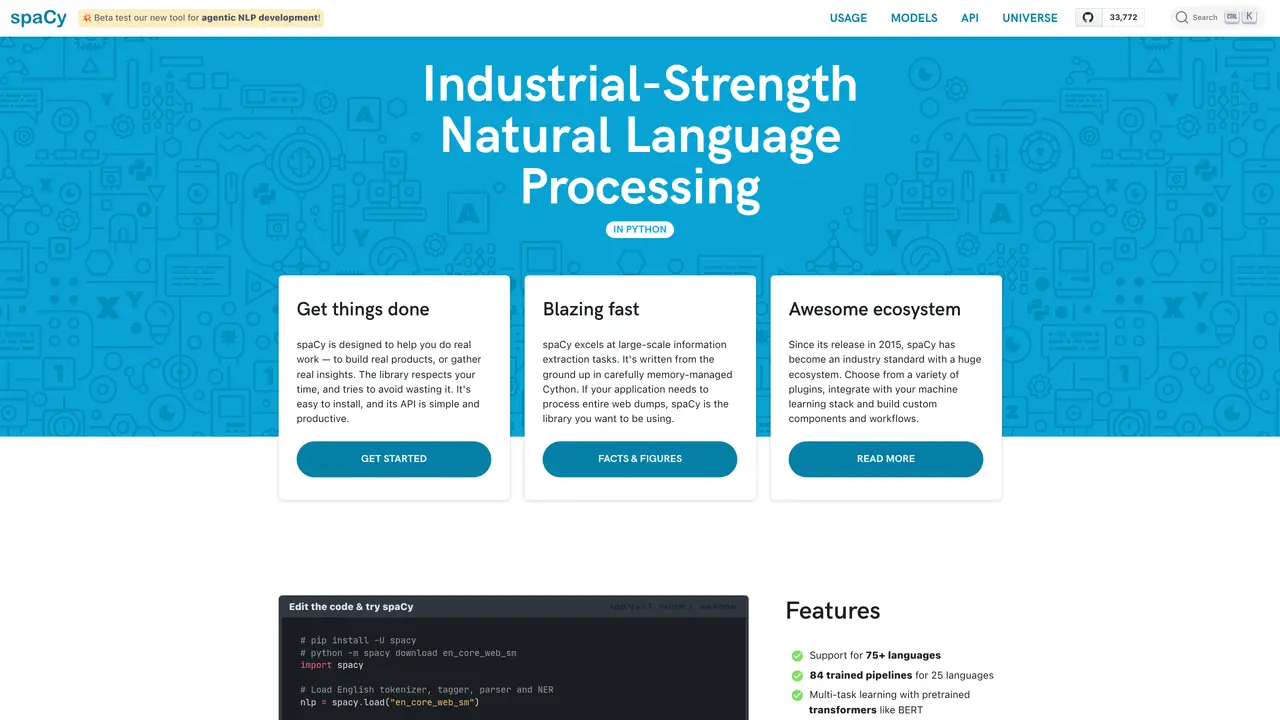
SpaCy is an open-source software library designed for advanced natural language processing. It enables developers and data scientists to build sophisticated NLP solutions efficiently by providing tools for processing large volumes of text and extracting meaningful information. The library supports core NLP tasks such as tokenization, parsing, named entity recognition, and part-of-speech tagging. SpaCy is optimized for speed and memory efficiency, allowing users to handle large datasets without compromising performance. Its intuitive API and comprehensive documentation make it accessible to both experienced developers and beginners. The tool is widely used for tasks requiring high accuracy and efficiency in text analysis, including information extraction, document classification, and linguistic annotation. With its modular design, SpaCy also supports customization and integration with other machine learning frameworks, making it a versatile choice for NLP projects of any scale.
Key features
- Tokenization and text segmentation
- Part-of-speech tagging
- Named entity recognition
- Dependency parsing
- Lemmatization
- Rule-based matching
- Pre-trained models for multiple languages
- Custom pipeline components
- Memory-efficient processing
- Integration with machine learning frameworks
Use cases
- Extracting structured information from unstructured text
- Building chatbots and conversational AI systems
- Automating content analysis for research or business intelligence
Pros
- Optimized for speed and memory efficiency, enabling processing of large-scale text datasets
- Supports over 75 languages with 84 trained pipelines for 25 languages
- Modular and extensible architecture for custom components and workflows
- Integrates with machine learning frameworks like PyTorch and TensorFlow
- Provides built-in visualizers for syntax and named entity recognition
Cons
- Requires familiarity with Python and NLP concepts for advanced customization
- Large language model integration may introduce complexity in structured pipelines
Frequently asked questions about SpaCy
What is spaCy and what does it do?
SpaCy is an open-source Python library for industrial-strength natural language processing. It provides tools for tokenization, parsing, named entity recognition, part-of-speech tagging, and more, designed to build real-world NLP applications efficiently.
Who is spaCy suitable for?
SpaCy is suitable for developers, data scientists, and researchers working on NLP tasks such as information extraction, document classification, and linguistic annotation. Its intuitive API and comprehensive documentation make it accessible to both beginners and experts.
How does spaCy integrate with other tools or frameworks?
SpaCy supports integration with machine learning frameworks like PyTorch and TensorFlow, and offers plugins for extending functionality. It also features a project system for end-to-end workflows and reproducible training.
What are the main limitations of spaCy?
While spaCy is highly efficient, it requires Python knowledge for advanced use. Customization and integration with large language models may introduce additional complexity. Performance heavily depends on the chosen pipeline and hardware.
How can I get started with spaCy?
Getting started with spaCy involves installing the library and using its quickstart tools or project templates. The library provides extensive documentation and examples to guide users through setup and implementation.
Does spaCy support custom models?
Yes, spaCy supports custom models in frameworks like PyTorch and TensorFlow. Users can train and deploy custom pipelines using spaCy's production-ready training system and configuration tools.
SpaCy Website Engagement
Last Update: 9 days ago
Total Monthly Visits
0
Bounce Rate
0%
Visit Duration (avg)
0.00s
Pages Per Visit
0
Country Rank
0
United States
Global Rank
0
Category Rank
#0
Programming & Developer Software
Monthly Traffic
Traffic Sources
Traffic Share By Country
- United States16.2%
- India14.7%
- Germany10.8%
- Spain6%
- Brazil5.3%