GitHub hosts HunyuanVideo, Tencent's open-source framework for large-scale video generation models, enabling AI-driven video creation.

Stanford Natural Language Processing Group – CoreNLP
0Popularity
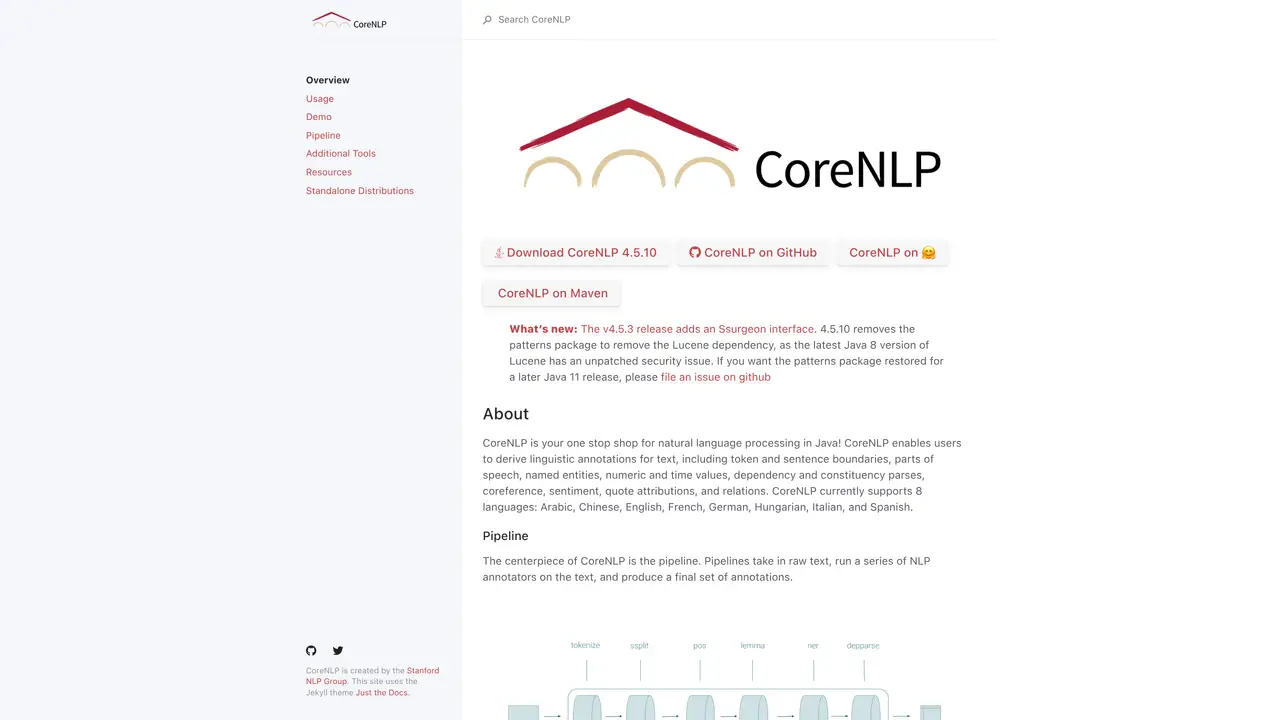
About Stanford Natural Language Processing Group – CoreNLP
Stanford CoreNLP is a powerful natural language processing (NLP) toolkit developed by the Stanford Natural Language Processing Group. CoreNLP enables users to extract information from text, including sentiment analysis, entity recognition, part-of-speech tagging, and more. It is designed to be user-friendly and simple to use, allowing even those with no prior experience in NLP to quickly develop powerful applications. With CoreNLP, users can quickly identify important topics, entities, and sentiment in their text data. CoreNLP is highly scalable and can be run over large datasets. Additionally, CoreNLP is open-source, meaning users can access the code for free and make customizations to meet their specific needs. With its wide range of features, CoreNLP is an ideal tool for anyone looking to unlock the power of natural language processing.
Key features
- Extract sentiment from text
- Identify topics, entities, and sentiment
- Analyze large datasets with scalability
- Sentiment analysis
- Entity recognition
- Part-of-speech tagging
Use cases
- Analyzing customer feedback to improve product development
- Extracting insights from large text datasets for research purposes
- Developing chatbots and virtual assistants that understand natural language
Pros
- Supports multiple languages including Arabic, Chinese, English, French, German, Hungarian, Italian, and Spanish
- Offers a wide range of linguistic annotations such as tokenization, part-of-speech tagging, named entity recognition, dependency parsing, coreference resolution, sentiment analysis, and more
- Provides multiple interfaces for usage, including command-line, Java API, simple API, third-party language APIs (e.g., Python, JavaScript), and a web service
- Open-source with a flexible GPL license, allowing customization and free access to the codebase
- Includes a modular pipeline architecture that processes raw text through a series of annotators to produce structured linguistic annotations
Cons
- Requires Java 8+ for operation, which may limit accessibility for users unfamiliar with Java environments
- The full GPL license restricts use in proprietary software distributed to others without a commercial license
- Some advanced features, such as SUTime for time-related annotations, depend on libraries that may introduce licensing complexities
Frequently asked questions about Stanford Natural Language Processing Group – CoreNLP
What is Stanford CoreNLP?
Stanford CoreNLP is a natural language processing toolkit developed by the Stanford NLP Group that provides linguistic annotations for text, including tokenization, parts of speech, named entities, dependency parses, coreference, sentiment, and more.
Who should use Stanford CoreNLP?
CoreNLP is suitable for researchers, developers, and organizations needing robust NLP capabilities, particularly those working with multilingual text or requiring detailed linguistic analysis.
How does CoreNLP work?
CoreNLP processes raw text through a configurable pipeline of annotators, producing structured annotations stored in objects like CoreDocument, which can be accessed via APIs or serialized for further use.
What programming languages and operating systems does CoreNLP support?
CoreNLP is written in Java and requires Java 8 or later, but it can be used via command-line, web service, or third-party APIs for languages like Python or JavaScript, and runs on Linux, macOS, and Windows.
Is Stanford CoreNLP open-source?
Yes, CoreNLP is open-source under the GNU General Public License v3 or later, though commercial licensing is available for proprietary software distribution.
How do I get started with CoreNLP?
Download the CoreNLP distribution, include it in your CLASSPATH, and run a pipeline via command-line, API, or web service. Language-specific model jars must be downloaded separately for the desired languages.