GitHub hosts HunyuanVideo, Tencent's open-source framework for large-scale video generation models, enabling AI-driven video creation.

Apple Natural Language
0Popularity
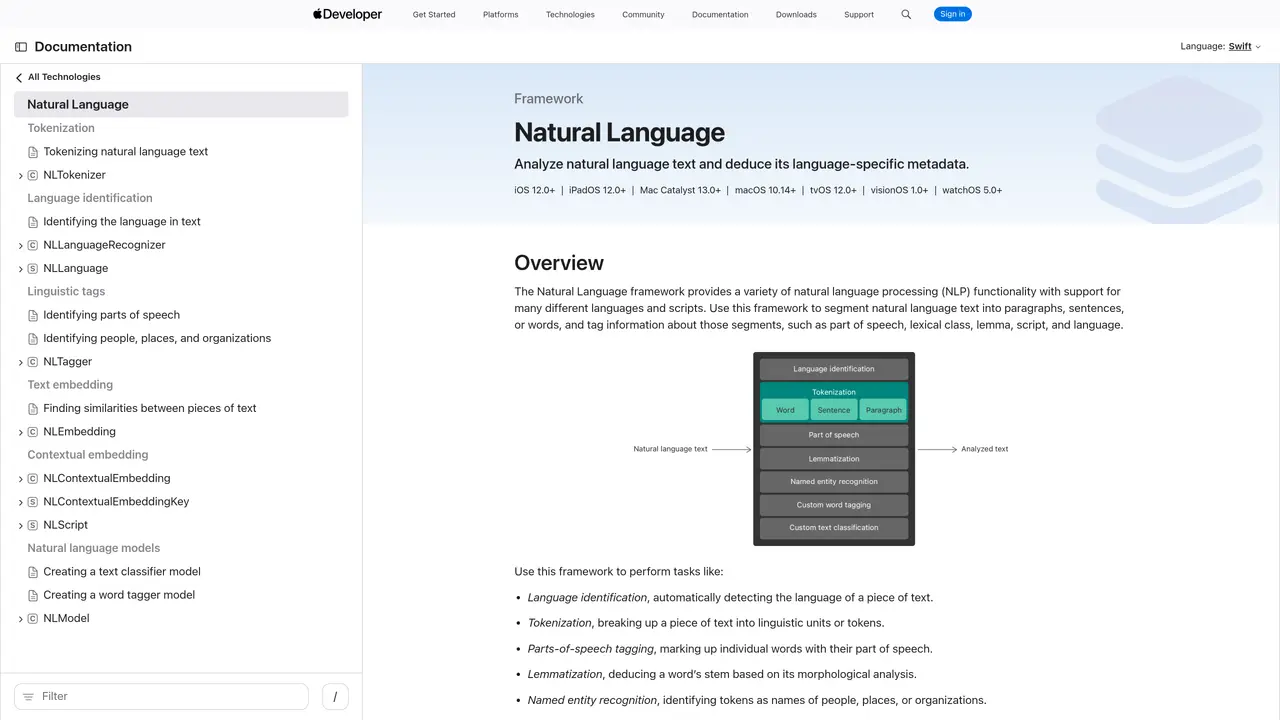
About Apple Natural Language
Apple Natural Language is a framework provided by Apple for performing natural language processing tasks within applications. It enables developers to analyze and interpret text in multiple languages, including English, Spanish, French, German, and Chinese, without requiring an internet connection. The tool supports a range of functionalities such as tokenization, part-of-speech tagging, named entity recognition, and sentiment analysis, allowing applications to understand the structure and meaning of text. It also facilitates language identification, lemmatization, and text classification, which can be used to build features like chatbots, content moderation, or automated responses. The framework is designed to integrate seamlessly with Apple’s ecosystem, including iOS, macOS, and other platforms, ensuring efficient and privacy-focused processing. Developers can leverage these capabilities to create applications that respond intelligently to user input, extract meaningful insights from text, or automate language-related tasks. Apple Natural Language is particularly useful for applications requiring offline functionality or enhanced privacy, as it processes data locally on the device.
Apple Inc.
Cupertino, United States · Founded 1976
- Founders
- Steve Wozniak, Ronald Wayne
- Founded
- 1976
- Headquarters
- Cupertino, United States
- Legal status
- Public company
Key features
- Identify text meaning
- Extract key phrases
- Detect sentiment
- Classify text
- Automate tasks in multiple languages
- Supports multiple languages including English, Spanish, French, German, and Chinese
Use cases
- Building natural language-powered applications that can better understand user intent and automate common tasks
- Creating interactive experiences for users that are truly natural and effortless
- Automating tasks in multiple languages
Pros
- Integrates seamlessly with Apple’s ecosystem and development tools
- Supports multiple languages including English, Spanish, French, German, and Chinese
- Provides structured analysis of text, including part-of-speech tagging and named entity recognition
- Enables sentiment analysis and text classification for deeper understanding
- Designed for developers to build natural language interfaces within apps
Cons
- Requires JavaScript to access full documentation on the website
- Limited to Apple’s development environment and frameworks
- May lack advanced customization options compared to specialized NLP libraries
Frequently asked questions about Apple Natural Language
What is Apple Natural Language?
Apple Natural Language is a framework provided by Apple for performing natural language processing tasks. It enables developers to analyze and understand text, including language identification, tokenization, lemmatization, part-of-speech tagging, and named entity recognition.
Who should use Apple Natural Language?
Apple Natural Language is designed for developers building applications that require text analysis and natural language understanding. It is particularly useful for apps targeting Apple platforms such as iOS, macOS, watchOS, and tvOS.
What languages does Apple Natural Language support?
The framework supports multiple languages, including English, Spanish, French, German, Italian, Japanese, Korean, Portuguese, Russian, and simplified Chinese. Language support may vary depending on the specific task and version of the framework.
How does Apple Natural Language work?
Apple Natural Language uses machine learning models trained on large datasets to analyze text. It processes input text to identify linguistic structures, extract meaning, and perform tasks such as sentiment analysis or entity recognition without requiring an internet connection.
Can Apple Natural Language be used offline?
Yes, Apple Natural Language operates locally on the device, meaning it does not require an internet connection to function. This ensures privacy and reduces latency for text processing tasks.
How do I get started with Apple Natural Language?
To use Apple Natural Language, developers need to integrate the NaturalLanguage framework into their Xcode project. The framework is part of Apple's developer tools and can be accessed through the Apple Developer Documentation, which provides code examples and implementation guides.