GitHub hosts HunyuanVideo, Tencent's open-source framework for large-scale video generation models, enabling AI-driven video creation.

Stanford CoreNLP
0Popularity
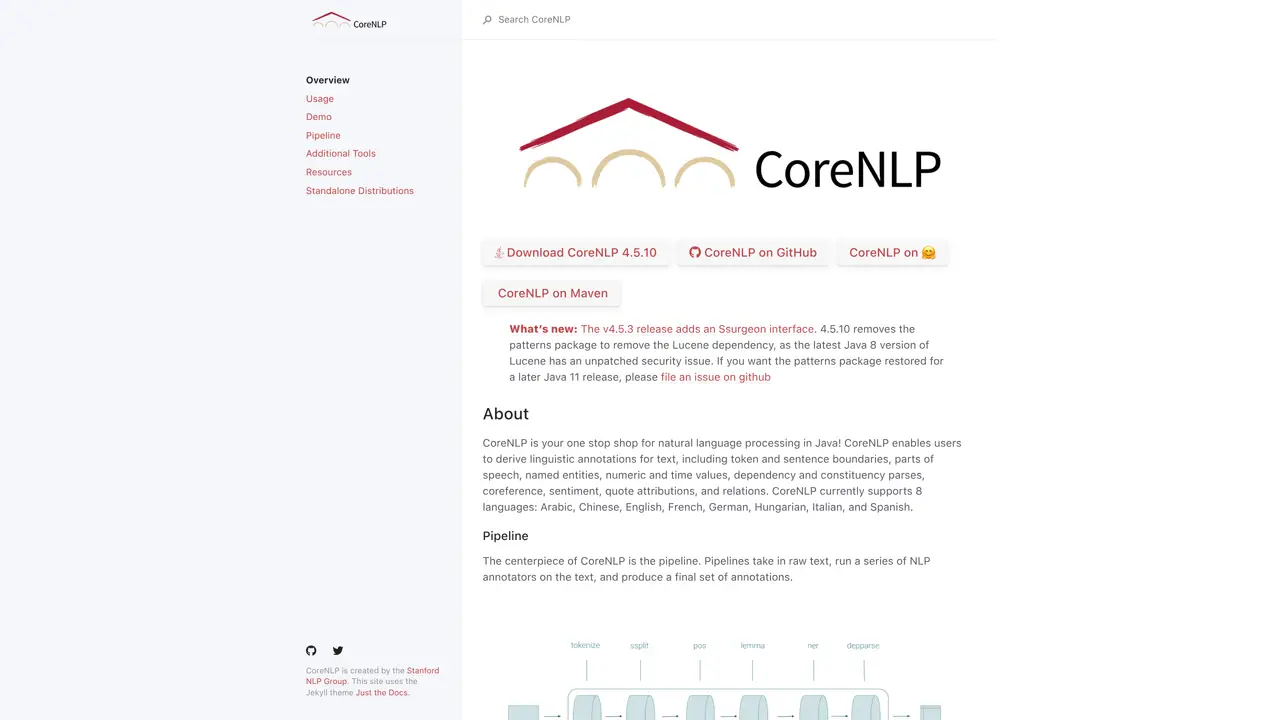
About Stanford CoreNLP
Stanford CoreNLP is a powerful natural language processing platform that makes it easy to work with human language data. This open-source Java-based library is used by researchers, developers, and data scientists to build powerful language-based applications. With Stanford CoreNLP, users can analyze text, extract information, and quickly generate insights from large datasets. Stanford CoreNLP provides a range of features and benefits designed to make language processing efficient, accurate, and intuitive. With this platform, users can easily access part-of-speech tagging, dependency parsing, named entity recognition, and coreference resolution. This powerful library also offers semantic role labeling, sentiment analysis, word sense disambiguation, and much more. The user-friendly interface of Stanford CoreNLP makes it easy to get started. The platform provides users with an integrated workflow that simplifies the entire natural language processing process.
Key features
- Access POS Tagging
- Extract Information
- Intuitive Interface
- Part-of-Speech Tagging
- Dependency Parsing
- Named Entity Recognition
- Coreference Resolution
- Semantic Role Labeling
- Sentiment Analysis
- Word Sense Disambiguation
Use cases
- Analyzing text to extract meaningful information from large datasets
- Building language-based applications for researchers, developers, and data scientists
- Quickly generating insights from human language data
Pros
- Open-source and freely available under GPL v3+ license with commercial options
- Supports multiple languages including Arabic, Chinese, English, French, German, Hungarian, Italian, and Spanish
- Provides a comprehensive pipeline-based architecture for processing raw text into structured linguistic annotations
- Offers extensive linguistic annotations such as parts-of-speech tagging, named entity recognition, dependency parsing, coreference resolution, sentiment analysis, and more
- Integrates with multiple programming languages via APIs, command-line tools, or web services
Cons
- Requires Java 8+ runtime environment, limiting accessibility for non-Java developers without additional setup
- Full GPL v3+ license restricts use in proprietary software without a commercial license
- Memory and time usage can be significant for large datasets, requiring careful configuration
Frequently asked questions about Stanford CoreNLP
What is Stanford CoreNLP?
Stanford CoreNLP is a natural language processing toolkit that derives linguistic annotations for text, including tokenization, sentence splitting, parts of speech, named entities, dependency and constituency parses, coreference, sentiment, and more.
Who should use Stanford CoreNLP?
It is designed for researchers, developers, and data scientists who need to build language-based applications or analyze large text datasets efficiently.
How does Stanford CoreNLP work?
CoreNLP processes raw text through a pipeline of annotators, producing structured annotations stored in a CoreDocument object, which can be accessed via a simple API or serialized for further use.
What programming languages and operating systems does CoreNLP support?
CoreNLP is written in Java and requires Java 8 or later, but it can be accessed via command-line, web service, or third-party APIs for languages like Python or JavaScript. It runs on Linux, macOS, and Windows.
Does Stanford CoreNLP require a commercial license?
CoreNLP is available under the GNU General Public License v3 for most uses, but proprietary software distributors may need a commercial license from Stanford.
How do I get started with Stanford CoreNLP?
Download the CoreNLP distribution and language-specific model jars, set up the CLASSPATH, and run a pipeline via command-line, API, or web service to process text and generate annotations.